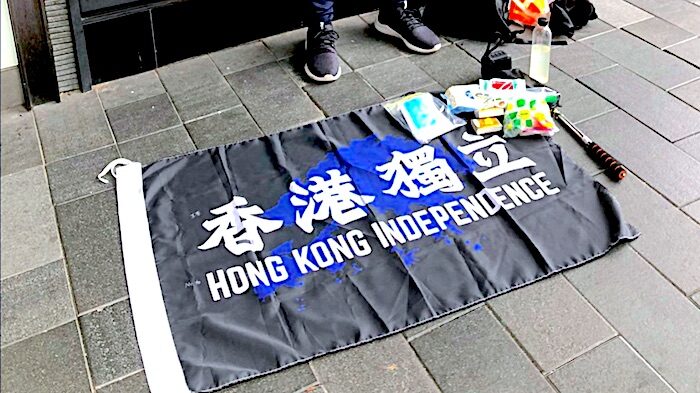
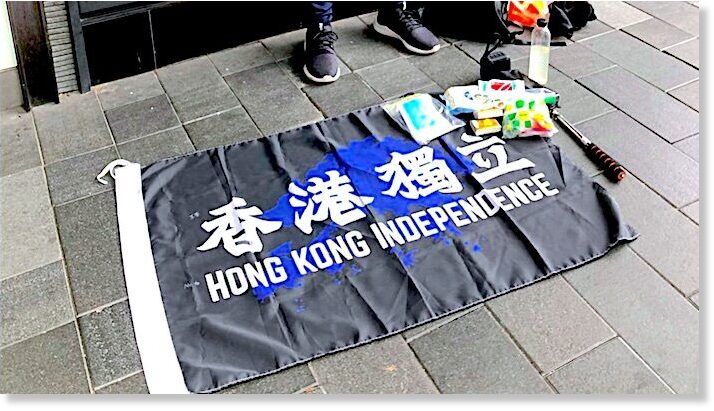
© Hong Kong Police/TwitterHong Kong independence flag
The U.N. human rights office voiced concern on Friday that "vague and overly broad" provisions in Hong Kong's new national security law may lead to activists being prosecuted in violation of fundamental freedoms of assembly and expression.
National security legislation imposed by China this week on Hong Kong will punish crimes of secession, subversion, terrorism and collusion with foreign forces with up to life in prison, heralding a more authoritarian era for the city.
"We are alarmed that arrests are already being made under the law with immediate effect, when there is not full information and understanding of the scope of the offences," U.N. human rights spokesman Rupert Colville said.
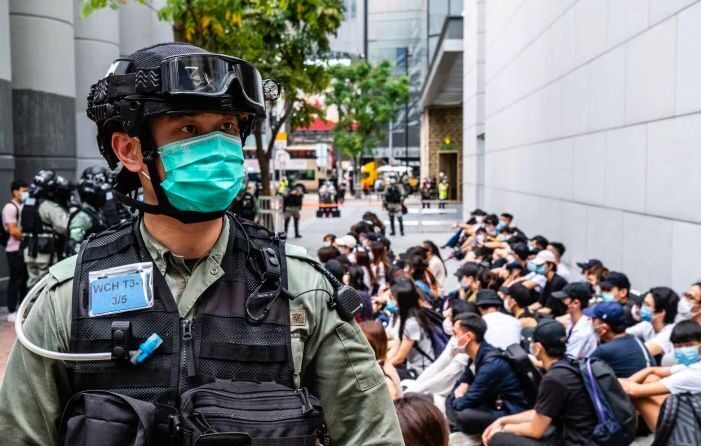
Hundreds were arrested at a protest on Wednesday, a day after the new law went into effect, and at least 10 have been charged under it, he told a Geneva news briefing.
"We are concerned that the definition of some of the offences contained in the law are vague and overly broad and
do not adequately distinguish between violent and non-violent acts. This may lead to discriminatory or arbitrary interpretation and enforcement of the law, which could undermine human rights protection," Colville said.
Comment: On the positive side, perhaps this law will be useful in rooting out actual examples of American interference. On the negative side, China's criminal justice system leaves a lot to be desired. With a 99.9% conviction rate, good luck having any nuance brought to your trial if you happen to be mistaken for an
actual American-backed agitator. Legislation like this makes it very easy to scoop up any dissidents guilty of "subverting" the government through their criticism - however mild - and blaming it on alleged foreign actors or influence. That's a key feature of practically all "Communist" governments, and has been increasingly used by Western government and media in recent years in regards to Russia.
See also:
















Comment: See also:
More on this topic: