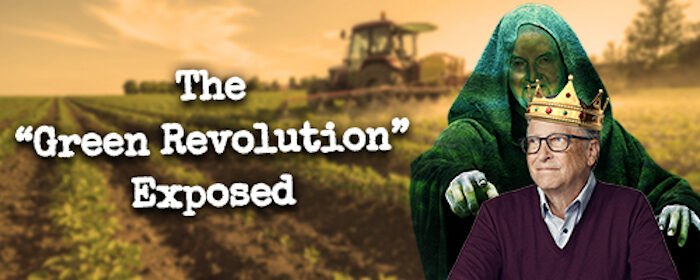
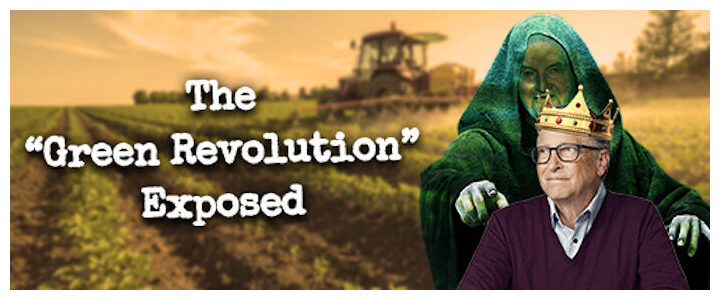
© Corbett Report
You've got to hand it to the globalists: they know how to take advantage of our better instincts. They have designed an entire international institutional infrastructure around the issues that the average non-psychopath cares about (or at least pretends to): helping the poor and the downtrodden, caring for children, ending inequities, taking care of the planet, etc.
This is why Antonio Guterres, the Secretary-General of the United Nations, just released his report on "
Our Common Agenda," which purports to provide a road map for "rebuilding our world and mending the trust in one another we need so desperately at this moment in history." Not because he
actually cares about saving the world, of course, but because he knows that we do, and that
many people can be persuaded to "make sacrifices" — up to an including relinquishing their personal sovereignty, as this report ultimately calls for — for the "greater good." And, as viewers of
this week's New World Next Week will know, this is why the Bill & Melinda Gates Foundation, the Rockefeller Foundation and a gaggle of their Big Agra cronies are teaming up in a billion dollar alliance to "elevate the single coordinated African voice" in a United Nations summit on food security in Africa. Not because they care about feeding starving African children or raising up poor African farmers, but because they know that we do.
Specifically, the Gates-Rockefeller-Big Ag monstrosity known as the Alliance for a Green Revolution in Africa (AGRA) and their associated fundraising vehicle, the African Green Revolution Forum (AGRF) is seeking to "elevate the single coordinated African voice" at the UN Food Systems Summit in New York this week. But, as the
Alliance for Food Safety in Africa (AFSA) and literally
dozens of other groups are pointing out, the AGRA-promoted approach to farming —
monocultural commodity production heavily reliant on chemical inputs — is great for the big agribusiness corporations who make up the AGRA alliance
but terrible for actual African farmers, not to mention terrible for long-term soil fertility and human development.This is not by accident. In fact, the entire premise behind the "green revolution" from which AGRA and AGRF derive their name is that Big Ag is the saviour of the world and the only way to provide food security for the masses. This is a lie, of course, but it's one that plays nicely on our better instincts. After all, who wants to see African farmers living in poverty and African children starving?
But in order to better understand the scam that is being perpetrated on the people of Africa (and the people of the world), we need to look beyond this billion-dollar corporate alliance to discover the sordid history of the "green revolution" itself. As usual, the real history of this event is completely opposite to the history you will read about it in the mainstream textbooks.

















Comment: This dire global supply-demand crisis is a direct result of mandated lockdown measures, not the virus. The focus was on calculated maneuvers to produce just such an outcome in order to cripple industry and reduce access to goods and services. Who does this serve? Not industry. Who benefits? Not the people.