Science & TechnologyS


Fireball 5

New discovered asteroid to zoom pass Earth tonight

Asteroid 2015 YB
© GettyThe asteroid was discovered just two days ago.
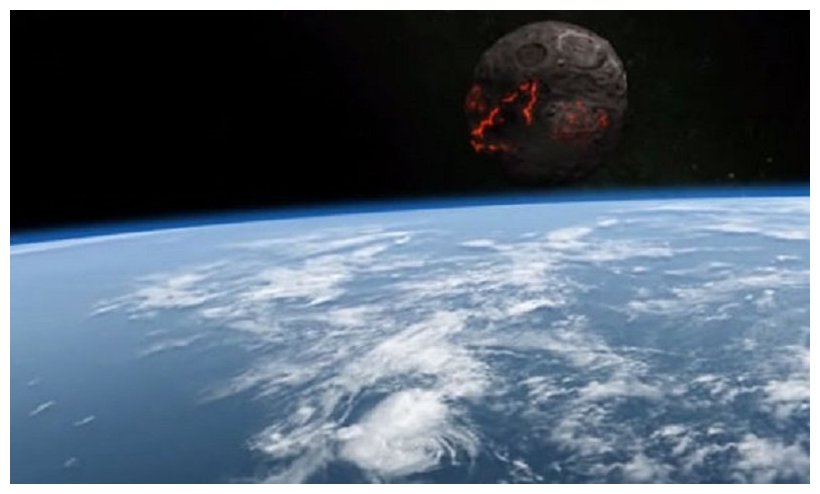
Astronomers were oblivious to the existence of the space rock, which is big enough to destroy a town and called 2015 YB, until Wednesday.

The Slooh Telescope internet channel is hosting a special live broadcast to capture the flyby at 2am.

A Slooh spokesman said the pass was so near it would be within range of geosynchronous satellites which orbit at the same rotation period as Earth.

He said: "Discovered just two days ago, Slooh will provide live coverage.

"The size and speed of this asteroid makes it very difficult to track.

"During our live broadcast, host Paul Cox and Slooh Astronomer Bob Berman will discuss why it is so difficult to track these fast moving objects, and of course, the kind of damage a (it) would cause were it to impact Earth, and why."

Telescope

The awakened force of a star

Herbig-Haro
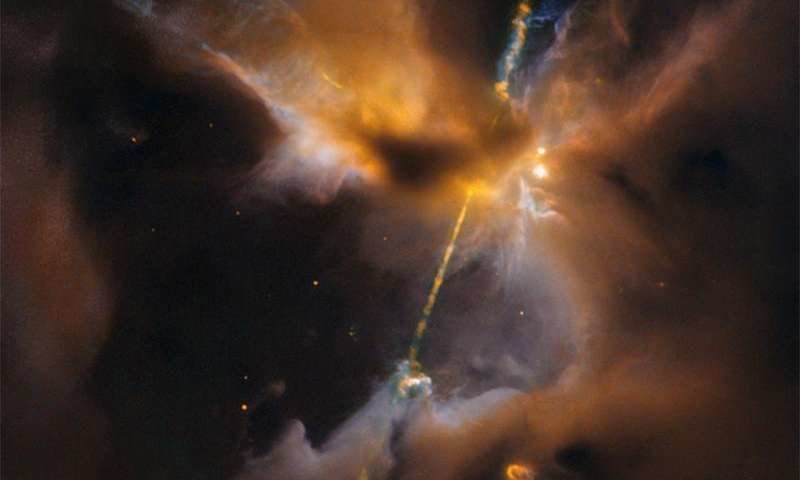
© ESA/Hubble & NASAThe two lightsaber-like streams crossing the image are jets of energized gas, ejected from the poles of a young star. If the jets collide with the surrounding gas and dust they can clear vast spaces, and create curved shock waves, seen as knotted clumps called Herbig-Haro objects.
Perfectly timed for the release of Star Wars Episode VII: The Force Awakens, this NASA/ESA Hubble Space Telescope has imaged a cosmic double-bladed light-saber. In the center of the image, partially obscured by a dark Jedi-like cloak of dust, an adolescent star shoots twin jets out into space, demonstrating the fearsome forces of the Universe.

This celestial light-saber lies not in a galaxy far, far away, but within our home galaxy, the Milky Way. More precisely, it resides within a turbulent patch of space known as the Orion B molecular cloud complex, which is located just over 1350 light-years away in the constellation of Orion (The Hunter).

Bearing a striking resemblance to Darth Maul's double-bladed light-saber in Star Wars Episode One, the spectacular twin jets of material slicing across this incredible image are spewing out from a newly formed star that is obscured from view, cloaked by swirling dust and gas.

Mars

New Mars rover findings: Much higher concentrations of silica indicate "considerable water activity"

Marias Pass
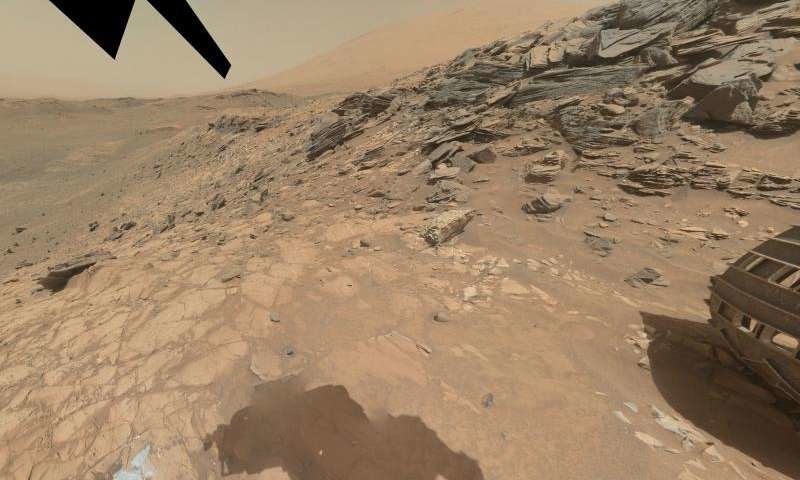
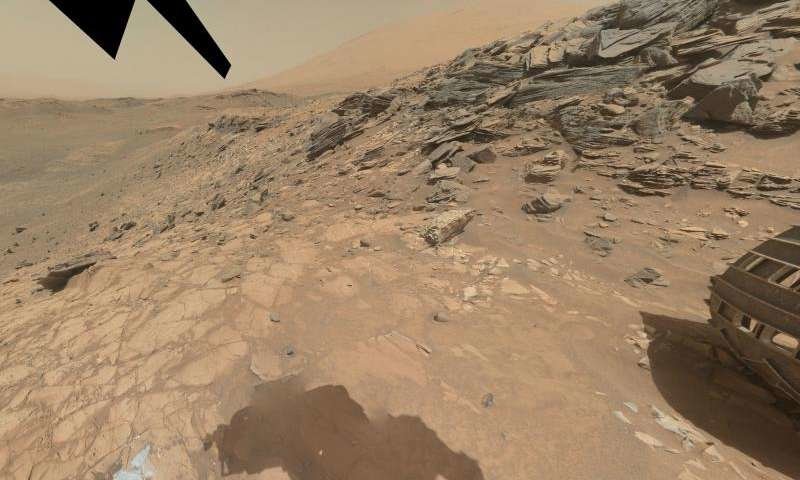
© NASA/JPL-Caltech/MSSSThe view from Marias Pass in Gale crater, Mars, where scientists found high concentrations of silica in the light toned bedrock seen in the lower half of the image. The Buckskin drill hole where the mineral tridymite was detected is visible in the lower left part of the image. Mount Sharp (Aolis Mons), the mountain in the center of Gale Crater is seen in the background, and the right front wheel of the Curiosity rover is seen to the right in the image. The image is made up of a number of smaller images by Curiosity's arm-mounted camera.
New findings by NASA's Mars Curiosity rover are the focus of a press conference this morning at the American Geophysical Union (AGU) meeting in San Francisco, Calif.

A group of scientists, including one from Los Alamos National Laboratory, revealed that the Curiosity rover found much higher concentrations of silica at some sites the rover has investigated in the past seven months than anywhere else it has visited since landing on Mars 40 months ago. Silica makes up nine-tenths of the composition of some of the rocks.

"The high silica was a surprise," said Jens Frydenvang of Los Alamos National Laboratory and the University of Copenhagen, also a Curiosity science team member. "While we're still working with multiple hypotheses on how the silica got so enriched, these hypotheses all require considerable water activity, and on Earth high silica deposits are often associated with environments that provide excellent support for microbial life. Because of this, the science team agreed to make a rare backtrack to investigate it more."

The first discovery was as Curiosity approached the area "Marias Pass," where a lower geological unit contacts an overlying one. ChemCam, the rover's laser-firing instrument for checking rock composition from a distance, detected bountiful silica in some targets the rover passed along the way to the contact zone. The ChemCam instrument was developed at Los Alamos in partnership with the French IRAP laboratory in Toulouse and the French Space Agency.

Telescope

Disrupted globular cluster found in the constellation of Draco

NGC 6362
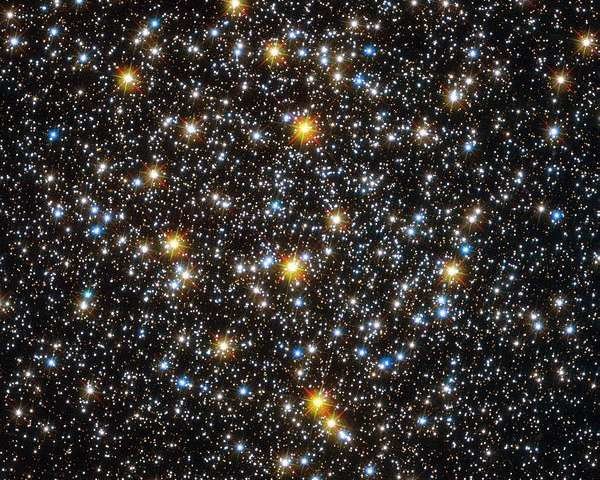
© ESA/Hubble & NASANGC 6362, an example of a globular cluster.
A co-moving clump of stars was found in the constellation of Draco at a distance of approximately 8,500 light years away by a team of astronomers from the Chinese Academy of Sciences. It is assumed that the newly detected stellar group is a disrupted globular cluster, according to the researchers. They described their discovery in a paper published online on Dec. 16 on the arXiv pre-print server.

Using the data from the Large Sky Area Multi-Object Fibre Spectroscopic Telescope (LAMOST) at the Xinglong Station observatory in China, the scientists were able to derive important information about the cluster such as its distance, age, mass, luminosity, velocity and orbit. They used about 2.5 million stellar spectra available in the second data release of the LAMOST spectroscopic survey, searching through the spectroscopic dataset and looking for metallicity-velocity clumping inconsistent with the field.

John Jason Vickers, who is the lead author of the study along with the co-authors, estimates that this cluster, named Lamost 1, has a total mass of about 25,000 solar masses and has luminosity approximately 15,000 times greater than our sun. The researchers are 90 percent sure that the stellar group is about 11 million years old.

Eye 1

U.S. intelligence agencies are funding technology companies

cia funding technology companies
Government funding of companies provides a steady stream of support for tech developing innovations. One vehicle for facilitating this relationship can be found in an entity called, In-Q-Tel. IQT describes their function as: "In-Q-Tel is the independent, not-for-profit organization created to bridge the gap between the technology needs of the U.S. Intelligence Community (IC) and emerging commercial innovation. We invest in venture-backed startups developing technologies that provide ready-soon innovation (within 36 months) vital to the IC mission. These technology startups are traditionally outside the reach of the IC; in fact, more than 70 percent of our portfolio companies have never before done business with the government."

A Fox Business article, In-Q-Tel: A Glimpse Inside the CIA's Venture-Capital Arm, lists some of the companies and agencies that are involve[d].
"Founded in 1999 as a way for the U.S. to keep up with the rapid innovation in science and technology, In-Q-Tel has been an early backer of start-ups later acquired by Google (GOOG), Oracle (ORCL), IBM (IBM) and Lockheed Martin (LMT).

While IQT originally catered largely to the needs of the CIA, today the firm supports many of the 17 agencies within the U.S. intelligence community, including the National Geospatial-Intelligence Agency (NGA), the Defense Intelligence Agency (DIA) and the Department of Homeland Security Science and Technology Directorate."
Their focus on Startups Backed By The CIA is still a prime objective.

Comment: Forward to the future: DARPA makes technology predictions


Telescope

NuSTAR finds cosmic clumpy doughnut around black hole

Galaxy 1068
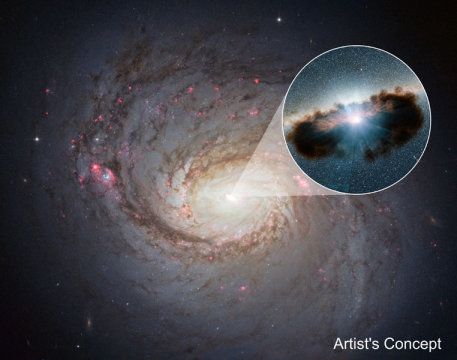
© NASA/JPL-CaltechGalaxy 1068 can be seen in close-up in this view from NASA's Hubble Space Telescope. NuSTAR's high-energy X-rays eyes were able to obtain the best view yet into the hidden lair of the galaxy's central, supermassive black hole.
The most massive black holes in the universe are often encircled by thick, doughnut-shaped disks of gas and dust. This deep-space doughnut material ultimately feeds and nourishes the growing black holes tucked inside.

Until recently, telescopes weren't able to penetrate some of these doughnuts, also known as tori.

"Originally, we thought that some black holes were hidden behind walls or screens of material that could not be seen through," said Andrea Marinucci of the Roma Tre University in Italy, lead author of a new Monthly Notices of the Royal Astronomical Society study describing results from NASA's Nuclear Spectroscopic Telescope Array, or NuSTAR, and the European Space Agency's XMM-Newton space observatory.

With its X-ray vision, NuSTAR recently peered inside one of the densest of these doughnuts known to surround a supermassive black hole. This black hole lies at the center of a well-studied spiral galaxy called NGC 1068, located 47 million light-years away in the Cetus constellation.

The observations revealed a clumpy, cosmic doughnut.

Fish

The ocean garbage myth: Where did the sea of plastic go?

Garbage ocean
Images such as this appear on the Internet and in the Main Stream Media, alongside of almost every article or report about the pollution of the Earth's oceans with plastics of all kinds. The image is usually associated with the words "Great Pacific Garbage Patch" in the text of the article. The implication by association is that the image is a photograph of said 'garbage patch'.

This clip from the Guardian shows a typical example:
Floating garbage - Guardian

Comment: Nature is the greatest Mother.


Telescope

Magnetic reconnection: Magnetic explosions in Northern lights and solar flares

magnetic reconnection
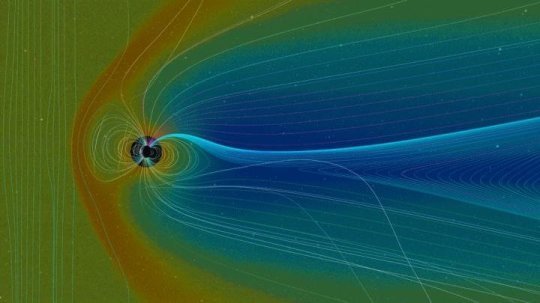
© NASA Goddard/SWRC/CCMC/SWMFThe explosive realignment of magnetic fields -- known as magnetic reconnection -- is a thought to be a common process at the boundaries of Earth's magnetic bubble. Magnetic reconnection can connect Earth's magnetic field to the interplanetary magnetic field carried by the solar wind or coronal mass ejections. NASA's Magnetospheric Multiscale, or MMS, mission studies magnetic reconnection by flying through the boundaries of Earth's magnetic field.
Just under four months into the science phase of the mission, NASA's Magnetospheric Multiscale, or MMS, is delivering promising early results on a process called magnetic reconnection -- a kind of magnetic explosion that's related to everything from the northern lights to solar flares.

The unprecedented set of MMS measurements will open up our understanding of the space environment surrounding Earth, allowing us to better understand what drives magnetic reconnection events. These giant magnetic bursts can send particles hurtling at near the speed of light and create oscillations in Earth's magnetic fields, affecting technology in space and interfering with radio communications. Scientists from the Southwest Research Institute, NASA, the University of Colorado Boulder and the Johns Hopkins University Applied Physics Laboratory presented an overview of MMS science and early results on Dec. 17, 2015, at the American Geophysical Union's Fall Meeting in San Francisco.

Planned for more than 10 years, the MMS mission started with the launch of four identical spacecraft on a single rocket in March 2015. Nine months later, the spacecraft are flying through the boundaries of Earth's magnetic system, the magnetosphere. Their initial orbit is taking them through the dayside boundaries of the magnetosphere -- known as the magnetopause -- where the solar wind and other solar events drive magnetic reconnection. Eventually, their orbit will loop out farther to carry them through the farthest reaches of the magnetosphere on the night side, where magnetic reconnection is thought to be driven by the build-up of stored energy.

Book

"Which-hunting" and the hegemony of style guides

The Elements of Style
© William Strunk, Jr.William Strunk, Jr.'s The Elements of Style.
A new study reveals just how strong the influence of mass-market books promoting a certain style of writing have had on authors since they were first published in the late 1950s. The study "Which-hunting and the Standard English Relative Clause," by a team of linguists at the University of Texas at Austin and KU Leuven, was published in the December, 2015 issue of the scholarly journal Language.

The article examines the significant impact of mass-market manuals to systematically change the way that writers use the English language. Advice books such as Strunk and White's Elements of Style, or Fowler's Modern English Usage have been able to systematically influence generation after generation of students in much of the English-speaking world. The new study demonstrates the importance of prescriptive grammar as a social force and its steady increase over the course of the twentieth century.

The authors of the study, Lars Hinrichs and Axel Bohmann, of the University of Texas at Austin, and Benedikt Szmrecsanyi, of KU Leuven, show that these changes can sometimes be rather drastic. To introduce relative clauses, English writers (especially American ones) now clearly prefer the relative pronoun that (as in the sentence: This is the book that impressed me), whereas in the middle of the twentieth century, the use of which (as in This is the book which impressed me) was still much more common. This shift dovetails with recommendations in style guides to go which-hunting, and to instead use that in defining relative clauses.

Mars

Scientists discover tiny dwarf star that influences nearby monster planet's unusual orbit

Planet
© NASA
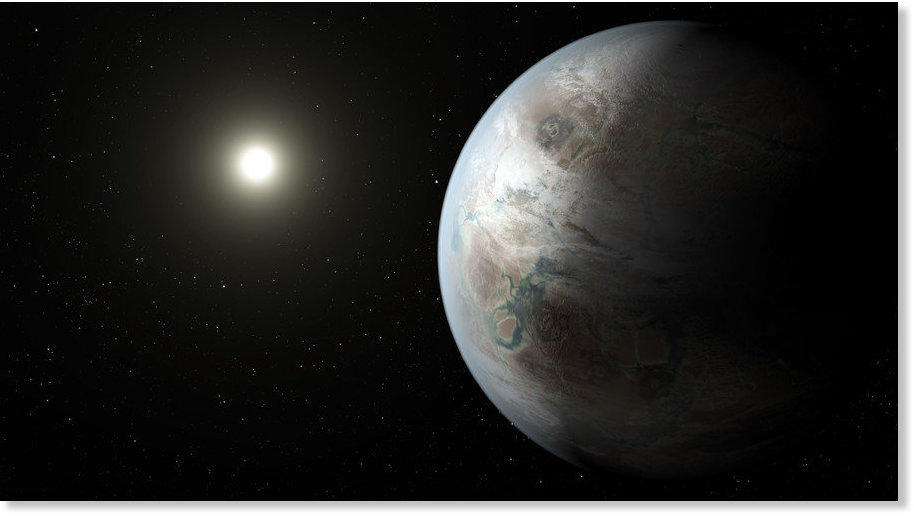
A huge planet is having quite the party in space, dancing between its cosmic companions rather eccentrically - all thanks to a tiny dwarf star which influences its bizarre movements. The new finding makes for a rather peculiar planetary system.

Measuring about eight times the mass of Jupiter, the enormous planet was discovered in 2011. At the time of its discovery, it was found to be orbiting a sun-like star called HD 4779 with high eccentricity. That is, its movements were far from perfectly circular - the further from a circle the trajectory is, the more eccentric it is.

But the eccentric orbit led a team made up almost entirely of current and former Carnegie scientists to speculate that something else may be influencing the monster planet's movements. They tested that theory with the Magellan adaptive optics (MagAO) instrument suite, which allowed them to take extremely high-resolution images and gave them a sharper look at the night sky than ever before. Their speculation was then confirmed.