Science & TechnologyS


Magnify

Mazes and brains: When preconception trumps logic

Maze
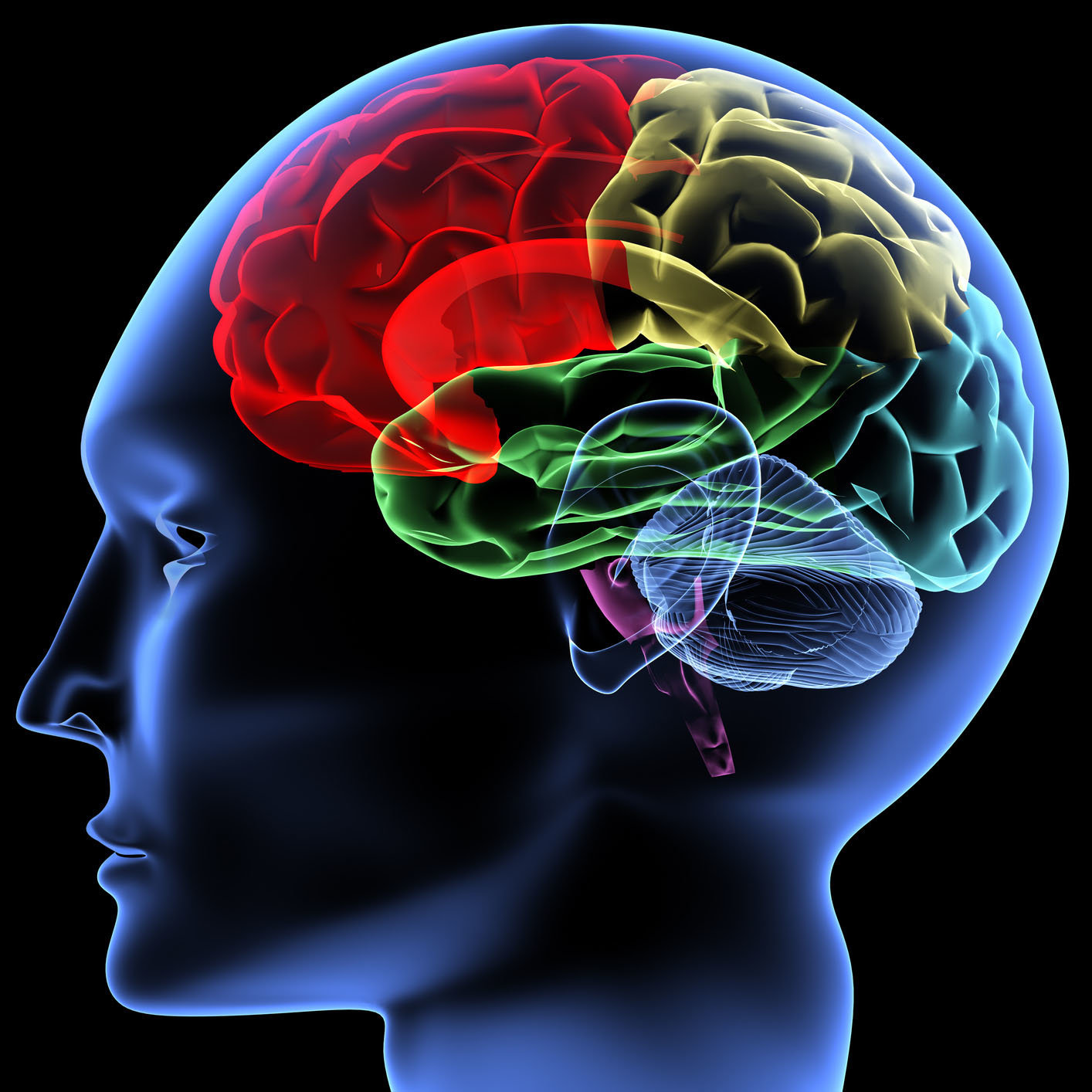
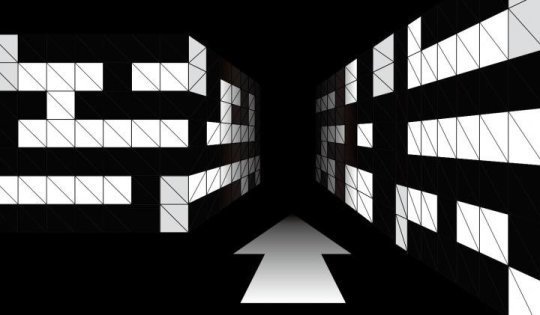
© Kyoto UniversityUsing virtual three-dimensional mazes together with functional magnetic resonance imaging (fMRI), researchers from Kyoto University investigated whether a person's preconceptions could be represented in brain activity.
Regions in brain that may lead to new communication tools found. Researchers can now reconstruct what we see in our minds when we navigate -- and explain how we get directions wrong.

The brain helps us navigate by continually generating, rationalizing, and analyzing great amounts of in-formation. For example, this innate GPS-like function helps us find our way in cities, follow directions to a specific destination, or go to a particular restaurant to satisfy a craving.

"When people try to get from one place to another, they 'foresee' the upcoming landscape in their minds," said study author Yumi Shikauchi. "We wanted to decode prior belief in the brain, because it's so crucial for spatial navigation."

Using virtual three-dimensional mazes together with functional magnetic resonance imaging (fMRI), the researchers investigated whether a person's preconceptions could be represented in brain activity.

Magnify

Are you Facebook dependent? New study findings reveal user trends

Facebook logo
© Facebook
What can create a dependency on Facebook? In a new study, researchers learned the more a person uses Facebook to fulfill goals, the more dependent on the social media platform they may become. A Facebook dependency is not equivalent to an addiction. Rather, the reasons why people use Facebook determine the level of dependency they have on the social network. 301 Facebook users between the ages of 18 and 68 who post on the site at least once per month were studied.

What drives you to Facebook? News? Games? Feedback on your posts? The chance to meet new friends?

If any of these hit home, you might have a Facebook dependency. But that's not necessarily a bad thing, says Amber Ferris, an assistant professor of communication at The University of Akron's Wayne College.

Ferris, who studies Facebook user trends, says the more people use Facebook to fulfill their goals, the more dependent on it the become. She is quick to explain this dependency is not equivalent to an addiction. Rather, the reason why people use Facebook determines the level of dependency they have on the social network. The study found those who use Facebook to meet new people were the most dependent on Facebook overall.

Comment:

Facebook for the dead: Memorialize your account for eternity

Facebook more popular than Google? For one week, it hit first place in the US

Facebook Tracks Your Every Move, Even After Logging Out

Study: Facebook use cuts productivity at work


Magnify

New technology enables us to "chart" all cells in brain

Brain 9
© Creative Commons
The human brain is made up of hundreds of millions of cells. Many of these cells and their functions are as yet unknown. This is about to change with a new technology that is being used for the first time at the Center for Brain Research at MedUni Vienna and Karolinska Institutet in Stockholm.

By combining traditional methods of identifying cells under a microscope and so-called "single-cell RNA sequencing," it is possible to identify every building block of any given excitable cell. "We are well on the way to being able to map many, if not all, neurons and their functions before too long," explains lead investigator Tibor Harkany, Head of the Department of Molecular Neurosciences at MedUni Vienna.

So far, we have only been able to study neurons based on a set of scientific premises and to determine or "search for" their function on the basis of a priori knowledge on their morphology (what does the cell look like?), biochemistry (what does it contain?) and what partners a cell might communicate with. "This has hindered the analysis of new types of neurons for which we do not have any anatomical, biochemical or electrophysiological markers. Neuroscience therefore needs radically new approaches to chart the identity of all neurons and other types of non-neuronal cells in the brain," explains Harkany. "Any new method that helps us to gain a better understanding of the brain and its cellular components has direct relevance to our search for new therapies to treat neuropsychiatric and age-related diseases."

Magnify

Scientists look deeper into the body with new fluorescent dye

NIR-II dye
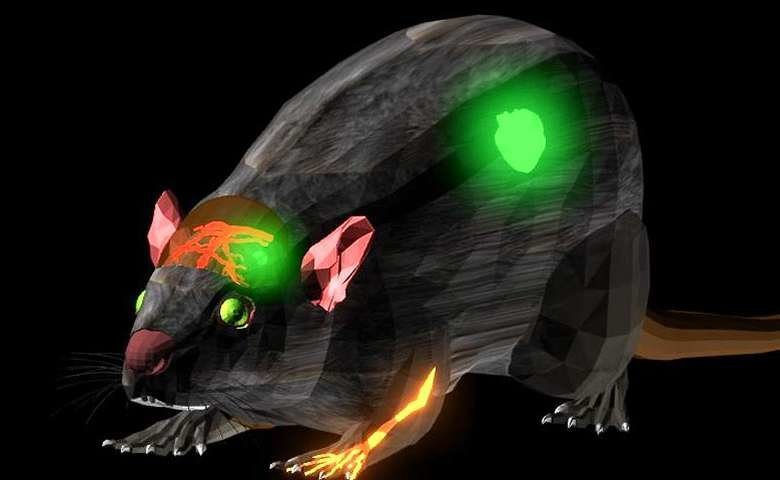
© Alexander AntarisThe NIR-II dye can resolve blood vessels in the forelimb as well as the brain with unprecedented clarity. The dye also allows clear resolution of tumors in the center of the mouse's brain.
Glowing dyes help scientists see inside the body and diagnose ailments, but they needed a certain type of molecule to improve the imaging depth. They invented a long wavelength near-infrared fluorescent molecule, and it works.

In recent years, physicians and researchers have increasingly turned to glowing dyes to look beneath the skin. An eye doctor, for example, might inject a dye into a patient's blood before shining a bright light in her eye. The dye causes the blood vessels to glow, providing a roadmap of the patient's retina on a computer screen.

At Stanford and elsewhere, researchers have worked to create dyes that, when stimulated, emit light of long wavelengths close to infrared light. Such a light, which is not visible to the human eye, could then be viewed by a special camera and be projected to a monitor to produce deeper, sharper images from inside the body.

This fluorescent imaging can help to pinpoint tumor locations near the skin's surface in a variety of cancers, such as head and neck, melanoma and breast cancer.

Magnify

Physicists continue to investigate why the universe did not collapse

Carina Nebula
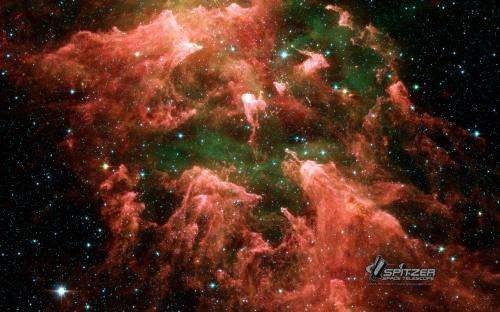
© NASAThis is the "South Pillar" region of the star-forming region called the Carina Nebula. Like cracking open a watermelon and finding its seeds, the infrared telescope "busted open" this murky cloud to reveal star embryos tucked inside finger-like pillars of thick dust.
According to the best current physics models, the universe should have collapsed shortly after inflation—the period that lasted for a fraction of a second immediately after the Big Bang.

The problem lies in part with Higgs bosons, which were produced during inflation and which explain why other particles have the masses that they do. Previous research has shown that, in the early universe, the Higgs field may have acquired large enough fluctuations to overcome an energy barrier that caused the universe to transition from its standard vacuum state to a negative energy vacuum state, which would have caused the universe to quickly collapse in on itself.

In a new paper published in Physical Review Letters, Matti Herranen at the University of Copenhagen and coauthors may have come a step closer to solving the problem by constraining the strength of the coupling between the Higgs field and gravity, which is the last unknown parameter of the standard model.

Magnify

The link between imagery and performance

athletic performance and imagery
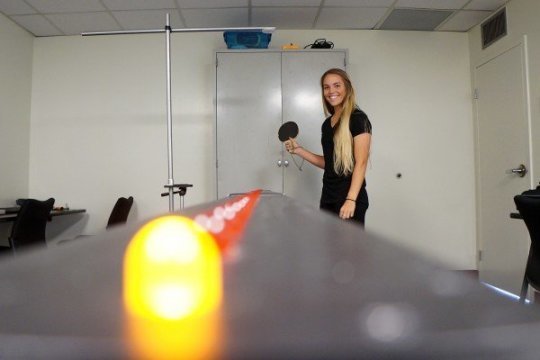
© Adriana M. ChavezFormer NMSU soccer player Katelyn Smith participates in an anticipation timing study in professor Phillip Post’s laboratory. Post is exploring the link between athletic performance and imagery in hopes of using his research in clinical settings.
Imagine standing on a basketball court, throwing the basketball and watching it arc into the net, followed by a soft swoosh sound.

Chances are you'll make that shot without a problem if you've been practicing on the court regularly, according to research by Phillip Post, associate professor in the Kinesiology and Dance Department in the College of Education at New Mexico State University. Post is studying the link between imagery and how it impacts motor learning and sport performance. Recently, Post presented his research at an international conference at Universidad Autónoma de Chihuahua.

"Specifically, I presented research, mostly research that I conducted, on the efficacy of using imagery to enhance learning or motor performance of well-rehearsed tasks," Post said. "The research presented suggests that imagery might be effective for enhancing learner's skill acquisition of tasks that contain greater cognitive elements, such as tasks that require decision making or remembering a sequence or pattern, as opposed to motor elements, or tasks that require correct skill execution, like a soccer kick. However, with more experienced performers imagery appears to be effective on a range of tasks, including both motor and cognitive. In addition to this research I discussed imagery theories and how to best apply the mental skill."

Comet

Are we doomed? Hundreds of newly discovered giant comets in solar system

Giant Comets
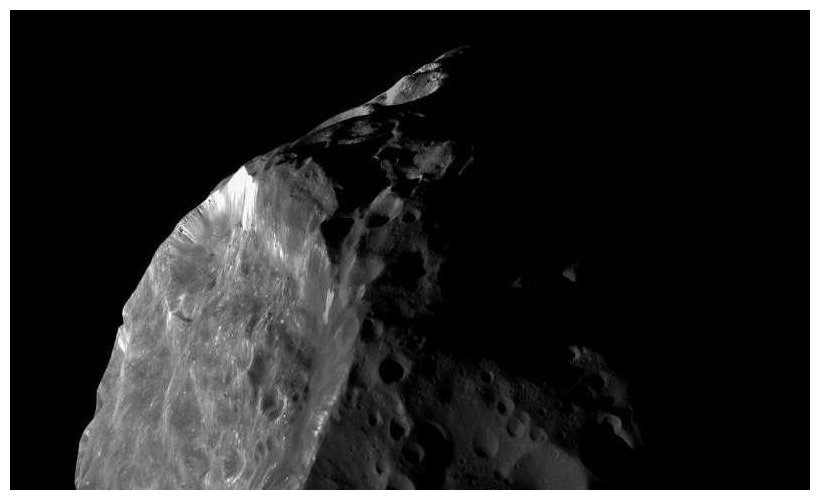
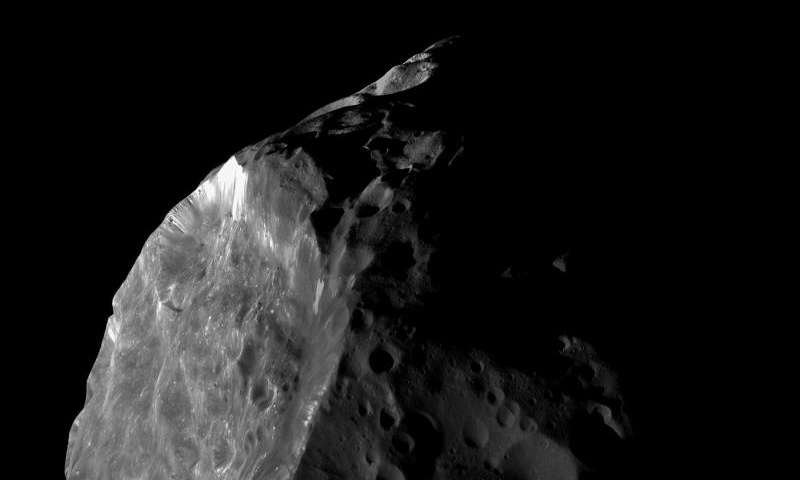
© NASA/JPL-Caltech/Space Science Institute Because they are so distant from the Earth, Centaurs appear as pinpricks of light in even the largest telescopes. Saturn's 200-km moon Phoebe, depicted in this image, seems likely to be a Centaur that was captured by that planet's gravity at some time in the past. Until spacecraft are sent to visit other Centaurs, our best idea of what they look like comes from images like this one, obtained by the Cassini space probe orbiting Saturn. NASA’s New Horizons spacecraft, having flown past Pluto six months ago, has been targeted to conduct an approach to a 45-km wide trans-Neptunian object at the end of 2018.
A team of astronomers from Armagh Observatory and the University of Buckingham report that the discovery of hundreds of giant comets in the outer planetary system over the last two decades means that these objects pose a much greater hazard to life than asteroids. The team, made up of Professors Bill Napier and Duncan Steel of the University of Buckingham, Professor Mark Bailey of Armagh Observatory, and Dr David Asher, also at Armagh, publish their review of recent research in the December issue of Astronomy and Geophysics, the journal of the Royal Astronomical Society.

The giant comets, termed centaurs, move on unstable orbits crossing the paths of the massive outer planets Jupiter, Saturn, Uranus and Neptune. The planetary gravitational fields can occasionally deflect these objects in towards the Earth.

Centaurs are typically 50 to 100 kilometres across, or larger, and a single such body contains more mass than the entire population of Earth-crossing asteroids found to date. Calculations of the rate at which centaurs enter the inner solar system indicate that one will be deflected onto a path crossing the Earth's orbit about once every 40,000 to 100,000 years. Whilst in near-Earth space they are expected to disintegrate into dust and larger fragments, flooding the inner solar system with cometary debris and making impacts on our planet inevitable.

Known severe upsets of the terrestrial environment and interruptions in the progress of ancient civilisations, together with our growing knowledge of interplanetary matter in near-Earth space, indicate the arrival of a centaur around 30,000 years ago. This giant comet would have strewn the inner planetary system with debris ranging in size from dust all the way up to lumps several kilometres across.

Mars

Evidence of ancient nuclear explosions on Mars, says scientist

Mars
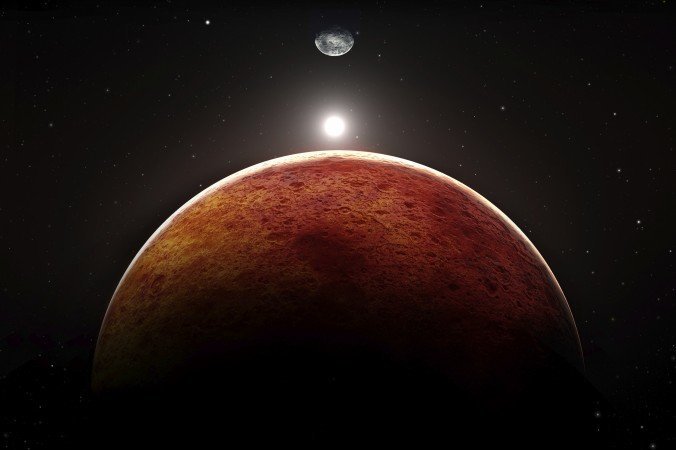
© Pitris/iStockIllustration of Mars
Nuclear reactions on Mars, Earth said to be 'natural,' but are they?

Mars has a high concentration of the gas isotope Xenon 129 in its atmosphere. Xenon 129 is produced by nuclear reactions. The surface of the red planet also has an excess of uranium and thorium.

These conditions are likely the result of two large anomalous nuclear explosions on Mars in the past, argues propulsion scientist Dr. John Brandenburg in a 2014 paper, titled "Evidence of a Massive Thermonuclear Explosion on Mars in the Past."

On Earth, in Oklo, Gabon, uranium was extracted in 1972 and found to have unusual properties. Natural uranium deposits all contain about 0.7 percent U235. The isotope U235 in the Oklo mine, however, showed at levels around 0.6 percent, suggesting the U235 had already been "burned."

Dr. Francis Perrin, former chairman of the French High Commission for Atomic Energy, told the French Academy of Sciences on Sept. 25, 1972, that a nuclear reaction had taken place approximately 1.7 billion years ago.

Magnify

Scientists find evidence for "chronesthesia", or mental time travel

chronesthesia
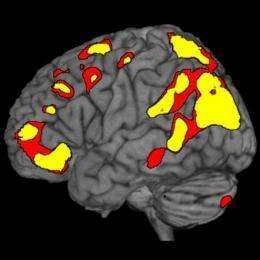
© Lars Nyberg, et al.Researchers have found evidence for "chronesthesia," which is the brain’s ability to be aware of the past and future, and to mentally travel in subjective time. They found that activity in different brain regions is related to chronesthetic states when a person thinks about the same content during the past, present, or future.
The ability to remember the past and imagine the future can significantly affect a person's decisions in life.

Scientists refer to the brain's ability to think about the past, present, and future as "chronesthesia," or mental time travel, although little is known about which parts of the brain are responsible for these conscious experiences. In a new study, researchers have used functional magnetic resonance imaging (fMRI) to investigate the neural correlates of mental time travel and better understand the nature of the mental time in which the metaphorical "travel" occurs.

The researchers, Lars Nyberg from Umea University in Umea, Sweden; Reza Habib from Southern Illinois University in Carbondale, Illinois; and Alice S. N. Kim, Brian Levine, and Endel Tulving from the University of Toronto in Toronto, Ontario, have published their results in a recent issue of the Proceedings of the National Academy of Sciences.

"Mental time travel consists of two independent sets of processes: (1) those that determine the contents of any act of such 'travel': what happens, who are the 'actors,' where does the action occur; it is similar to the contents of watching a movie - everything that you see on the screen; and (2) those that determine the subjective moment of time in which the action takes place - past, present, or future," Tulving told PhysOrg.com.

Magnify

Mental time travel: An exclusively human capacity?

Brain head
© digitalshotgun/Flickr
Are humans the only ones who are able to remember events that they had experienced and mentally time travel not only into the past but also the future? Or do animals have the same capacity? To a certain extent they do, according to three researchers who are contributing a new theoretical model to this long-standing discussion.

They published their results in the journal Neuroscience and Behavioral Reviews.

Episodic memory is a component of mental time travel

The model developed by the three researchers Prof Markus Werning, Prof Sen Cheng (both Mercator Research Group "Structure of Memory" at RUB) and Prof Thomas Suddendorf (University of Queensland) differs from other approaches with regard to one major aspect: it suggests a new relationship between mental time travel and episodic memory.

The research team assumes that mental time travel is composed of different components. "Component one are memory traces from episodic memory. That means: fairly accurate representations of personally experienced episodes, where each trace represents a particular experience, i.e. is very specific," explains Prof Sen Cheng. Component two is the ability to construct mental scenarios; by this, the researchers mean dynamic representations of past or expected situations that are not isolated but rather can be embedded into larger contexts and be reflected. If, for example, someone misplaces their key, they mentally travel back to places and situations where they still had the key. By associating the past situation with other experiences and information, a scenario is created. The question if and, if so, how the construction of mental scenarios is linked to a specific "autonoetic" form of consciousness is particularly interesting from the philosophical point of view. The authors discuss several options with an open outcome.