Science & TechnologyS


Telescope

China launches space telescope to study mysterious dark matter

dark matter particle explorer
© China Daily / Reuters
China has launched its first space telescope that will look for signs of dark matter, a type of substance invisible to the naked eye but hypothetically constituting the whole universe's mass.

The Dark Matter Particle Explorer (DAMPE), the first of China's four planned missions, blasted off a launch pad at the Jiuquan Satellite Launch Center in the Gobi desert on Thursday.

The satellite, nicknamed "Wukong" after a character from Chinese legend, is going to keep track of the direction, energy and electric charge of particles in space. Scientists believe that from space it will be easier for the instruments to detect something that may subsequently help them crack the mystery that surrounds dark matter.

Telescope

Monster planet is "dancing with the stars"

unusual planetary system
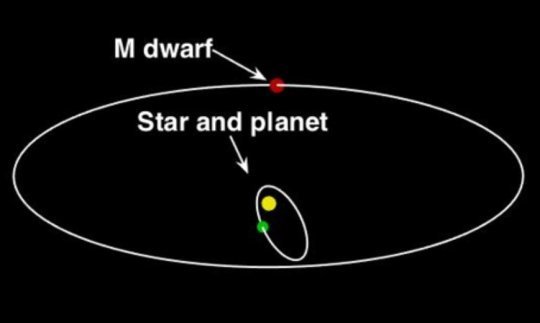
© Timothy RodigasA team of scientists has discovered a highly unusual planetary system comprised of a sun-like star, a dwarf star, and an enormous planet "dancing" in between. The dwarf star and the planet have been gravitationally influencing each other for millions of years. Specifically, the planet's eccentricity (the amount it deviates from being perfectly circular) and orbital inclination, meaning its angle relative to the equatorial plane of the primary star, have been oscillating back and forth in a process known as Kozai oscillations -- and will continue to do so for the foreseeable future.
A team made up almost entirely of current and former Carnegie scientists has discovered a highly unusual planetary system comprised of a Sun-like star, a dwarf star, and an enormous planet sandwiched in between.

The planet, first discovered in 2011 orbiting a star called HD 7449, is about eight times the mass of Jupiter and has one of the most eccentric orbits ever found. An eccentric orbit is one that deviates from being perfectly circular. The further from a circle it is, the more eccentric it is. A large eccentricity can also indicate that a planet is being affected by other objects nearby. For the planet around HD 7449, the large eccentricity was a clue that something else--something bigger than the known planet--also resided in the system.

"The question was: is it a planet or a dwarf star?" said lead author Timothy Rodigas. To answer the question, Rodigas and his team used the Magellan adaptive optics (MagAO) instrument suite to directly image the mysterious object. MagAO, commissioned in 2013, enables astronomers to take extremely high-resolution images, giving them a sharper look at the night sky than ever before.

"At the telescope, we saw the object within seconds, and that told us it had to be a dwarf star," Rodigas added.

Telescope

Nearby star hosts closest alien planet in the "habitable zone"

Wolf 1061
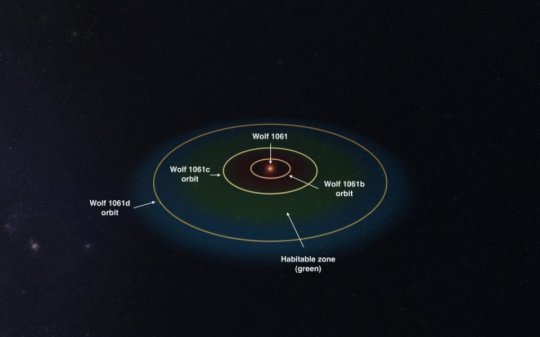
© Universe Sandbox 2This is a simulation of the orbital configuration of the Wolf 1061 system. Wolf 1061 is an inactive red dwarf star, smaller and cooler than our sun, 14 light years away. The orbits for the planets b, c and d (ordered from the inner planet to the outer) have periods of 4.9 days, 17.9 days and 67.2 days. In the simulation we show the planet orbits as all lying in a single plane. The planetary habitable zone around the star is marked in green -- the colors grade from red (where a planet would be too hot), through green (where the surface of a planet could sustain liquid water), through to blue (where a planet would be too cold).
UNSW Australia astronomers have discovered the closest potentially habitable planet found outside our solar system so far, orbiting a star just 14 light years away.

The planet, more than four times the mass of Earth, is one of three that the team detected around a red dwarf star called Wolf 1061.

"It is a particularly exciting find because all three planets are of low enough mass to be potentially rocky and have a solid surface, and the middle planet, Wolf 1061c, sits within the 'Goldilocks' zone where it might be possible for liquid water -- and maybe even life -- to exist," says lead study author UNSW's Dr Duncan Wright.

"It is fascinating to look out at the vastness of space and think a star so very close to us -- a near neighbour -- could host a habitable planet.

Magnify

Aging warps our perception of time, study finds

passage of time
© alphaspirit / FotoliaPhoto illustration depicting elderly man and the passage of time.
Much like trying to watch a video with the audio out of synch, older adults may have difficulty combining the stimuli they see and hear, and it could have implications for rapid decision-making tasks such as driving, according to new research.

A recent study from the University of Waterloo found that seniors have a harder time distinguishing the order of events than younger adults. When researchers presented them with both a light and sound at the same or different times, they found that young and older adults could determine whether they occurred simultaneously with similar accuracy. But when asked to determine which appeared first, the light or the sound, older adults performed much worse.

"To make sense of the world around us, the brain has to rapidly decide whether to combine different sources of information," said Michael Barnett-Cowan, a professor in the Department of Kinesiology at the University of Waterloo and senior author on the paper. "Older adults often experience problems processing multisensory information, which in turn can affect everyday tasks from following conversations, to driving, to maintaining balance."

Galaxy

Supernova in Einstein Cross galaxy reappears

Supernova
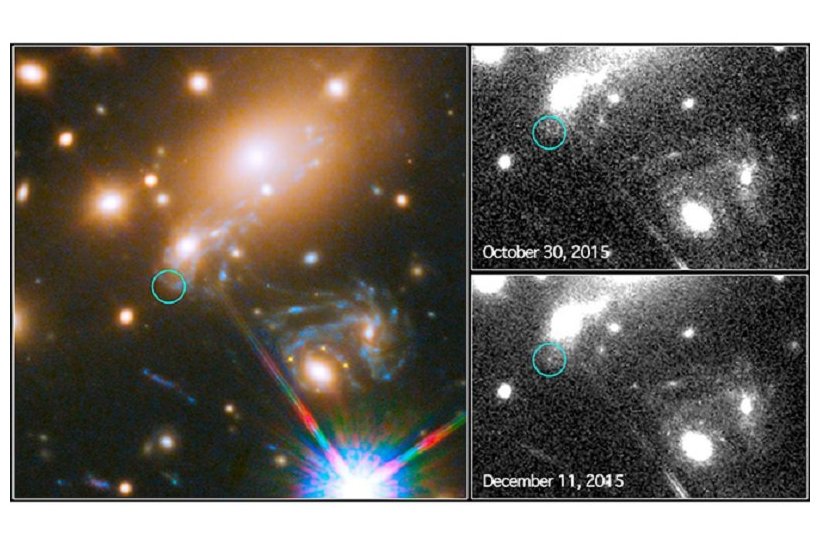
© NASA & ESA and P. Kelly (University of California, Berkeley)This Hubble image shows the supernova's signal appearing in the Einstein Cross as predicted by astronomers.
An ancient supernova that was serendipitously captured in four Hubble space telescope images thanks to a naturally occurring cosmic magnifying lens has reappeared, as astronomers predicted.

The exploded star, known as Refsdal in honor of Norwegian astronomer Sjur Refsdal, first appeared in November 2014. Scientists were stunned to find four images of the supernova around a galaxy, a configuration known as an "Einstein Cross."

The multiple images were caused by light from the supernova, which exploded about 10 billion years ago, taking different paths around a gravitationally warped region of space, relative to Hubble's line of sight.

These warped regions are due to massive galaxy clusters bending space and time, a phenomenon predicted by Albert Einstein 100 years ago.

Magnify

Snake bellies help scientists get a grip

tree snake
© iStockA brown tree snake moving on a smooth artificial branch.
A new study sheds light on how snakes' sharp-edged belly keels improve climbing abilities, which could lead to bio-inspired robotic designs and new methods to prevent snake invasion.

For many of us, the bodies of moving snakes look like little more than wiggly strands of spaghetti. However, Bruce Jayne, University of Cincinnati professor of biology in the McMicken College of Art and Sciences, sees a wide variety of anatomy and behavior that allows diverse snake species to crawl and climb almost anywhere, including tree branches with variable bark texture.

Using three different species to test their tree-worthy talents, Jayne and his students studied stout and heavy boa constrictors, medium-weight corn snakes and the slender and agile brown tree snakes.

Unlike most snakes that have a nearly circular cross sectional shape, Jayne found that brown tree snakes look more like a loaf of bread where the top is rounded but the bottom has corners -- called keels -- where the skin on either side of the belly is folded. He says these sharply contoured keels are the key for how various tree snakes can exploit subtle nooks and crannies in tree bark to prevent slipping, and propel themselves up a tree quickly, making it easier to get to their prey in a flash with less effort. To a smaller extent corn snakes have this shape, and boa constrictors were the roundest species that Jayne studied.

Info

Forward to the future: DARPA makes technology predictions

artificial intelligence
© dupress.com
When it comes to predictions, perhaps no organization on the planet is better able to make dreams a reality than the Defense Advanced Research Projects Agency (DARPA). Their "mad science" reputation already has given the world humanoid robots, drones, and the world's most advanced surveillance systems. But they are telling us that there is much more to come.

Interestingly, the timeline given by DARPA's "Forward to the Future" video messages, seen below, is 2045 - the theorized date of The Singularity popularized by futurist Ray Kurzweil in his 2006 book The Singularity is Near: When Humans Transcend Biology. As the title implies, The Singularity is the threshold where computer systems surpass and/or augment both the intelligence and the biological functions of the human body. It's a process that already has begun, and DARPA is reinforcing their commitment to make it a reality by the target date.

With yearly (known) funding in the tens of billions of dollars, DARPA also receives untold funding for "black budget" secret projects not even subjected to presidential and congressional oversight. So when they cast a vision of the future, it is worth paying attention.

Laptop

U mad bro? Computers now know when you're angry

Mad Mouse
© Jaren S. Wilkey/BYU PhotoPhoto illustration shows someone using a mouse rapidly.
Most people can tell if you're angry based on the way you're acting. Professor Jeffrey Jenkins can tell if you're angry by the way you move a computer mouse.

The BYU information systems expert says people experiencing anger (and other negative emotions--frustration, confusion, sadness) become less precise in their mouse movements and move the cursor at different speeds.

Thanks to advances in modern technology, Jenkins and his colleagues can now gather and process enough data points from your cursor movement to measure those deviations and indicate your emotional state.

"Using this technology, websites will no longer be dumb," Jenkins said. "Websites can go beyond just presenting information, but they can sense you. They can understand not just what you're providing, but what you're feeling."

According to his research, when users are upset or confused, the mouse no longer follows a straight or gently curving path. Instead, movements become jagged and sudden. Additionally, someone exhibiting negative emotions moves a mouse slower.


Satellite

Observations from ESO telescopes provide crucial third dimension in probe of Universe's dark side

XXL-South Field
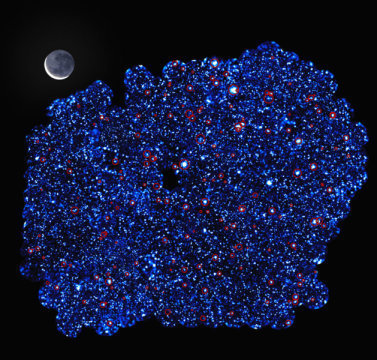
© ESA/XMM-Newton/XXL survey consortiumX-ray image of the XXL-South Field.
ESO telescopes have provided an international team of astronomers with the gift of the third dimension in a plus-sized hunt for the largest gravitationally bound structures in the Universe -- galaxy clusters. Observations by the VLT and the NTT complement those from other observatories across the globe and in space as part of the XXL survey -- one of the largest ever such quests for clusters.

Galaxy clusters are massive congregations of galaxies that host huge reservoirs of hot gas -- the temperatures are so high that X-rays are produced. These structures are useful to astronomers because their construction is believed to be influenced by the Universe's notoriously strange components -- dark matter and dark energy. By studying their properties at different stages in the history of the Universe, galaxy clusters can shed light on the Universe's poorly understood dark side.

The team, consisting of over 100 astronomers from around the world, started a hunt for the cosmic monsters in 2011. Although the high-energy X-ray radiation that reveals their location is absorbed by the Earth's atmosphere, it can be detected by X-ray observatories in space. Thus, they combined an ESA XMM-Newton survey -- the largest time allocation ever granted for this orbiting telescope -- with observations from ESO and other observatories. The result is a huge and growing collection of data across the electromagnetic spectrum1, collectively called the XXL survey.

Satellite

Gamma rays detected from galaxy halfway across the visible universe

blazar
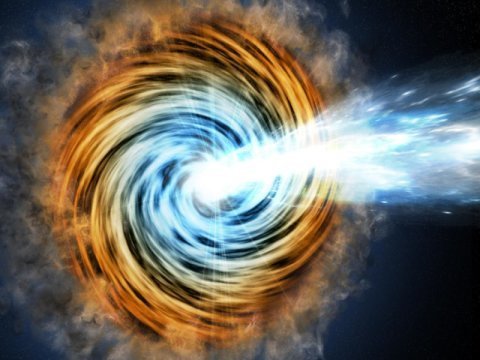
© M. Weiss/CfAThis artist's conception shows a blazar -- the core of an active galaxy powered by a supermassive black hole. The VERITAS array has detected gamma rays from a blazar known as PKS 1441+25. Researchers found that the source of the gamma rays was within the relativistic jet but surprisingly far from the galaxy's black hole. The emitting region is at least a tenth of a light-year away, and most likely is 5 light-years away.
In April 2015, after traveling for about half the age of the universe, a flood of powerful gamma rays from a distant galaxy slammed into Earth's atmosphere. That torrent generated a cascade of light -- a shower that fell onto the waiting mirrors of the Very Energetic Radiation Imaging Telescope Array System (VERITAS) in Arizona. The resulting data have given astronomers a unique look into that faraway galaxy and the black hole engine at its heart.

Gamma rays are photons of light with very high energies. These gamma rays came from a galaxy known as PKS 1441+25, which is a rare type of galaxy known as a blazar. At its center it hosts a supermassive black hole surrounded by a disk of hot gas and dust.

As material from the disk swirls toward the black hole, some of it gets channeled into twin jets that blast outward like water from a fire hose only much faster -- close to the speed of light. One of those jets is aimed nearly in our direction, giving us a view straight into the galaxy's core.