Science & TechnologyS


Mars

Evidence for more recent clay formation on Mars discovered

Ritchey Crater
© NASA/JPL/University of Arizona/Brown UniversityRitchey Crater, located near the Martian equator, has impact melt deposits containing clay minerals. Impact melt forms when rock melted during an impact cools and hardens. The clay minerals found within these deposits are very likely to have formed after the impact event. Most clay minerals on Mars are thought to have formed during the earliest Martian epoch, known as the Noachian. However, evidence from Ritchey crater and other post-Noachian craters, suggests that clay formation after the Noachian was not uncommon.
Recent orbital and rover missions to Mars have turned up ample evidence of clays and other hydrated minerals formed when rocks are altered by the presence of water. Most of that alteration is thought to have happened during the earliest part of Martian history, more than 3.7 billion years ago. But a new study shows that later alteration -- within the last 2 billion years or so -- may be more common than many scientists had thought.

The research, by Brown University geologists Ralph Milliken and Vivian Sun, is in press in the Journal of Geophysical Research: Planets.

The lion's share of the clay deposits found on Mars thus far have turned up in terrains that date back to the earliest Martian epoch, known as the Noachian period. Clays also tend to be found in and around large impact craters, where material from deep below the surface has been excavated. Scientists have generally assumed that the clays found at impact sites probably formed in the ancient Noachian, became buried over time, and then were brought back to the surface by the impact.

That assumption is particularly true of clay deposits found in crater central peaks. Central peaks are formed when, in the aftermath of an impact, rocks from within the crust rebound upward, bringing layers to the surface that had been buried many kilometers deep.

Magnify

Emotion processing in brain changes with tinnitus severity

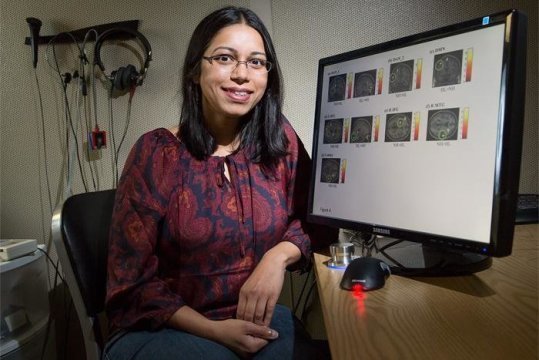
Fatima Husain
© L. Brian StaufferSpeech and hearing science professor Fatima Husain and her colleagues found a relationship between tinnitus severity and emotion processing in the brain.
Tinnitus, otherwise known as ringing in the ears, affects nearly one-third of adults over age 65. The condition can develop as part of age-related hearing loss or from a traumatic injury. In either case, the resulting persistent noise causes varying amounts of disruption to everyday life.

While some tinnitus patients adapt to the condition, many others are forced to limit daily activities as a direct result of their symptoms. A new study reveals that people who are less bothered by their tinnitus use different brain regions when processing emotional information.

"We are trying to understand how the brain adapts to having tinnitus for a very long time," said Fatima Husain, University of Illinois speech and hearing science and neuroscience professor who conducted the research with kinesiology and community health professor Edward McAuley and neuroscience graduate students Jake Carpenter-Thompson and Sara Schmidt. Husain also is affiliated with the Beckman Institute for Advanced Science and Technology. Carpenter-Thompson is lead author on the paper, which is published in the journal PLOS ONE.

Husain's research uses functional magnetic resonance imaging, an imaging tool that enables researchers to see changes in blood oxygen levels in the brain during an activity.

Bizarro Earth

Earth's day is getting longer - Rotation is slowing down

Scientists reveal that the rotation of Earth's core holds a clue to understanding global sea-level rise.

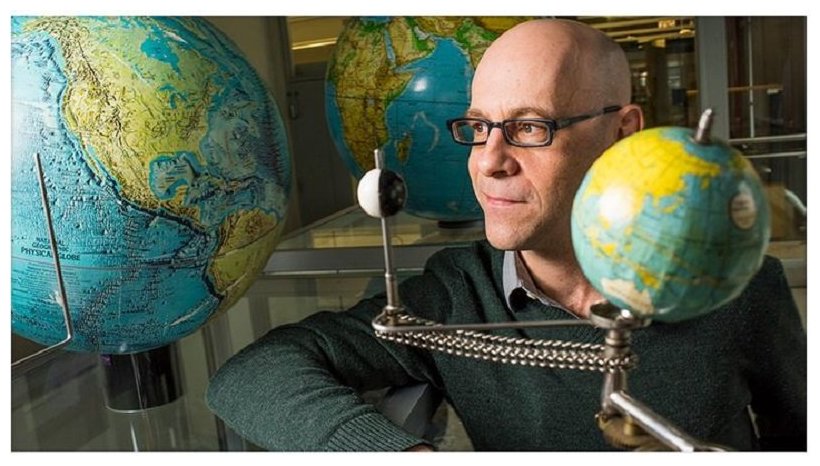
Mathieu Dumberry
© University of Alberta
Scientists are studying past changes in sea level to make accurate future predictions of this consequence of climate change, and they're looking down to Earth's core to do so.

"In order to fully understand the sea-level change that has occurred in the past century, we need to understand the dynamics of the flow in Earth's core," says Mathieu Dumberry, a professor in the Department of Physics at the University of Alberta.

The connection is through the change in the speed of Earth's rotation. Meltwater from glaciers not only causes sea levels to rise, but also shifts mass from the pole to the equator, which slows down the rotation. (Picture the Earth as a spinning figure skater. The skater moves his or her arms in to spin more quickly or out to slow down.) The gravity pull from the Moon also contributes to the slowdown, acting a little like a lever brake. However, says Dumberry, the combination of these effects is not enough to explain the observations of the slowing down of Earth's rotation: a contribution from Earth's core must be added.

Magnify

Turn-taking in communication may be more ancient than language

Communications
© Shutterstock
The central use of language is in conversation, where we take short turns in rapid alternation, a pattern found across unrelated cultures and languages.

In the December issue of Trends in Cognitive Sciences, Stephen Levinson from the Max Planck Institute for Psycholinguistics reviews new research on turn-taking, focusing on its implications for how languages are structured and for how language and communication evolved.

When we speak, we take turns responding to each other. The speed of response (about 200 milliseconds on average, about the same time as it takes to blink) is astonishing when we appreciate the slow nature of language encoding: it takes 600ms or more to prepare a word for delivery. This implies a substantial overlap between listening to the current speaker and preparing our own response. Levinson reviews research focused on this overlap of comprehension and production, and points out that this double-tasking may have systematic effects on language structure: it may motivate the compact clause found in all languages and the inferential reasoning that allows much to be meant by a few words.

Magnify

How the brain can handle so much data

random projection
© ChenPG / FotoliaThis is believed to be the first study of "random projection," the core component of the researchers' theory, with human subjects.
Humans learn to very quickly identify complex objects and variations of them. We generally recognize an "A" no matter what the font, texture or background, for example, or the face of a coworker even if she puts on a hat or changes her hairstyle. We also can identify an object when just a portion is visible, such as the corner of a bed or the hinge of a door. But how? Are there simple techniques that humans use across diverse tasks? And can such techniques be computationally replicated to improve computer vision, machine learning or robotic performance?

Researchers at Georgia Tech discovered that humans can categorize data using less than 1 percent of the original information, and validated an algorithm to explain human learning -- a method that also can be used for machine learning, data analysis and computer vision.

"How do we make sense of so much data around us, of so many different types, so quickly and robustly?" said Santosh Vempala, Distinguished Professor of Computer Science at the Georgia Institute of Technology and one of four researchers on the project. "At a fundamental level, how do humans begin to do that? It's a computational problem."

Control Panel

Tinkering with time travel: Physicists mathematically send a photon back in time

time travel
Hoverboards, flying cars, free energy and more, every day the prospect of living in a futuristic world seems more reality and less fiction.

This is especially so, now that scientists from the University of Queensland, Australia have reportedly sent particles of light into the past.

Scientific American reports that the researchers used single particles of light (photons) to simulate quantum particles traveling through time. They have, in effect, shown that one photon can pass through a wormhole and then interact with its older self.

Their findings were published in Nature Communications.

2 + 2 = 4

Helping others dampens the effects of everyday stress

helping others
Providing help to friends, acquaintances, and even strangers can mitigate the impact of daily stressors on our emotions and our mental health, according to new research published in Clinical Psychological Science, a journal of the Association for Psychological Science.

"Our research shows that when we help others we can also help ourselves," explains study author Emily Ansell of the Yale University School of Medicine. "Stressful days usually lead us to have a worse mood and poorer mental health, but our findings suggest that if we do small things for others, such as holding a door open for someone, we won't feel as poorly on stressful days."

Moon

First full moon since 1977 to rise on Christmas

Full Moon
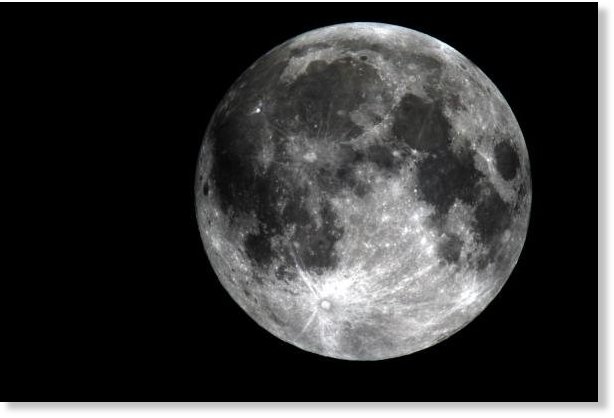
© Ismael Mohamad/UPIFor the first time since 1977, a full moon will rise on Christmas.
The last time a full moon rose on Christmas, the Bee Gees were on the radio and Saturday Night Fever was in the theaters.

A full moon rises every 29.53 days. That makes the chances of a full moon landing on a special day -- like your birthday, or Christmas -- rather slim.

But 2015 is a lucky year. For the first time in 38 years, Christmas Day will host a full moon. Christmas won't get another full moon until 2034.

A NASA spokesperson told ABC News the full moon will peak at just after six in the morning, Eastern Standard Time. According to the Farmer's Almanac, the last full moon in the month of December is called the "Cold Moon" or the "Big Moon."

The last time a full moon rose on Christmas, it was December 25, 1977 -- the Bee Gees were on the radio and Saturday Night Fever was in the theaters. J.R.R. Tolkien was a best-selling author, but none of his books had been made into movies yet.

Telescope

Report of discovery of large object in far outer edges of solar system incites skeptical reactions

ALMA test facility
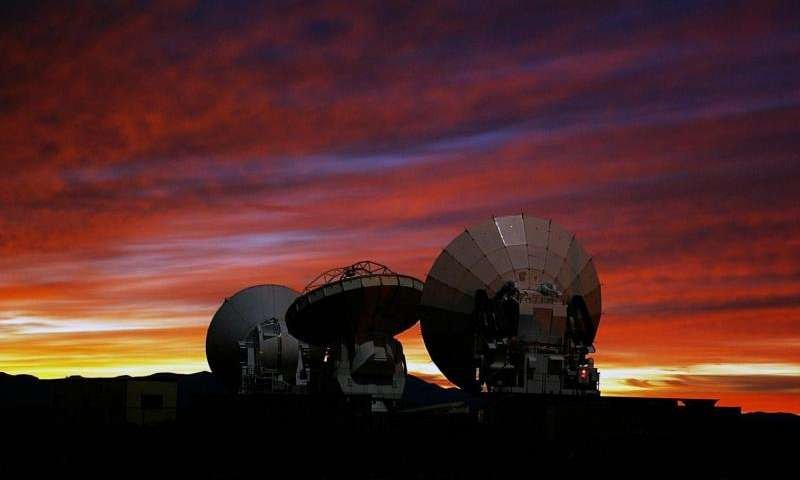
© ESOALMA prototype-antennas at the ALMA test facility.
Two separate teams of researchers (one from Mexico, the other Sweden), have incited skepticism among the astronomy community by posting papers on the preprint server arXiv each describing a different large object they observed in the outer edges of the solar system. Both teams made their observations after reviewing data from ALMA—a cluster of radio dishes in the Chilean mountains.

One of the objects was found to be near W Aquilae in the night sky—the other adjacent to Alpha Centauri . Both groups report being skeptical at first regarding a faint glow, but monitored what they had seen nonetheless—to their surprise they found that the objects appeared to move relative to the stars behind them, which suggested they might be relatively close and that they might be orbiting the sun. Neither group was able to gain much evidence regarding the properties of the objects they had spied, because both of them were only able to make two observations, but both teams suggest there was enough data to allow for ruling out the object being an ordinary star.

The Swedish team nick-named the object they observed Gna, after a Nordic God known for its swiftness, and have told the press they had no intention of suggesting they had found the mythical Planet X which supposedly lies somewhere beyond Pluto. Instead they suggest it might be a large asteroid. The team from Mexico went a little further suggesting that the object they observed might possibly turn out to be a brown dwarf.

Magnify

Researchers create powerful pseudomagnetic fields in graphene

pseudomagnetic field
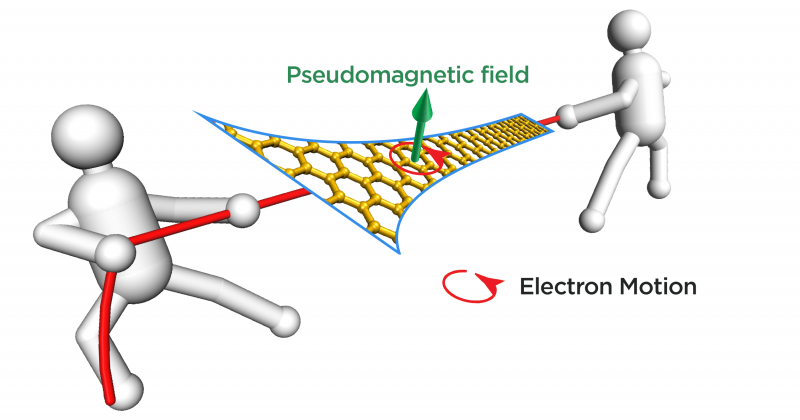
© University of MarylandIllustration shows how applying a simple stretch to a specifically shaped sheet of graphene creates a stable and controllable pseudomagnetic field.
University of Maryland (UMD) researchers have made a breakthrough discovery in graphene research that could provide a testbed for understanding how electrons move in extremely high magnetic fields. Since its discovery in 2004, graphene has become a celebrity in the materials science and physics world due to its remarkable physical properties.

One of the thinnest and strongest materials ever made on earth with incredible powers of conductivity, graphene has quickly become one of the most versatile materials discovered. Graphene-related research is currently fueling potentially revolutionary new applications in everything from faster electronics, wearable technology and smart clothing to better energy storage, sensors and medical devices. And now, mechanical engineers at the UMD may have found a way to make it even more powerful.

Graduate student Shuze Zhu and Associate Professor Teng Li, along with National Institute of Standards and Technology (NIST) collaborator Joseph Stroscio, have developed a theoretical model that demonstrates how to shape and stretch graphene to create a powerful, adjustable and sustainable magnetic force.