Science & TechnologyS


Moon

NASA discovers new asteroid 'dancing' with Earth

New celestial companion
© NASA Jet Propulson Laboratory/YouTube
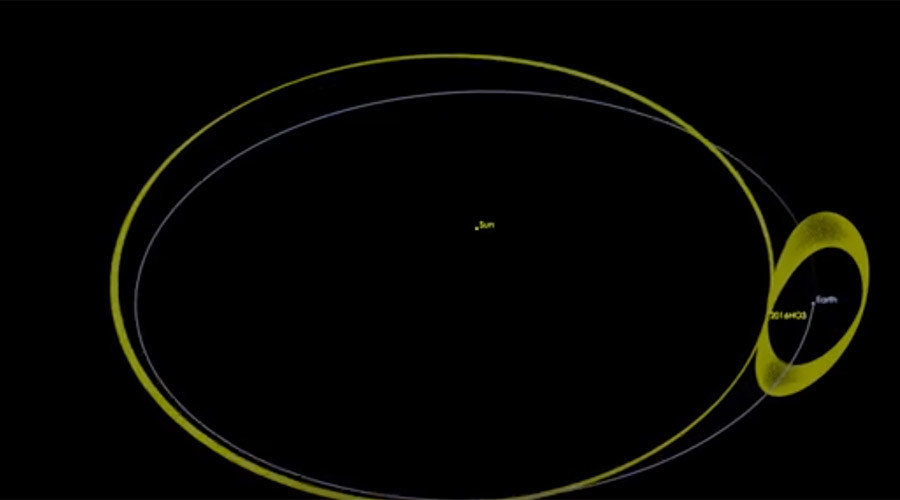
Move over, Moon - Earth has as new celestial companion. A tiny asteroid, named 2016 HO3, has been engaged in a steady orbital "dance" with our planet for almost a century, but was discovered only recently.

A telescope on Haleakala, Hawaii - funded by NASA's planetary defense program - spotted the asteroid in April and designated it 2016 HO3. The actual size of the celestial body has not been firmly established, but astronomers have estimated that its diameter is larger than 120 feet (40 meters) and smaller than 300 feet (100 meters).

NASA's Jet Propulsion Laboratory in Pasadena, California released a video of the asteroid's orbit on Wednesday, which is based on calculations that show 2016 HO3 has been Earth's "stable quasi-satellite" for almost a century and will remain our planet's companion for centuries to come.

"Since 2016 HO3 loops around our planet, but never ventures very far away as we both go around the sun, we refer to it as a quasi-satellite of Earth," said Paul Chodas, manager of NASA's Center for Near-Earth Object (NEO) Studies at the JPL.


Comment: 72 new asteroids discovered near Earth, says NASA


Bulb

The secret behind birds' brainy feats revealed

crow
© Edwin Butter | ShutterstockCrows are found all over the world. A group of crows is called a murder.
The next time someone calls you a "bird brain," you may want to plant a big, fat kiss on their overgrown primate noggin.

Inch for inch, birds cram more neurons into their pea-size brains than primates do, new research suggests.

"For a long time, having a 'bird brain' was considered to be a bad thing: Now, it turns out that it should be a compliment," Suzana Herculano-Houzel, a neuroscientist at Vanderbilt University in Tennessee, said in a statement.

That may explain how the feathery fliers are able to ace so many intelligence tests, the authors speculated.

Comment: Related articles:


Magnify

Hidden in our DNA: Physicists discover a second layer of information

another layer DNA
DNA is fascinating, and we stand to learn so much about who we are, where we came from, and what we are capable of (biologically speaking) from its study. Our capabilities in particular have yet to be studied in-depth by the mainstream scientific community. Yet the study of phenomena like the placebo effect, distant healing, telepathy, and the physical impacts of human intention, not to mention the Mind-Body connection, has yielded statistically significant results which have been available in 'reputable peer reviewed journals' for decades.

How does this relate to DNA? Well, there are many codes in our DNA that scientists have yet to crack. Parts of our DNA, for example have no known biological function, or at least we have yet to discover them. Maybe they have spiritual applications, or are connected to the non-physical realm in some way. These seemingly useless DNA are referred to as 'Junk DNA,' or 'non-coding DNA.' But we are learning more about them each day, as Scientific American reports, so the label isn't entirely accurate.

Info

Evidence of giant plasma structures above Earth say astronomers

Plasma Structures
© Screen Capture YouTube
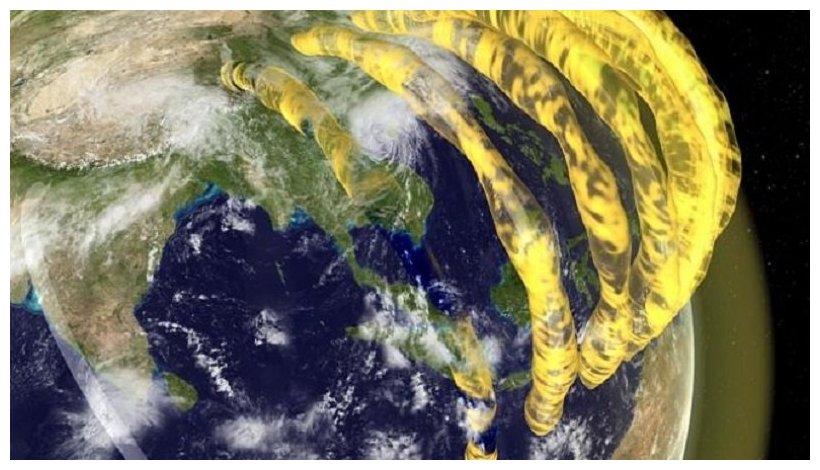
For the first time, astronomers have captured visual evidence of the existence of tubular plasma structures living in the inner layers of the magnetosphere that surrounds the Earth.

"For over 60 years, scientists believed these structures existed but by imaging them for the first time, we've provided visual evidence that they are really there," explained Cleo Loi of the ARC Centre of Excellence for All-sky Astrophysics (CAASTRO) and the School of Physics at the University of Sydney.

"The discovery of the structures is important because they cause unwanted signal distortions that could, as one example, affect our civilian and military satellite-based navigation systems. So we need to understand them," Loi, who is the lead author on this research, continued.

The plasma in the magnetosphere, which is the region of space around the Earth occupied by its magnetic field, is created by the atmosphere being ionised by sunlight. The ionosphere is the innermost layer of the magnetosphere, and higher up is the plasmasphere. These are implanted with many oddly shaped plasma structures, including the tubes.

Satellite

'Cassini' sends back photos of a disturbance in Saturn's rings

Saturn's Rings
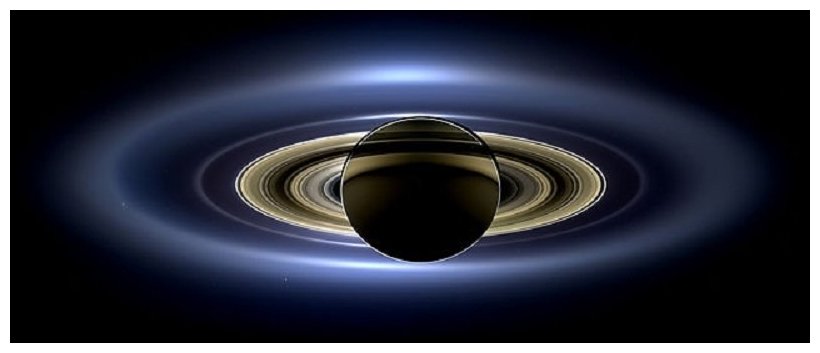
© NASA / JPL-Caltech / Space Science Institute / Wikimedia Commons CC BY 2.0The full set of rings, imaged as Saturn eclipsed the Sun from the vantage of the Cassini orbiter, 1,200,000 km (746,000 mi) distant, on 19 July 2013 (brightness is exaggerated). Earth appears as a dot at 4 o'clock, between the G and E rings.
NASA's Cassini space probe has recently sent back some very interesting images that reveal something strange going on with Saturn's wispy, thin F ring. The photos reportedly show a noticeably visible disturbance in the planetary ring.

The F ring, incidentally, was shaped by the two shepherd moons of Saturn, namely Pandora and Prometheus. Furthermore, the two comparatively tiny moons are still hard at work sculpting the rings, making it an ongoing process. The ring is comprised of gores, strands, jets and kinks.

Scientists from NASA have speculated that the disruption noticed on Saturn's ring is not the work of Pandora, which is located quite close by. The researchers have suggested that the strange disturbance could possibly be caused by the interaction of a minuscule object embedded in the F ring itself, with the ring's core material.

Planetary scientists sometimes call such features jets. Additionally, the tiny size of the embedded object makes their detection difficult, especially at the resolution of images captured by Cassini. However, scientists suggest their presence by observing the subsequent disruptive effects, caused by the tiny objects.

Blue Planet

'New era of astronomy': Gravitational waves detected for 2nd time, backing up theory of relativity

Gravitational Waves
© The SXS Project / Reuters
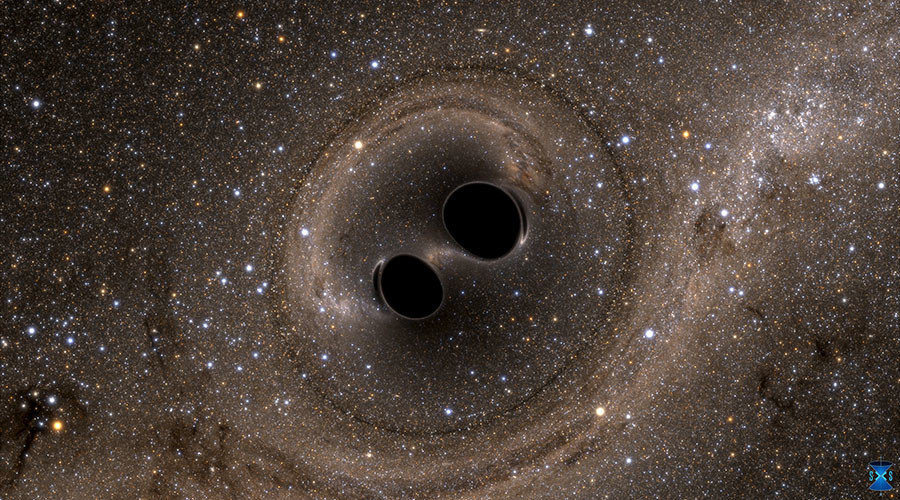
Scientists from the Laser Interferometer Gravitational-wave Observatory (LIGO) have announced they have detected gravitational waves from a pair of colliding black holes for the second time, thus backing up the theory of general relativity.

The international collaboration LIGO, with nearly 1,000 scientists working together, made the breakthrough announcement during a media conference taking place simultaneously in Lomonosov Moscow State University (MSU) and the San Diego Astronomy Association on Wednesday.

"Detecting the gravitational waves from the merger of two black holes by LIGO's detectors for the second time is highly important," said MSU physics department professor Valery Mitrofanov, adding that this underpins gravitational wave astronomy.

Meteor

First large-area telescope tracking dangerous asteroids goes live in Russia

Sayan Solar Observatory
© Petr Malinovskiy / Sputnik Sayan Solar Observatory
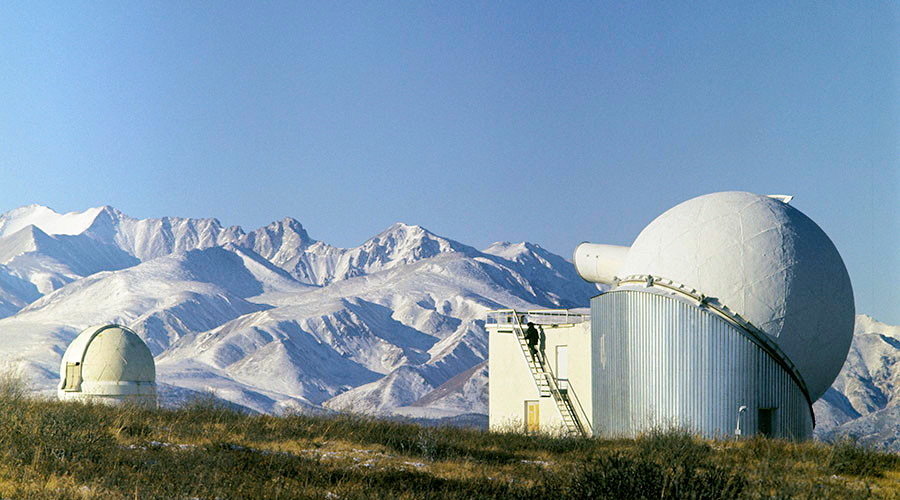
A large-area telescope installed at observatory in Sayan Mountains has started its sky-watching mission. The LAT is expected to operate as an 'early warning' tool alerting scientists about space rocks passing in imminent proximity to our planet. The AZT-33VM asteroid seeker is designed to execute rapid sky survey to spot and monitor potentially-dangerous space objects. The scientific instrument has been designed and constructed at LOMO (St. Petersburg) with assistance from Russian Academy of Science (RAS) and Roscosmos space agency.

"This is the first instrument of that kind in Russia, very powerful, capable of detecting remote [space] objects threatening Earth," Izvestia daily cited Boris Shustov, scientific supervisor at Institute of Astronomy. It takes just 30 seconds for the telescope to get data on any space extraterrestrial object 50 meters in size traveling in space at the distance of 150 million km (1 astronomical unit) away from Earth.

Comment: Yet another house-size asteroid comes closer to Earth than the Moon.

Quotes from NASA and independent researchers:
- "It's hard to believe we're looking at an asteroid. We were completely knocked out."
- "Although this particular object won't hit Earth in the immediate future.."
- "..the triple asteroid poses no threat to Earth."
- "This object is on the list of 'potentially hazardous asteroids.."
- "we can spot an object comparable to Tunguska meteorite" (see this article)

See also:


Telescope

NASA's Kepler telescope finds largest 'binary planet' ever found

Kepler-1647b
© Lynette Cook / NASA
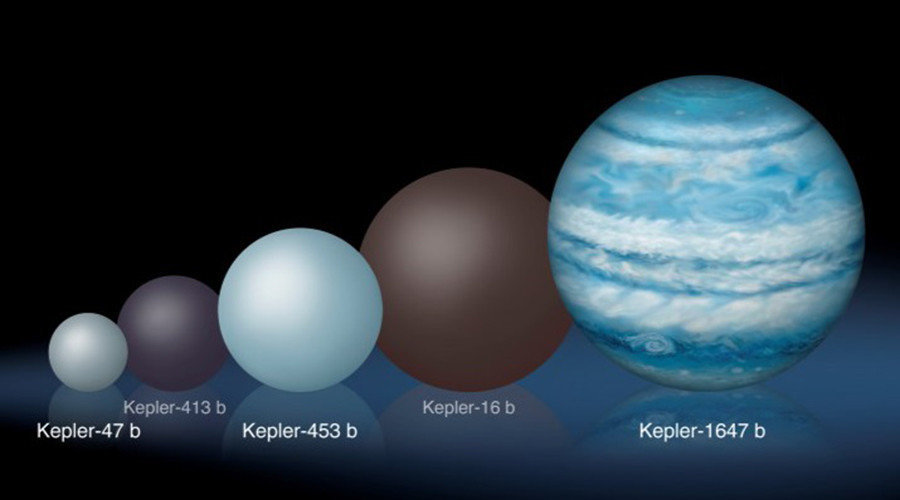
NASA's Kepler telescope has spotted a new planet - one where Luke Skywalker might feel right at home. Just like his native Tatooine, the new planet orbits two suns and is the largest "binary planet" ever found, taking the longest trip around its stars.

In the constellation Cygnus, the recently discovered planet orbits what scientists call a double-star system, known as Kepler-1647, from where the new planet takes its name, Kepler-1647b.

The team of scientists from San Diego State University (SDSU) that discovered the planet estimates it is about the size of Jupiter, making it the largest "binary planet" ever found. The so-called transiting circumbinary planets (CBP) "are likely to be less common," they wrote.

Outside the scientific community, planets like Kepler-1647b have also been called "Tatooine" after Luke Skywalker's home world in the Star Wars saga.

"It's a bit curious that this biggest planet took so long to confirm, since it is easier to find big planets than small ones," said SDSU astronomer Jerome Orosz, a coauthor of the study. "But it is because its orbital period is so long."

Comment: See also:


Info

New study links herpes virus with constipation and gastrointestinal problems

Herpes simplex virus
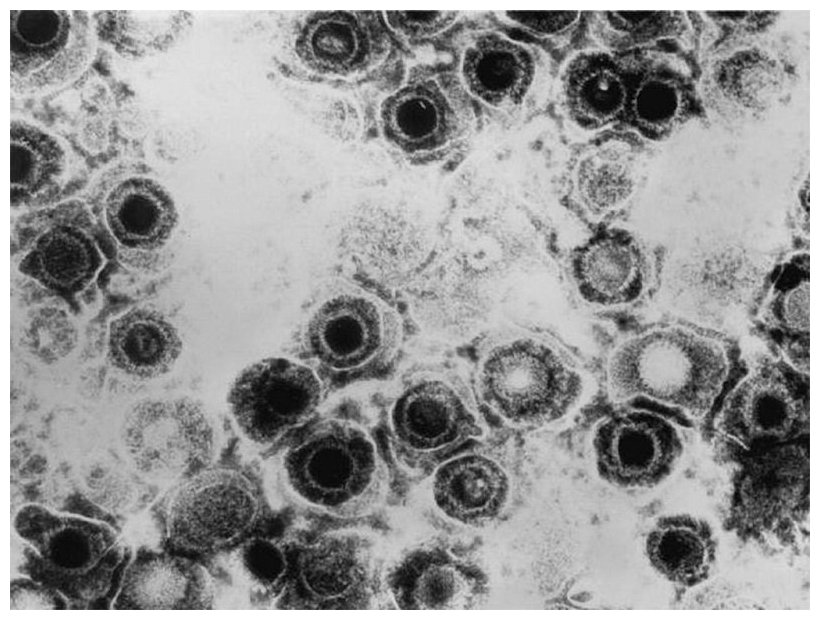
© The Independent, UKMicrograph of a herpes simplex virus.
People experiencing constipation for no reason might unknowingly have Herpes, according to new research.

The new study has found a surprising link between gastrointestinal problems or the inability to empty the bladder and the the virus that causes genital herpes.

The Yale-led study showed that the virus is able to spread from the genitals to nerves in the spinal chord. From there, it travels to neurons in the colon - killing them off, and leading to damage.

Those problems can stop food from moving along the digestive tract properly, which can in turn lead to an enlarged colon and disease.

The findings could prove important for people who are suffering with gut problems and can't find a cause, encouraging doctors to look at viral infection as a possible reason.

The study was led by Akiko Iwasaki, a professor of immunobiology at Yale. It is published this week in the journal Cell Host & Microbe.

"The key findings is that there is this unexpected infection in the neurons in the colon wall after herpes infection," said Iwasaki. "Other members of the herpes virus family, including Epstein-Barr virus, chicken pox virus, and cytomegalovirus have been found in the neurons of the colon of people with unexplained chronic constipation. When doctors can't figure out the cause of these chronic intestinal conditions, one thing to look at is a viral infection."

The study tested the effects of the virus that causes herpes in mice. Though the effects in mice are different from those in people, the study is a way understanding how the disease processes through the body.

Display

U.S. Appeals Court upholds net neutrality rules in full

The Democratic majority of the Federal Communications Commission voted to approve new
© Pablo Martinez Monsivais/APThe Democratic majority of the Federal Communications Commission voted to approve new "net neutrality" rules in February 2015, prompting a court challenge from Internet providers.
A federal appeals court on Tuesday fully upheld the so-called Open Internet rules, regulations backing the principle of net neutrality.

It's the idea that phone and cable companies should treat all of the traffic on their networks equally — no blocking or slowing their competitors, and no fast lanes for companies that can pay more.

The U.S. Court of Appeals for the D.C. Circuit delivered a slam-dunk victory to the Federal Communications Commission as it rejected the petition filed by telecom, cable and wireless industry associations alongside AT&T, CenturyLink and several smaller providers.