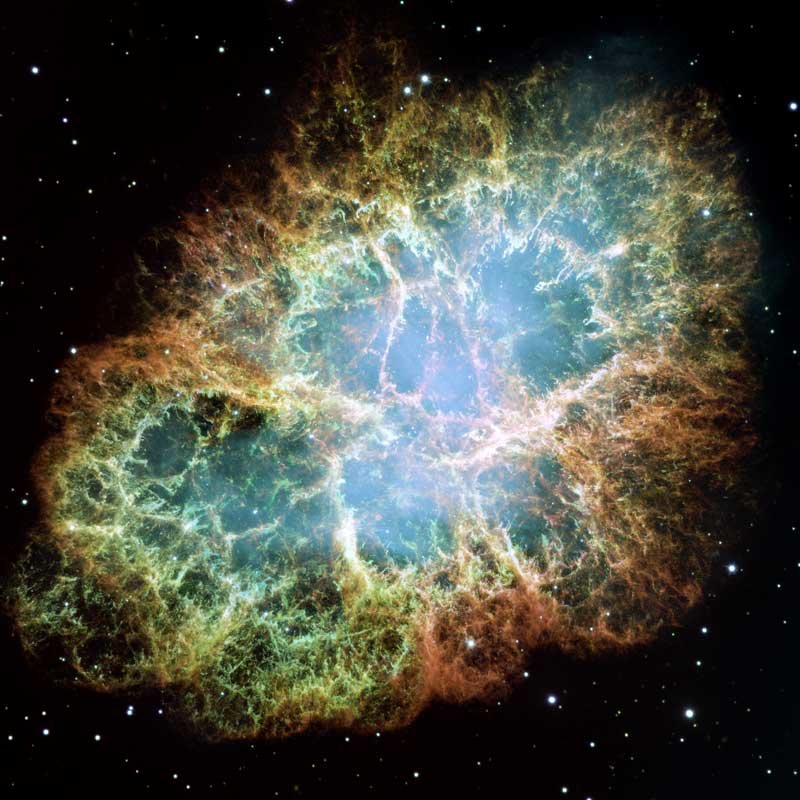
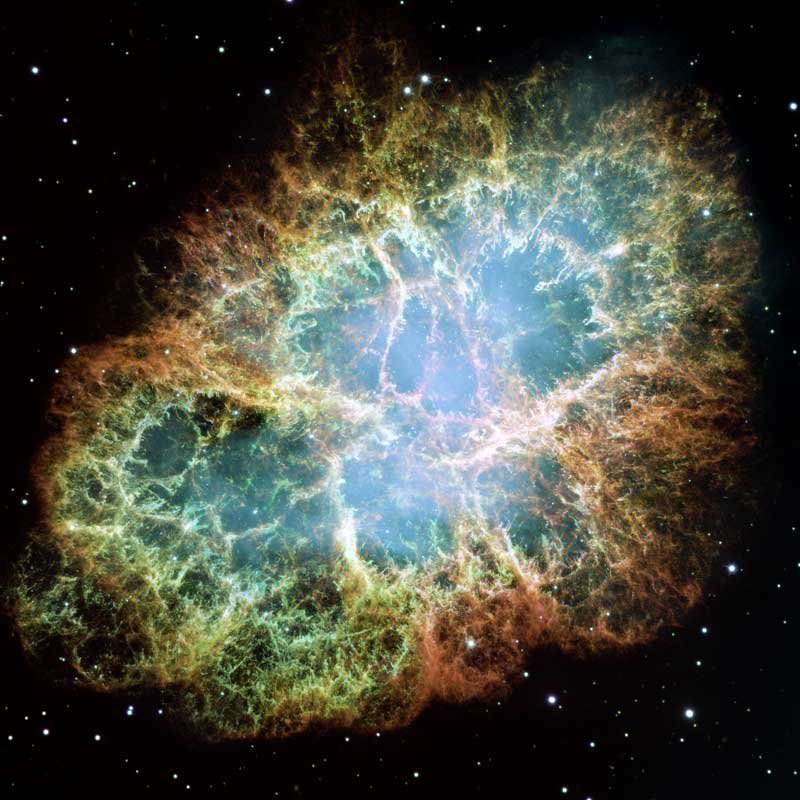
© NASAThe Crab Nebula, shown here in this image from NASA’s Hubble Space Telescope, is the expanding cloud of gas and dust left after a massive star exploded as a supernova in 1054. Supernovae propel a star’s innards back into space while creating new radioactive isotopes such as iron-60. Credit: NASA, ESA, J. Hester and A. Loll
Outer space touches us in so many ways. Meteors from ancient asteroid collisions and dust spalled from comets slam into our atmosphere every day, most of it unseen. Cosmic rays ionize the atoms in our upper air, while the solar wind finds crafty ways to invade the planetary magnetosphere and set the sky afire with aurora. We can't even walk outside on a sunny summer day without concern for the Sun's ultraviolet light burning out skin.
So perhaps you wouldn't be surprised that over the course of Earth's history,
our planet has also been affected by one of the most cataclysmic events the universe has to offer: the explosion of a supergiant star in a Type II supernova event. After the collapse of the star's core, the outgoing shock wave blows the star to pieces, both releasing and creating a host of elements. One of those is iron-60. While most of the iron in the universe is iron-56, a stable atom made up of 26 protons and 30 neutrons,
iron-60 has four additional neutrons that make it an unstable radioactive isotope.If a supernova occurs sufficiently close to our Solar System, it's possible for some of the ejecta to make its way all the way to Earth. How might we detect these stellar shards? One way would be to look for traces of unique isotopes that could only have been produced by the explosion. A team of German scientists did just that. In a paper published earlier this month in the
Proceedings of the National Academy of Sciences, they report the detection of iron-60 in biologically produced nanocrystals of magnetite in two sediment cores drilled from the Pacific Ocean.















Comment: Original headline: "Women are 'genetically programmed to have affairs'". Who writes these things? If this statement were true, all women would have affairs. They all don't, obviously. As usual, mainstream science gives us some interesting data, but leaves out all the actual humanity. 'Evolved for' doesn't imply that it we should behave in certain ways, nor does it mean we cannot do otherwise. After all, we also 'evolved for' the ability to choose our own behavior based on considerations other than what our gonads tell us to do.