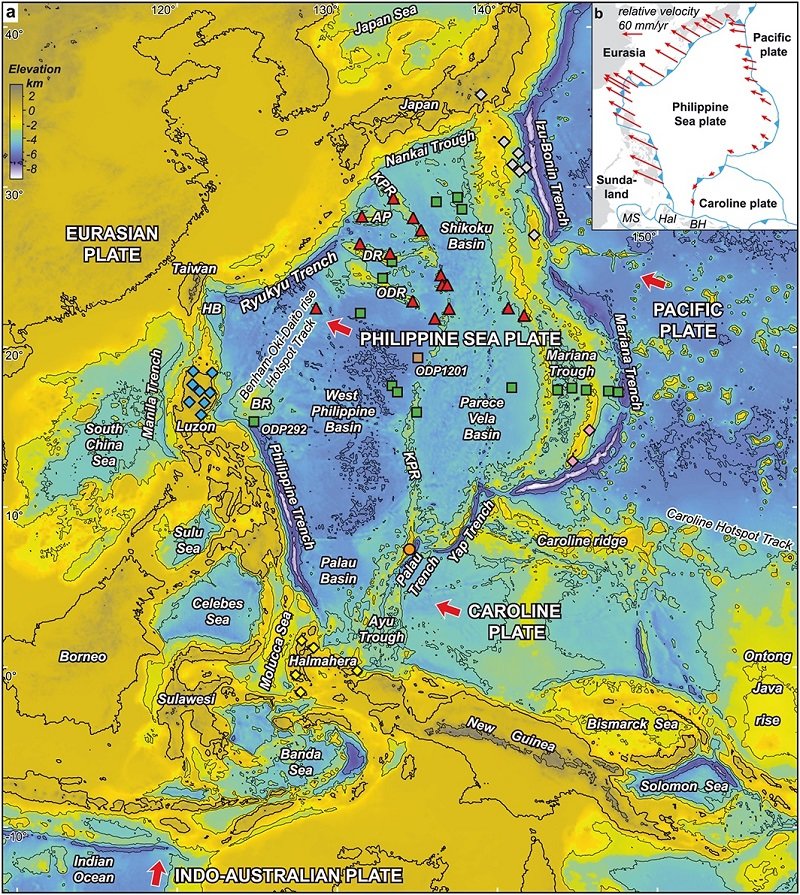
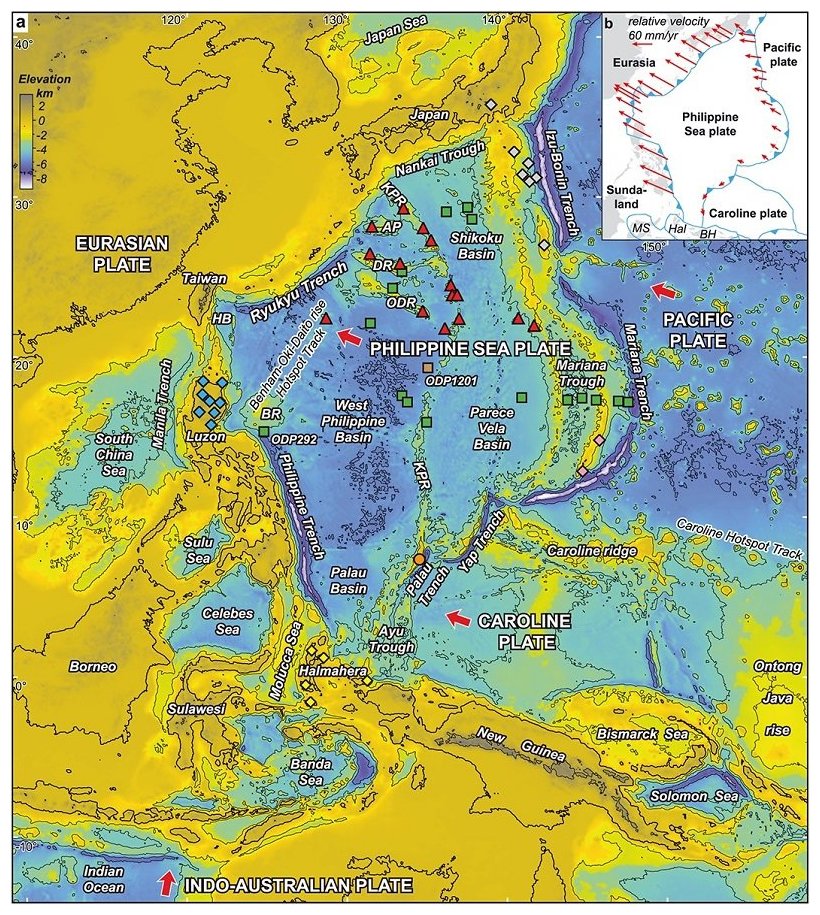
© Journal of Geophysical ResearchPresent-day Philippine Sea and East Asian tectonic setting.
Using images constructed from earthquake data, geoscientists have developed a method for resurrecting a "slab graveyard" of tectonic plate segments buried deep within the Earth,
unfolding the deformed rock into what it may have looked like up to 52 million years ago. This helped the researchers identify the previously unknown East Asian Sea Plate, where an ancient sea once existed in the region shortly after dinosaurs went extinct.
The Philippine Sea lies at the juncture of several major
tectonic plates. The Pacific, Indo-Australian and Eurasian plates frame several smaller plates, including the Philippine Sea Plate, which researchers say has been migrating northwest since its formation roughly 55 million years ago.
In the process, the Philippine Sea Plate collided with the northern edge of the East Asian Sea Plate, driving it
into the Earth's mantle. The southern area of the East Asian Sea Plate was eventually subducted by, or forced beneath, other neighboring plates, the researchers said.
Geologists attempting to reconstruct the past were once limited to visible evidence of slow-moving changes, such as mountains, volcanoes or the echoes of ancient waterways. But with new imaging technologies, scientists can now glean information from hundreds of miles within the Earth's interior to map distant history.















Comment: It probably beats the dying canary.