Science & TechnologyS


Question

Strange signals coming from deep in space 'probably' aliens, scientists say

earth
© Terry W. Virts / NASA
Scientists have heard hugely unusual messages from deep in space that they think are coming from aliens.

A new analysis of strange modulations in a tiny set of stars appears to indicate that it could be coming from extraterrestrial intelligence that is looking to alert us to their existence.

The new study reports the finding of specific modulations in just 234 out of the 2.5 million stars that have been observed during a survey of the sky. The work found that a tiny fraction of them seemed to be behaving strangely.

And there appears to be no obvious explanation for what is going on, leaving the scientists behind the paper to conclude that the messages are coming from aliens.

"We find that the detected signals have exactly the shape of an [extraterrestrial intelligence] signal predicted in the previous publication and are therefore in agreement with this hypothesis," write EF Borra and E Trottier in a new paper. "The fact that they are only found in a very small fraction of stars within a narrow spectral range centered near the spectral type of the sun is also in agreement with the ETI hypothesis," the two scientists from Laval University in Quebec write.

Comment: Related articles:


Telescope

Jupiter's stripes go deep, and other surprises from NASA's Juno probe

Jupiter
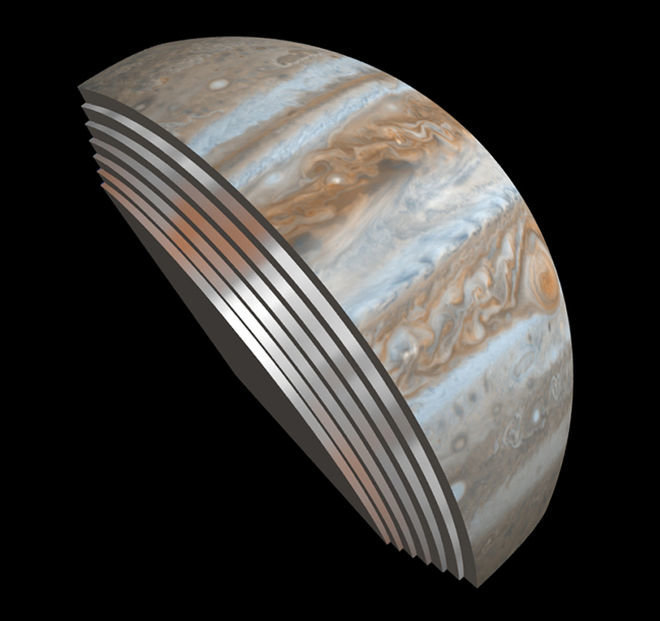
© NASA/JPL-Caltech/SwRI/GSFC This composite image depicts Jupiter's cloud formations as seen through the eyes of Juno's microwave radiometer (MWR) instrument as compared to the top layer, a Cassini imaging science subsystem image of the planet. The MWR can see a couple of hundred miles into Jupiter's atmosphere with the instrument's largest antenna. The belts and bands visible on the surface are also visible in modified form in each layer below.
Jupiter's stripes are more than skin deep, according to observations by NASA's Juno probe, which has revealed many new surprises about the Jovian giant.

Juno arrived at the Jupiter system in July. On Aug. 27, the probe made a close flyby of the planet, during which, the science team was supposed to calibrate Juno's instruments and get familiar with the intense environment around Jupiter, according to Juno principal investigator Scott Bolton. But the encounter proved more fruitful than expected.

Jupiter's bold, colorful stripes are clouds, and optical light can't penetrate them to see what's underneath. However, Juno is carrying microwave instruments that can each probe those clouds to different depths; together, these instruments can effectively peel back the clouds like layers of an onion. An artist's impression based on the microwave data reveals a striking feature: Some of the stripes are visible deep into the cloud layers.

Telescope

Mysterious flaring X-ray objects in nearby galaxies may represent a new class of explosive cosmic event

Centaurus A
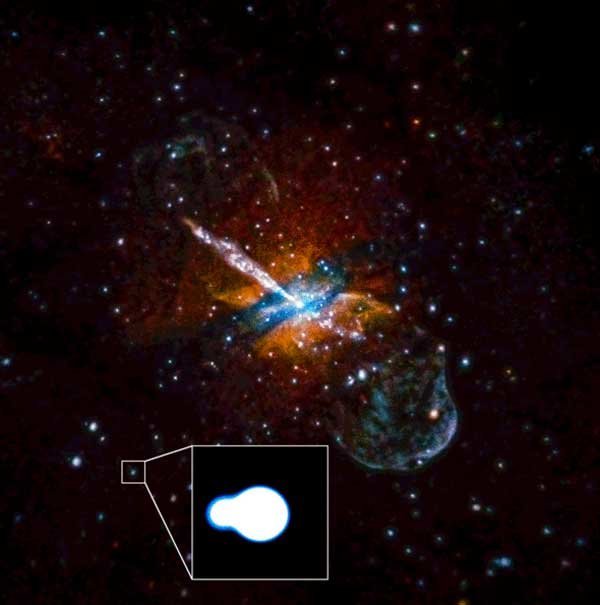
© NASA/CXC/UA/J.Irwin et al.In this Chandra X-ray Observatory image of NGC 5128 (also known as Centaurus A), low, medium, and high-energy X-rays are coloured red, green, and blue. Five flares were detected from the source located near NGC 5128, which is at a distance of about 14 million light-years from Earth. A movie showing the average change in X-rays for the three flares with the most complete Chandra data, covering both the rise and fall, is shown in the inset.
Astronomers have found a pair of extraordinary cosmic objects that dramatically burst in X-rays. This discovery, obtained with NASA's Chandra X-ray Observatory and ESA's XMM-Newton observatory, may represent a new class of explosive events found in space.

The mysterious X-ray sources flare up and become about a hundred times brighter in less than a minute, before returning to original X-ray levels after about an hour. At their peak, these objects qualify as ultraluminous X-ray sources (ULXs) that give off hundreds to thousands of times more X-rays than typical binary systems where a star is orbiting a black hole or neutron star.

"We've never seen anything like this," said Jimmy Irwin of the University of Alabama, who led the study that appears in the latest issue of the journal Nature. "Astronomers have seen many different objects that flare up, but these may be examples of an entirely new phenomenon."

Galaxy

Milky Way galaxy mapped in incredible detail

Astronomers have mapped atomic neutral hydrogen across the entire sky, creating an unprecedented portrait of our galaxy and some of its nearest neighbors.
Galaxy
© HI4PI CollaborationThis map depicts the radiation from neutral atomic hydrogen (HI) across the entire sky, as seen by the Parkes and Effelsberg radio telescopes. Our galaxy, the Milky Way, appears as a luminous band across the sky with the Galactic Center in the middle. The Large and Small Magellanic Clouds are prominently visible in orange below the Galactic plane. They are surrounded by huge clouds of gas, forcefully disrupted from their hosts by gravitational interaction with the Milky Way. The HI emissions of the Andromeda galaxy (M31) and its neighbor, Triangulum (M33), are also easy to spot as bright purple ellipses in the lower left. The gas motion is color-coded to represent the gas's motion, and the visual brightness in the image relates to how much neutral hydrogen is present.
Hydrogen is the single most abundant element in the universe. The simple pairing of a proton and electron is so reactive that atomic hydrogen doesn't occur naturally on Earth — it reacts with itself or other elements to form molecules instead. But in the large, mostly empty space between stars floats a copious amount of neutral atomic hydrogen.

We only know it's there when the atom's lone electron very occasionally flips from an "up" state to a "down" state, releasing a single 21-centimeter radio wave. Modern radio telescopes can easily pick up the faint signal, which multiplies thanks to the wealth of hydrogen atoms. What's hard is to map that signal across the entire sky — and that's exactly what astronomers have done in unprecedented detail.

Using two of the world's largest fully steerable radio dishes, the 100-meter Effelsberg dish near Bonn, Germany, and the 64-meter Parkes dish west of Sydney, Australia, astronomers have generated a survey they've dubbed HI4PI. Pronounced "hi four pie," the survey refers to the abbreviation for neutral hydrogen (HI) and the geometrical reference to the whole sky (4PI, or 4π).

Saturn

Saturn's polar hexagon has mysteriously changed colors

Saturn hex changes color
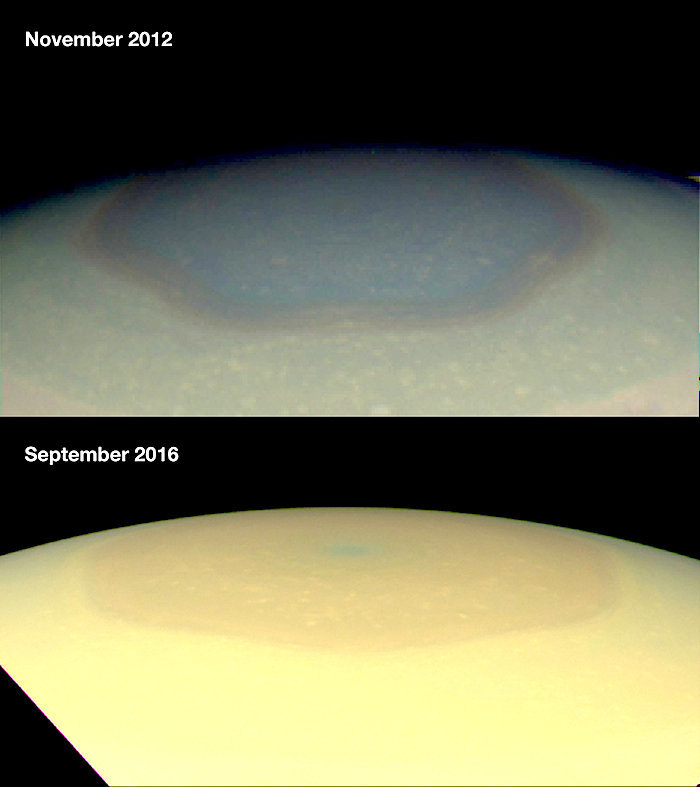
© NASASaturn's polar hexagon changes color from 2012 to 2016.
It's like nothing we've seen on any other planet in the entire Universe, and now the mysterious structure on Saturn's north pole just got even weirder. In just four years, Saturn's hexagon has changed its colour from blue to gold. So far, our best guess as to why this change occurred is that this is what it looks like when Saturn's north pole gears up for next year's summer solstice.

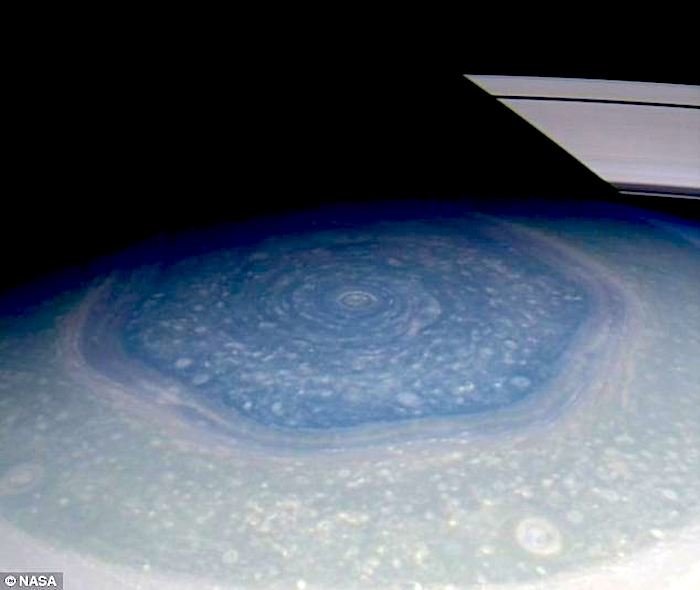
Discovered almost 30 years ago, Saturn's hexagon is a six-sided structure that spans roughly 32,000 km (20,000 miles) in diameter, and extends about 100 km (60 miles) down into the planet's dense atmosphere. As observed by NASA's Voyager and Cassini spacecraft, each point of the hexagon appears to rotate at its centre at nearly the same rate that Saturn rotates on its axis. Along the rim of the hexagon, a jet stream of air is blasting eastward at speeds of 321 km/h (200 mph).

Saturn hexagon
© NASA
Based on its size and movements, scientists have concluded that it's a vast cloud pattern generated by a gigantic, perpetual hurricane spinning at the centre of the planet's north pole. Scientists estimate that this storm has been raging for decades - maybe even centuries.

While we're pretty confident that we know what Saturn's hexagon is, the big mystery is how it got there in the first place. Once you have a giant whirlpool of air, it's relatively easy to keep it spinning - but the force you need to get it wound up in the first place is a whole lot more difficult to explain. "Scientists have bandied about a number of explanations for the hexagon's origin," says Charles Q. Choi from Space.com. "For instance, water swirling inside a bucket can generate whirlpools possessing holes with geometric shapes. However, there is of course no giant bucket on Saturn holding this gargantuan hexagon."

Now we've got something else to explain - how the Cassini spacecraft could have observed two completely different colours in the hexagon between November 2012 and September 2016. Here's more of the false colour hexagon:


Clipboard

A Long Road to the Epigenome

DNA broken
The link between DNA and disease is by now obvious. But it's also obscure. A zillion moving parts go into disorders like cancer and Alzheimer's disease, and only a comparative few are known for sure.

Researchers believe something called the Epigenome Roadmap a cascade of two dozen papers published last year is gradually changing that. The Roadmap is a catalog of the millions of epigenetic switches that control gene action. It's pretty clear that epigenetics is key to really understanding disease as well as normal human traits. Eventually, that is; nailing down those connections is going to take time.

For one thing, disease mutations and other DNA variations, it turns out, are hardly ever where you would expect them to be: in genes that make the proteins that run the show. Ninety percent of disease-related mutations are in the regions of DNA that lie outside those genes, the regulatory regions that control protein-coding gene action. The working hypothesis is that variation in disease susceptibility - or any other trait - depends mostly on subtle differences in the expression of protein-coding genes, which is under epigenetic control.

Mutations associated with Alzheimer's disease, in a surprising and immediately practical finding among those new papers, turned out to be active not so much in brain cells, where you might expect activity. Instead, they altered epigenomic activity in cells of the immune system.

Laptop

Could synthetic DNA be the future of data storage?

dna data storage computers
© Getty ImagesIn an age of gargantuan, power-sucking data centers, the space-saving potential of data stored in DNA is staggering.
How a synthetic version of our genetic code could become the world's most efficient hard drive

A quick riddle: What do 100 works of classic literature, a seed database from the nonprofit Crop Trust and the Universal Declaration of Human Rights have in common? All of them were recently converted from bits of digital data to strands of synthetic DNA. In addition to these weighty files, researchers at Microsoft and the University of Washington converted a high-definition music video of "This Too Shall Pass" by the alternative rock band OK Go. The video is an homage to Rube Goldberg-like contraptions, which bear more than a passing resemblance to the labyrinthine process of transforming data into the genetic instructions that shape all living things.

This recent data-to-DNA conversion, completed in July, totaled 200 megabytes—which would barely register on a 16-gigabyte iPhone. It's not a huge amount of information, but it bested the previous DNA storage record, set by scientists at Harvard University, by a factor of about 10. To achieve this, researchers concocted a convoluted process to encode the data, store it in synthetic DNA and then use DNA sequencing machines to retrieve and, finally, decode the data. The result? The exact same files they began with.

Which raises the question: Why bother?

Microscope 1

Scientists discover bizarre two-headed shark embryo

two headed shark
© onlinelibrary.wiley.com
Scientists have discovered what they believe could be the first two-headed embryo among egg-laying shark species. The embryo, which is growing in a Spanish lab, also has multiple hearts, stomachs, and livers.

While there have been previous instances when sharks have given birth to two-headed pups, researchers believe this may be the first two-headed shark embryo from the Galeus atlanticus family.

Scientists suspect the deformation is a result of genetics, but are hopeful the discovery will provide insight into the rare condition known as dicephaly - a term which refers to two-headed animals.

The Spanish scientists published their findings in the Journal of Fish Biology, and detailed the catshark's fascinating body, which included two heads - each with its own mouth - a set of eyes, a brain, gill openings, two hearts, and two sets of stomachs and livers. Despite the duplicate organs, the catshark had just one intestine.

R2-D2

Most of our history is 'the history of stupidity': Stephen Hawking lectures about artificial intelligence

stephen hawking
© Martin Hoscik/ShutterstockStephen Hawking
In a lecture at the University of Cambridge this week, Stephen Hawking made the bold claim that the creation of artificial intelligence will be "either the best, or the worst thing, ever to happen to humanity".

The talk was celebrating the opening of the new Leverhulme Centre of the Future of Intelligence, where some of the best minds in science will try to answer questions about the future of robots and artificial intelligence - something Hawking says we need to do a lot more of.

"We spend a great deal of time studying history," Hawking told the lecture, "which, let's face it, is mostly the history of stupidity."

But despite all our time spent looking back at past errors, we seem to make the same mistakes over and over again.

"So it's a welcome change that people are studying instead the future of intelligence," he explained.

Comment: Video on Hawking's remarks:


Cassiopaea

Bright new nova discovered in Sagittarius

A nova in Sagittarius, discovered a few nights ago by a Japanese amateur, has become bright enough to see in binoculars.
New Nova
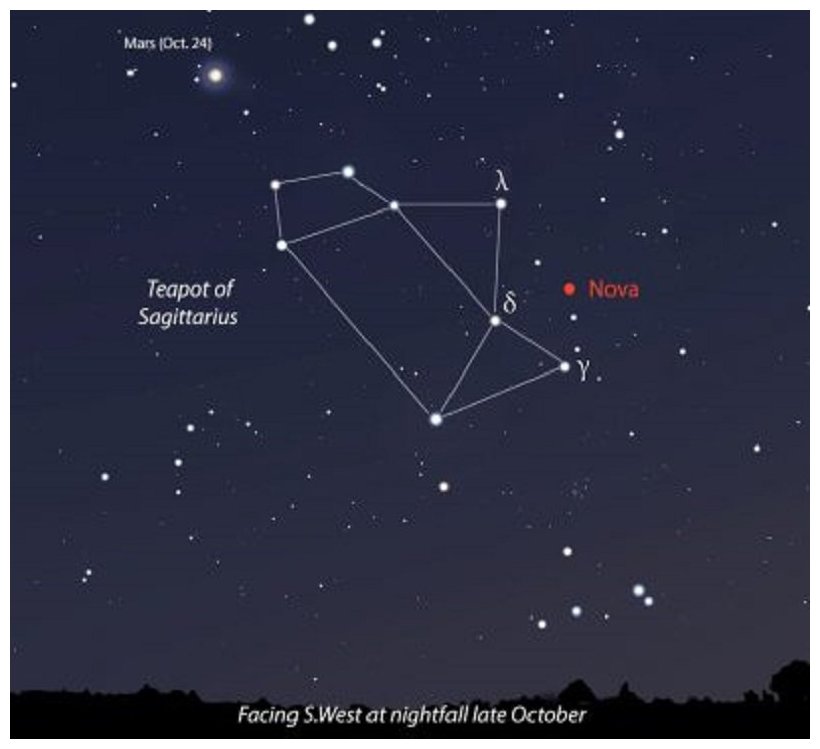
© StellariumThis map shows the sky facing southwest in late twilight for observers across the central U.S. and southern Europe. The 8th-magnitude nova (exaggerated here!) lies just above the spout of the Sagittarius Teapot, at right ascension 18h 10m 28s, declination –27° 29′ 59″. It has been temporarily dubbed TCP J18102829-2729590 accordingly.
Just in the nick for time — at least for northern observers — a bright nova has been discovered in Sagittarius. I say "nick of time" because the constellation is sinking in the southwestern sky right after dusk, affording only a short viewing window from mid-northern latitudes. But a window it is, and there's still time to snatch a view of this amazing stellar explosion. Just make sure to look right after the end of twilight. That means about an hour and a half after your local sunset time.
Spout stars
© StellariumI've labeled the two bright 'spout stars' in this more detailed map, which shows stars to about magnitude 9.5. This will get you very close. To continue to the nova, use the more detailed chart below.
Well-known nova hunter Koichi Itagaki of Japan nabbed the "new star" on October 20th, using a 180-mm telephoto lens to take sky-patrol photos. At the time it was only about 11th magnitude. But within two days, the star shot up an additional three magnitudes and now shines brighter than 8.0. That puts it within range of 50-mm binoculars and any telescope you might have.