Science & TechnologyS


Cow Skull

Using gene editing - scientists develop a hornless Holstein dairy cow

dairy cows
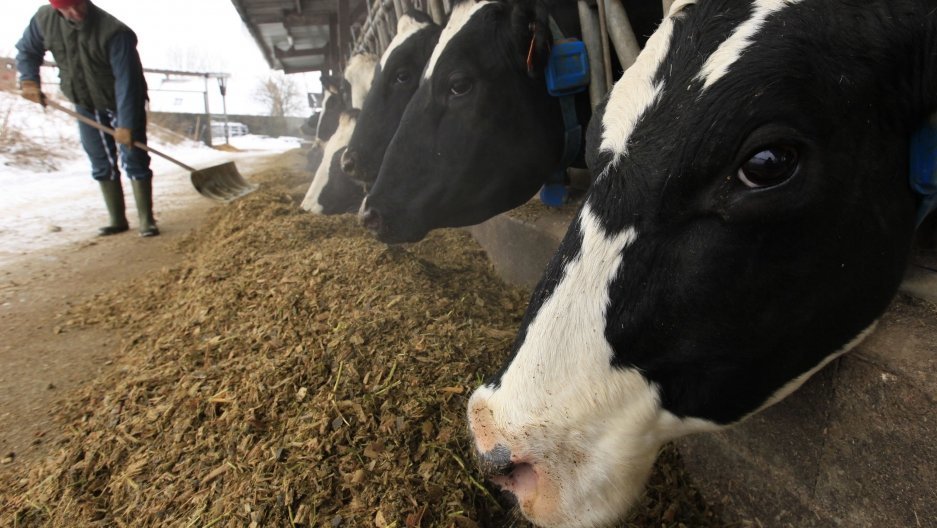
© Pascal Rossignol/ReutersThrough "genetic editing," Holstein cows, whose horns are usually removed on farms, will be born hornless.
If you've visited a dairy farm, you may have noticed that the cows — usually Holsteins — are hornless. They weren't born that way: Both female and male Holsteins naturally grow horns. But on farms, the horns of dairy calves are often removed (an unpleasant process for the animals), so that the cattle won't pose a threat to one another, or the farmworkers handling them.

Now, a team of researchers at the University of California-Davis has come up with another way to remove the horns. By swapping in a gene from the naturally hornless (polled) Angus breed, the researchers created hornless Holsteins that are born that way. Is the polled Holstein a new type of cow — a genetically modified organism? Or are researchers just speeding up the breeding process?

"To me, this is precision breeding as much as anything," says Alison Van Eenennaam, an animal geneticist at UC Davis who led the research. "We're able to introduce a desired genetic variant [into Holsteins] very precisely, without affecting any of the other genetics that makes them great milk-producing animals."

Comment: The overlooked threats of gene editing
In reality, all genetic editing, especially when it alters the genetic material of subsequent generations, represents a potential threat to the genetic heritage of the entire planet with potential consequences we may still not fully understand. In a world where the "science is final" regarding humanity's impact on the planet's climate, demanding "urgent action" to stop or reverse it, the absence of a similar impetus behind stopping the contamination of our planet's genetic heritage seems suspiciously hypocritical if not utterly reckless and even intentional.

Of course, gene editing will be done, with or without the approval of governments and the people they govern. However, measures should be developed and put in place to preserve the natural genetic heritage of the planet, and such measures should be decentralized as much as possible.


Blue Planet

Cosmic-ray detector finds possible crack in Earth's magnetic shield

Life itself has Earth's magnetosphere to thank, but as the latest research suggests, it's not a fail-safe shield.
Geomagnetic storms
© NASA/UPI Geomagnetic storms can trigger incredible light shows. Here, charged particles can be seen exciting the gas in the upper atmosphere of the northern hemisphere.
The world's largest, most sensitive cosmic-ray detector has identified a potential crack in Earth's magnetic field.

The weakness was revealed by a burst of galactic cosmic rays, detected by GRAPES-3 during a severe geomagnetic storm in June 2015. The storm as triggered by a plasma cloud ejected from the sun's corona.

It was one of the largest geomagnetic storms in recent history, generating an intense aurora borealis and thwarting radio communication systems among the most northern latitudes. The storm was strong enough to compress Earth's magnetosphere for several hours.

Satellite

NASA'S new asteroid alert system gives 5 days of warning

Asteroid hitting earth
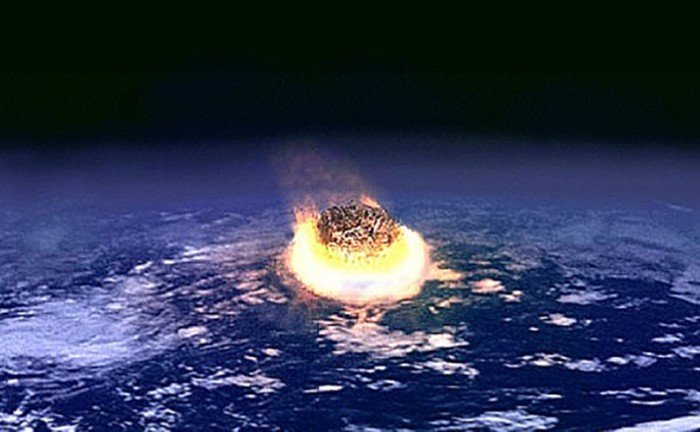
© Artist's illustration: NASAA huge asteroid impacting Earth would be catastrophic, but we may face a greater danger from more numerous, smaller asteroids.
Everyone knows it was a large asteroid striking Earth that led to the demise of the dinosaurs. But how many near misses were there? Modern humans have been around for about 225,000 years, so we must have come close to death by asteroid more than once in our time. We would have had no clue.

Of course, it's the actual strikes that are cause for concern, not near misses. Efforts to predict asteroid strikes, and to catalogue asteroids that come close to Earth, have reached new levels. NASA's newest tool in the fight against asteroids is called Scout. Scout is designed to detect asteroids approaching Earth, and it just passed an important test. Scout was able to give us 5 days notice of an approaching asteroid.

Here's how Scout works. A telescope in Hawaii, the Panoramic Survey Telescope & Rapid Response System (Pan-STARRS) detected the asteroid, called 2016 UR36, and then alerted other 'scopes. Three other telescopes confirmed 2016 UR36 and were able to narrow down its trajectory. They also learned its size, about 5 to 25 meters across.

Comment:


Galaxy

Fascinating similarity between human cells and neutron stars discovered

astronomy supernova
© NASA
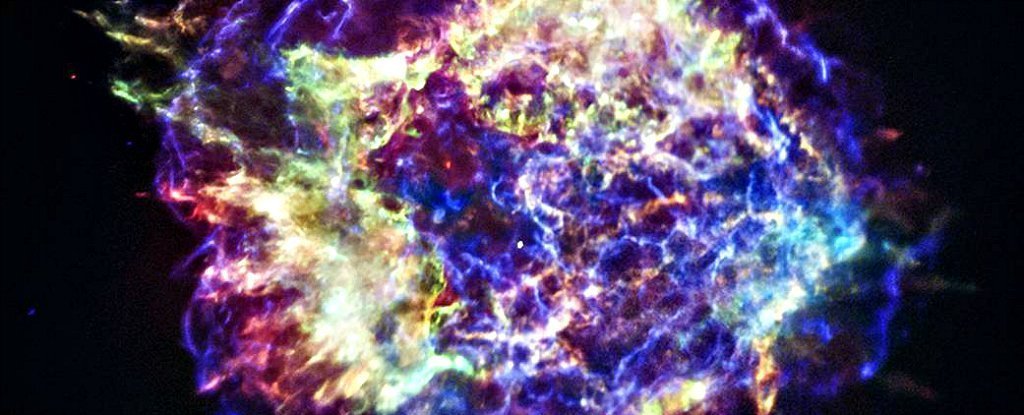
Our link to the stars.

If you were to compare yourself to a neutron star, you probably wouldn't find very many things in common. After all, neutron stars - celestial bodies with super strong magnetic fields - are made from collapsed star cores, lie light-years away from Earth, and don't even watch Netflix.

But, according to new research, we share at least one similarity: the geometry of the matter that makes us.

Researchers have found that the 'crust' (or outer layers) of a neutron star has the same shape as our cellular membranes. This could mean that, despite being fundamentally different, both humans and neutron stars are constrained by the same geometry.

"Seeing very similar shapes in such strikingly different systems suggests that the energy of a system may depend on its shape in a simple and universal way," said one of the researchers, astrophysicist Charles Horowitz, from Indiana University, Bloomington.

Satellite

NASA's most advanced telescope finally completed after 20 years

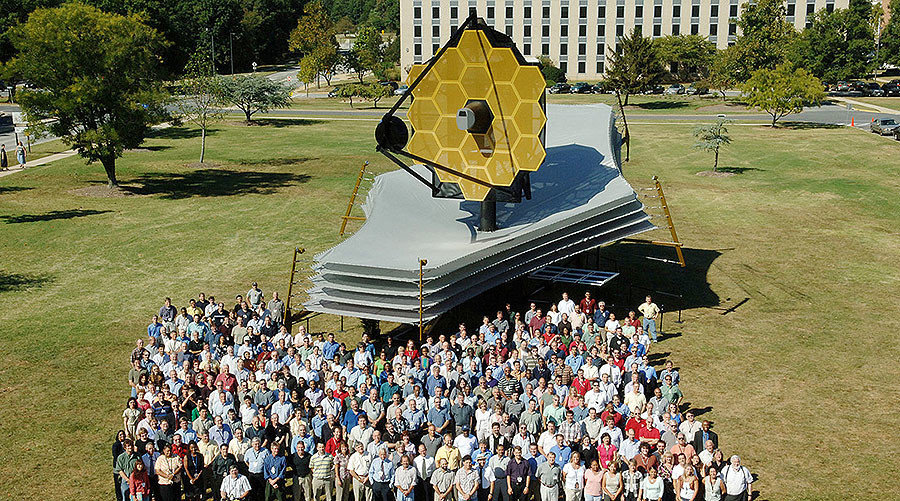
Early full-scale model on display at NASA Goddard
© Wikipedia
The James Webb Space Telescope (JWST) has finally been unveiled at NASA. The fruit of 20 years' labor, its 18 mirrors will peer further into space than any existing ground or space-based telescopes.

More than 20 years has been spent developing the machine, with its dazzling signature honeycomb look. The mirrors will correct infrared light and peer further into space than any of its contemporaries, including the Hubble Space Telescope, which the JWST succeeds.

"Today, we're celebrating the fact that our telescope is finished, and we're about to prove that it works," senior project scientist John Mather was cited by Space.com as saying on November 2, as the device was unveiled at NASA's Goddard Space Center in Maryland. "We've done two decades of innovation and hard work, and this is the result - we're opening up a whole new territory of astronomy."

Robot

Researchers show how smart appliances are vulnerable to remote hacking

remote hacking
© seyalr / YouTube
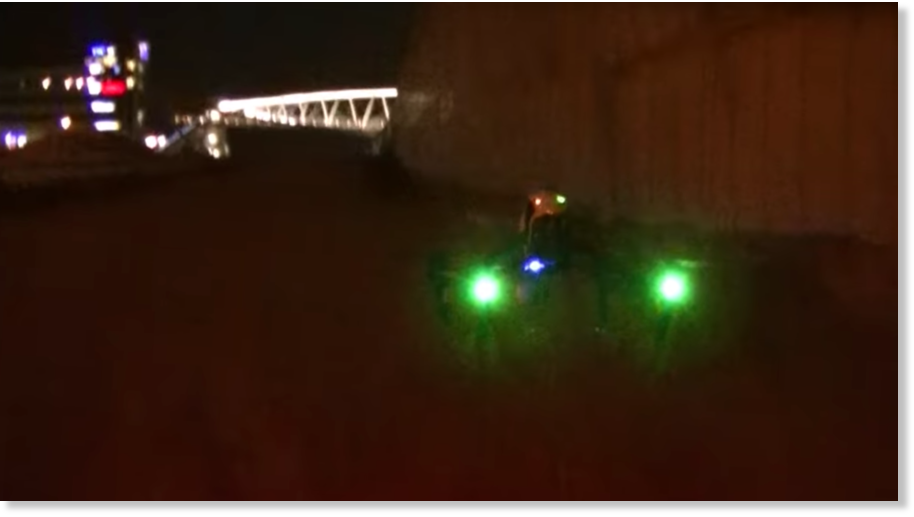
International researchers have demonstrated how simple it is to hack into internet-connected appliances, often called the 'Internet of Things.' As connected devices proliferate around the world, so does the risk of hacking attacks and disruptions.

Last month's massive distributed denial-of-service (DDOS) attack crashed or slowed down scores of major internet providers and services across the US. No information was compromised, but the disruption affected popular services such as Twitter and Spotify. The hacking group that claimed responsibility says it was a demonstration of vulnerability.

A new paper from cyber-security researchers at Israel's Weizmann Institute of Science and Canada's Dalhousie University shows that malicious hackers could cause a "nuclear chain reaction" by hacking into 'smart' lightbulbs or other popular IoT household devices.

"The attack can start by plugging in a single infected bulb anywhere in the city, and then catastrophically spread everywhere within minutes, enabling the attacker to turn all the city lights on or off, permanently brick them, or exploit them in a massive DDOS attack,"wrote Eyal Ronen, Colin O'Flynn, Adi Shamir and Achi-Or Weingarten in the paper, titled IoT Goes Nuclear: Creating a ZigBee Chain Reaction.


Hardhat

Oil production may have caused several of California's major earthquakes in early 20th century

1933 earthquake los angeles, oil production earthquakes
Southern California suffered a number of big earthquakes in the early 1900s, a pattern that prompted experts to declare the state an earthquake hazard. But new work shows some of the biggest temblors might have been caused by oil and gas production, not nature. The finding could ultimately change scientists' predictions for earthquakes in the Los Angeles Basin, and how well they understand man-made, or "induced," earthquakes around the country.

It is challenging enough for scientists to determine whether a modern-day quake is natural or induced, and even more so for one that occurred a hundred years ago. The tools they now use to measure earthquakes were not as sophisticated back then, and historic records are limited. So researchers Susan Hough and Morgan Page at the U.S. Geological Survey relied on a combination of old scientific surveys, crude instrumental data and newspaper accounts to piece together details of quakes in the early 20th century. "It's not as precise as having seismic data, but that doesn't mean it's hopeless," Hough says.

Robot

Scientists create robo-scavengers to clean up contaminated water

flesh eating robot
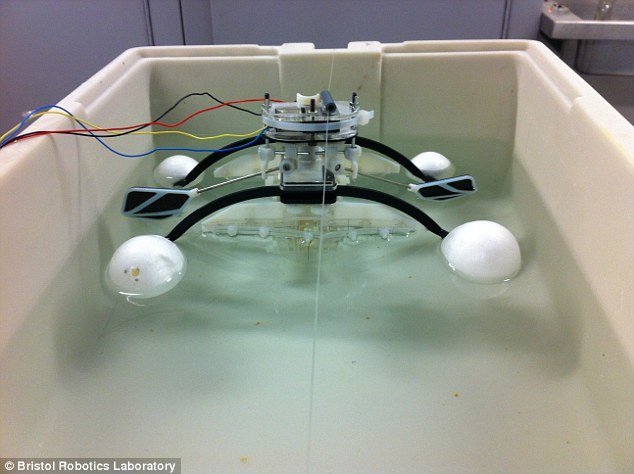
A robot developed by British robotics engineers can sustain itself by consuming living matter from its environment (pictured). The soft robot is capable of consuming organic material for energy, effectively digesting living things.
It may not be a living, breathing robot, but UK researchers have created something pretty close.

Robotics experts has developed a soft robot capable of consuming organic material for energy, effectively creating a machine which digests living things.

The hope is that such self-sustaining robo-scavengers could be used to mop up contaminated water or algal blooms, which choke out life.

Developed by a team of engineers based in Bristol, the machine is able to gain the energy it needs to keep it 'alive' from its watery surrounding.

According to New Scientist, the design imitates basic marine creatures called salps, simple, transparent tube-like creatures which filter the water for living scraps.

Microscope 2

Scientists engineer spinach to detect explosives with embedded carbon nanotubes

mit spinach bomb
© Massachusetts Institute of Technology (MIT) / YouTube
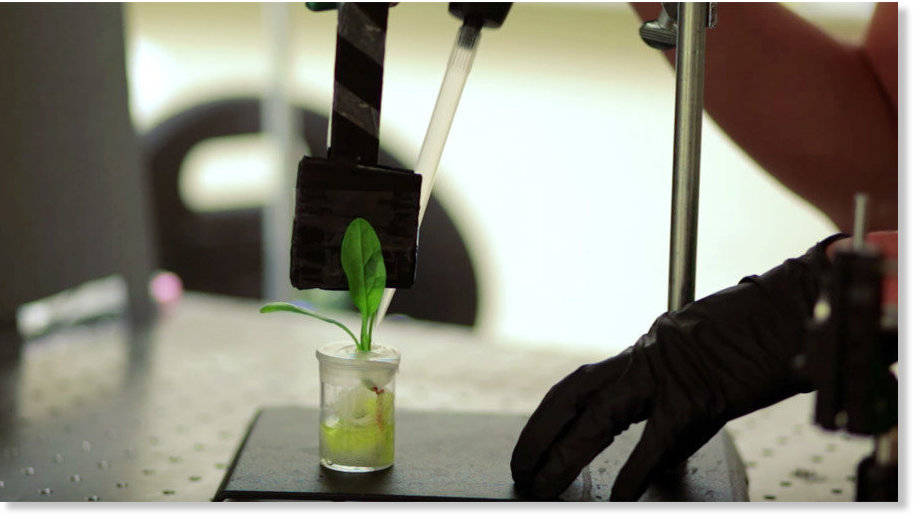
Popeye knew the secret of spinach's superpowers, and now scientists do too. MIT researchers have found out this leafy green can detect explosives and even be turned it into a bomb-sniffing machine that works wirelessly through a smartphone.

"We demonstrate that living spinach plants (Spinacia oleracea) can be engineered to serve as self-powered pre-concentrators and auto samplers of analytes in ambient groundwater and as infrared communication platforms that can send information to a smartphone," researchers said in a paper published in Nature Materials.

To do so, they literally embedded tiny cylinders of carbon, or carbon nanotubes as they are called, in leaves of spinach. They also painted them with a solution full of the tiny sensors, which were then absorbed.

Those carbon tubes can detect "nitroaromatics," chemical compounds often used in landmines and other explosives. For the experiment, sensors for nitroaromatic compounds were embedded into a part of the plant, where most photosynthesis takes place.


Arrow Up

Woman blind for seven years regains ability to see shapes and colors with bionic eye implant

bionic eye implant
© Aban Tech / YouTube
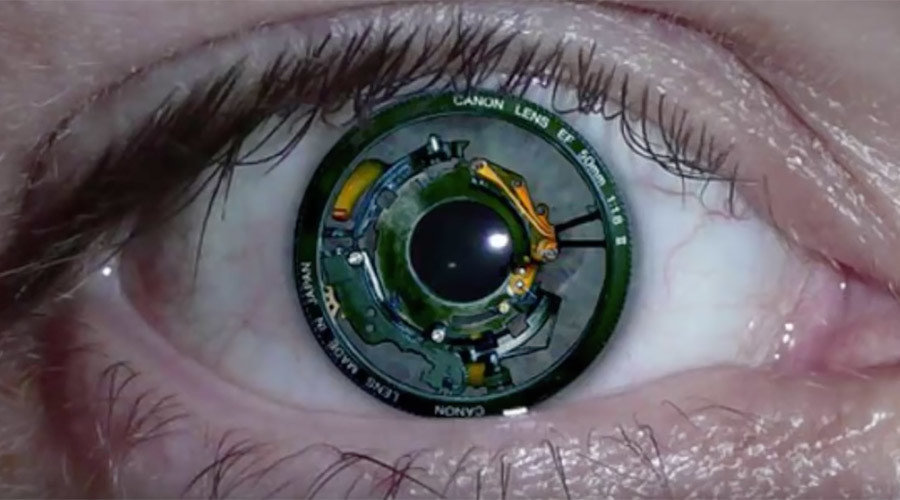
Scientists may have made a significant breakthrough in restoring human sight, as a woman who had been blind for seven years has regained the ability to see shapes and colours with a bionic eye implant.

The 30-year-old woman had a wireless visual stimulator chip inserted into her brain by University of California, Los Angeles (UCLA) surgeons in the first human test of the product. As a result, she could see colored flashes, lines, and spots when signals were sent to her brain from a computer.

Comment: Bionic eye lets blind man see again