Science & TechnologyS


Magnify

Epigenetic inheritance mechanisms: Experiences leave behind epigenetic traces in our DNA

epigenetic traces
© Swiss National Science Foundation
An ideological dispute is taking place in biology. And it's about a big topic that's central to everything: heredity. In his epoch-making book On the Origin of Species of 1859, Darwin wrote of the reigning ignorance about how differences between individuals come about. It was only with 'modern evolutionary synthesis' in the 1940s that people became convinced that heredity functions through genetics - in other words, that the characteristics of living creatures are passed on to the next generations through their genetic substance, DNA.

This perspective was helpful in providing a focus for research in the ensuing decades, which brought about extraordinary discoveries. As a result, many aspects of the form and function of living creatures can now be explained. But already in the 1950s, different observations called into question the seemingly exclusive control of the genes. For example, maize kernels can have different colors even if their DNA sequence is identical.

Attention

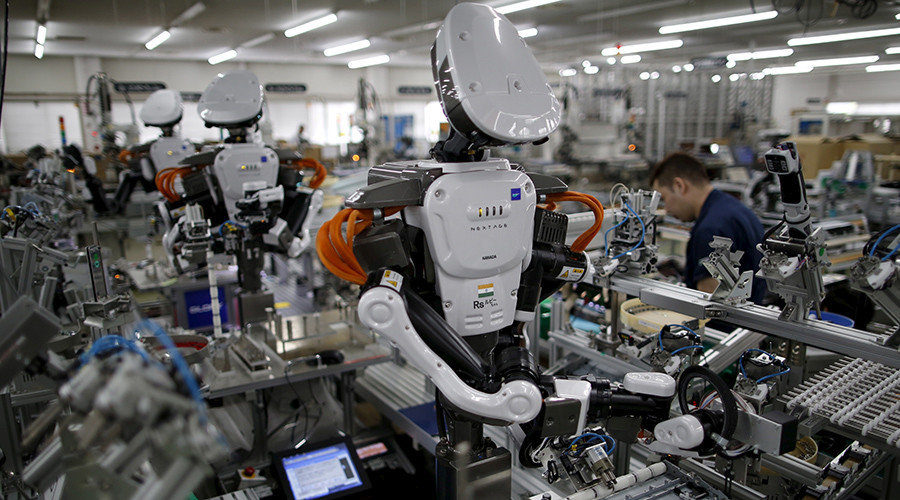
Artificial intelligence could replace almost half of U.S. jobs over the next 20 years

Robots
© Issei Kato / Reuters / Reuters
Automation through robots and other artificial intelligence could affect nearly half of all US jobs, a report from the Obama administration has found. Education and job-training programs could prevent the sea change from destroying the American economy.

Scientists and economic advisers within the executive branch studied the potential effects of artificial intelligence on the US workforce and economy over the next 20 years, as well as ways to prevent the technological advances from automation from potentially destroying job opportunities for Americans ‒ which they said it could, for up to 47 percent of jobs. Rather, the authors sought to guide the government's automation policy to create better economic opportunities for the country as a whole.

"These transformations will open up new opportunities for individuals, the economy, and society, but they have the potential to disrupt the current livelihoods of millions of Americans," the 55-page report said. "Whether AI leads to unemployment and increases in inequality over the long-run depends not only on the technology itself but also on the institutions and policies that are in place."

The authors compared use of AI to how the Industrial Revolution introduced mass production to the economy, which negatively affected the livelihoods of skilled craftsman, as well as to the rise of computers in the workplace, which benefited white-collar workers.

"Output per hour rose [in the 19th Century] while inequality declined, driving up average living standards, but the labor of some high-skill workers was no longer as valuable in the market," they wrote. "The advent of computers and the Internet raised the relative productivity of higher-skilled workers."

Solar Flares

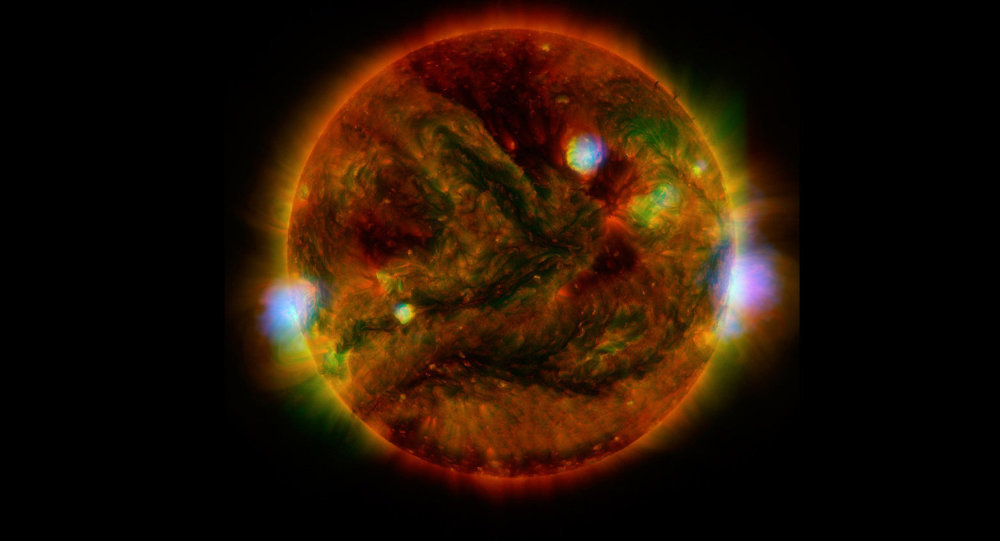
Christmas Solar Storm Threatens Earth's Electrical Infrastructure

solar storm
© NASA/JPL-Caltech/GSFC/JAXA
A solar storm will send extraordinary displays of colorful lights through the skies of northern countries, but may interfere with electrical equipment and power supplies.

Solar storms, also called geomagnetic storms, occur when plasma, the superheated matter that makes up the sun, is blown outward from our star to create a stream of supercharged particles, sometimes referred to as the solar wind. If the supercharged particles are pulled into Earth's magnetic field, the atoms react, causing a solar storm. This can cause interference in devices powered with electricity, and also create awe-inspiring atmospheric displays known as aurorae.

Aurorae are most frequently seen at Earth's magnetic poles, the Arctic and Antarctica, but a solar storm can greatly extend their reach. Space-weather forecasters say that Michigan, Maine, Alaska, Canada, Scandinavia, Scotland, and Northern England all stand a good chance of seeing aurorae in the night sky over the next two days.

Comment: Research suggests that powerful solar storms may be more common than previously thought. But while such 'space weather events' do in fact present the dangers as described, and may quite probably occur, it seems just as likely that 'space weather events' has become a euphemistic description for the destruction caused by neo's, meteors, comets, etc. - which have their own electrical properties. Whatever the case, being prepared for such an eventuality (and others in the offing) seems like a very good idea! See also:


Comet 2

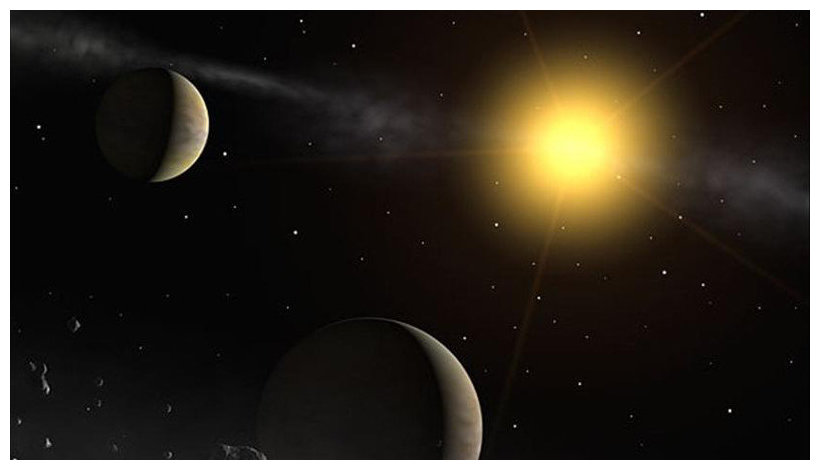
Incoming star Gliese 710 could spawn swarms of comets when it passes our Sun

Gliese 710
© ESOArtist’s impression of Gliese 710, a sun-like star that will travel through our Solar System’s Oort Cloud in about 1.3 million years.
For years, scientists have known that Gliese 710 will come excruciatingly close to our Solar System in about a million years. An updated analysis suggests this star will come considerably closer than we thought, during which time it's expected to spawn dangerous cometary swarms.

Gliese 710 is currently 64 light-years from Earth, but for all intents and purposes, it's heading straight for us. A new study published in the journal Astronomy and Physics projects the close encounter will happen about 1.35 million years from now, and that the star will come within 13,365 AU of our sun (where 1 AU is equal to the average distance of the Earth to the sun), or 1.2 trillion miles. At that distance, it would take light 77 days to reach the Earth.

That's obviously far, but not in cosmological terms. That distance is well within the Solar System's Oort Cloud—a large bubble of ice and rock that surrounds the sun to a distance as far as 50,000 to 200,000 AU. So while Gliese 710 is sure to avoid a direct hit with any object in the inner Solar System, it'll likely travel through the Oort Cloud. And with its tremendous gravitational influence (it's about 60 percent the size of our sun), it'll perturb the many large rocks currently sitting idle way out there in the outer reaches. This star is poised to send a shower of comets into the inner Solar System, possibly causing a serious impact event with Earth.

Info

Simulated Babies Meant to Scare Teens Out of Having Kids is Backfiring

Robot babies
Two out of three U.S. school districts buy infant simulators, but new research shows the automaton newborns simply don't work.

Fifteen-year-old Shaila Dominguez dreaded the thought of taking her baby out in public, but it was a rare day when she didn't have work or school or both, and Christmas was fast approaching. So on an overcast December afternoon in Rapid City, S.D., she strapped the baby into its animal-print car seat, swung by Taco John's to pick up her paycheck, and made her way to the nearest Walmart.

In the toy aisle, Shaila picked out a robotic turtle for her 4-year-old cousin, with whom she shares a room in their aunt's single-wide trailer. Seconds after she paid the cashier, the baby began to cry, so Shaila perched the car seat on a vacant checkout counter and swapped a green diaper for a yellow one. An elderly man with long white hair approached in a motorized wheelchair. Shaila had draped a blanket to shield the baby from view. Without asking, the man used his thumb and two forefingers to peel it back for a glimpse. "They still make 'em that small!" he said, laughing, and rolled away.

Shaila, who has a pretty, round face and big brown eyes that she makes look bigger with a catlike swoop of black liner, froze in a nervous half-smile. "I don't know if he thinks I'm weird because it's fake, or if he thinks it's real," she said. "I'm so confused. I don't know what to think!"

Comment: See also: Science fiction or new reality? - Sex and marriage with robots


Robot

Science fiction or new reality? - Sex and marriage with robots

Sexbots
© Agence France-Presse
Sex with robots is "just around the corner", an expert told a global conference in London this week featuring interactive sex toys and discussions on the ethics of relationships with humanoids.

"Sexbots" are a staple of science fiction -- the idea of robots as sex partners is explored, for instance, in recent films and television series like Ex-Machina and Westworld.

But some specialists believe the first animated lovers made of metal, rubber and plastic, programmed to provide sexual bliss, will take a step into reality just months from now.

"Sex with robots is just around the corner, with the first sexbots coming... some time next year," artificial intelligence expert David Levy told the International Congress on Love and Sex with Robots at Goldsmiths, University of London.

US California-based company Abyss Creations next year will start marketing sex robots that are billed as life-like, with the ability to talk and move like humans.

Ultimately, Levy said, people should entertain the thought of marriage with robots as early as 2050.

The conference in London showcased some of the latest developments in robotic sex toys, such as gadgets which allow couples to kiss, no matter how far apart they are.

The "Kissenger", (derived from the word Kiss+Messenger) which attaches to your mobile phone, contains sensors to detect the pressure of a kiss and transmit it to your partner's device in real time. It has been under development for several years.

Now students at Tokyo's Keio University are developing the "Teletongue", aimed at providing "remote oral interaction" and designed to be "kinky", according to co-creator Dolhathai Kaewsermwong.

It allows couples to send licking sounds and sensations through cyberspace using a "lollipop", creating an "immersive experience", she explained.


Comment:
A Robot Bride by 2050?

Bye-bye humanity: Futurologist predicts that by 2050 more humans will have sex with robots than with each other


Nebula

NASA releases spectacular image of diffuse nebula NGC 6357

Nebula NGC 6357
© X-ray – NASA / CXC / PSU / L.Townsley et al; optical – UKIRT; infrared – NASA / JPL-Caltech.This composite image of NGC 6357 contains X-ray data from NASA’s Chandra X-ray Observatory and the ROSAT telescope (purple), infrared data from NASA’s Spitzer Space Telescope (orange), and optical data from the SuperCosmos Sky Survey (blue) made by the United Kingdom Infrared Telescope.
NASA has released an amazing composite image of NGC 6357, a region where radiation from hot, young stars is energizing the surrounding gas and dust. This composite contains X-ray data from NASA's Chandra X-ray Observatory as well as infrared and optical data.

Also known as the Lobster Nebula and the War and Peace Nebula, NGC 6357 is a diffuse nebula.

It is located in the constellation Scorpius, approximately 5,500 light-years away.

NGC 6357 is actually a 'cluster of clusters,' containing at least three clusters of young stars, including many hot, massive, luminous stars.

Astronomers call NGC 6357 and other objects like it 'HII' regions.

An HII region is created when the radiation from hot, young stars strips away the electrons from neutral hydrogen atoms in the surrounding gas to form clouds of ionized hydrogen.

Info

Researchers solve mystery of London's 1952 killer fog - and it might help China's air pollution

London's 1952 killer fog
A killer fog blanketed London in December 1952, killing as many as 12,000 people and puzzling researchers for decades. Texas A&M researchers believe they have solved the mystery.
Few Americans may be aware of it, but in 1952 a killer fog that contained pollutants covered London for five days, causing breathing problems and killing thousands of residents. The exact cause and nature of the fog has remained mostly unknown for decades, but an international team of scientists that includes several Texas A&M University-affiliated researchers believes that the mystery has been solved and that the same air chemistry also happens in China and other locales.

Texas A&M researcher Renyi Zhang, University Distinguished Professor and the Harold J. Haynes Chair of Atmospheric Sciences and Professor of Chemistry, along with graduate students Yun Lin, Wilmarie Marrero-Ortiz, Jeremiah Secrest, Yixin Li, Jiaxi Hu and Bowen Pan and researchers from China, Florida, California Israel and the UK have had their work published in the current issue of Proceedings of the National Academy of Sciences (PNAS).

In December of 1952, the fog enveloped all of London and residents at first gave it little notice because it appeared to be no different from the familiar natural fogs that have swept over Great Britain for thousands of years.

But over the next few days, conditions deteriorated, and the sky literally became dark. Visibility was reduced to only three feet in many parts of the city, all transportation was shut down and tens of thousands of people had trouble breathing. By the time the fog had lifted on Dec. 9, at least 4,000 people had died and more than 150,000 had been hospitalized. Thousands of animals in the area were also killed.

Recent British studies now say that the death count was likely far higher - more than 12,000 people of all ages died from the killer fog. It has long been known that many of those deaths were likely caused by emissions from coal burning, but the exact chemical processes that led to the deadly mix of fog and pollution have not been fully understood over the past 60 years.

Jet5

China prepares secretive H-20 strategic stealth long range bomber

China’s secretive H-20 bomber jet
© Youtube/arronlee33
China's secretive H-20 bomber is well on its way to becoming a fully developed next-generation strategic stealth aircraft, but not in the near future.

A Chinese admiral said that China and the rest of the world must be patient while waiting for the H-20 to be launched.

China has not yet produced an operational, large-tonnage bomber aircraft capable of hitting long-range targets. Nevertheless, a host of technologies that Beijing expects the "legendary" aircraft to carry, including cruise missiles and nuclear arms, "are all in place," Rear Admiral Yin Zhuo of the People's Liberation Army said, ripening the conditions for the country's development of a stealth bomber.

Snowflake

Winter solstice turning point: It's supposed to get better from here

winter solstice
© U.S. Naval Observatory, NOAA
Here comes the cold and dark: The winter solstice, the day of the year with the least amount of daylight in the Northern Hemisphere, occurs early Wednesday morning. The solstice happens at the same instant everywhere on Earth. In the U.S., it happens at 5:44 a.m. EST Wednesday (or 4:44 a.m. CT, 3:44 a.m. MT and 2:44 a.m. PT). After the solstice, the amount of daylight slowly starts to get longer again each day.

The winter solstice is the exact moment that the Northern Hemisphere is tilted the farthest it ever gets from the sun. During the Northern Hemisphere's winter, the land north of the equator is tilted away from the sun. This lowers the amount of the sun's warming energy that reaches Earth, hence, winter!

It's the opposite in the Southern Hemisphere, where Dec. 21 marks the beginning of astronomical summer. On the winter solstice, all places south of the equator have more than 12 hours of daylight, while all locations north of the equator have less than 12 hours of daylight, AccuWeather said.

One of the most famous solstice celebrations occurs at the ancient Stonehenge ruins in Wiltshire, England, where druids, pagans and other revelers gather each year to celebrate the event. The winter and summer solstices, along with the equinoxes, loom large in myth and folklore. "Culturally, the solstices and equinoxes are typically used to denote either the beginnings of the seasons or the center points of the seasons," as in England, says Rick Kline, with the Spacecraft Planetary Imaging Facility at Cornell University in Ithaca, N.Y. "Christmas, Hanukkah, Kwanzaa and other holidays have arisen out of the solstices, equinoxes and the midpoints between them," he said. ...