Science & TechnologyS


Blue Planet

Scientists discover Earth's inner core isn't just slowing down — it's also changing shape

earth core extended image
© forplayday/Getty ImagesEarth's core does not rotate at a consistent rate, and now scientists have discovered its shape may change too.
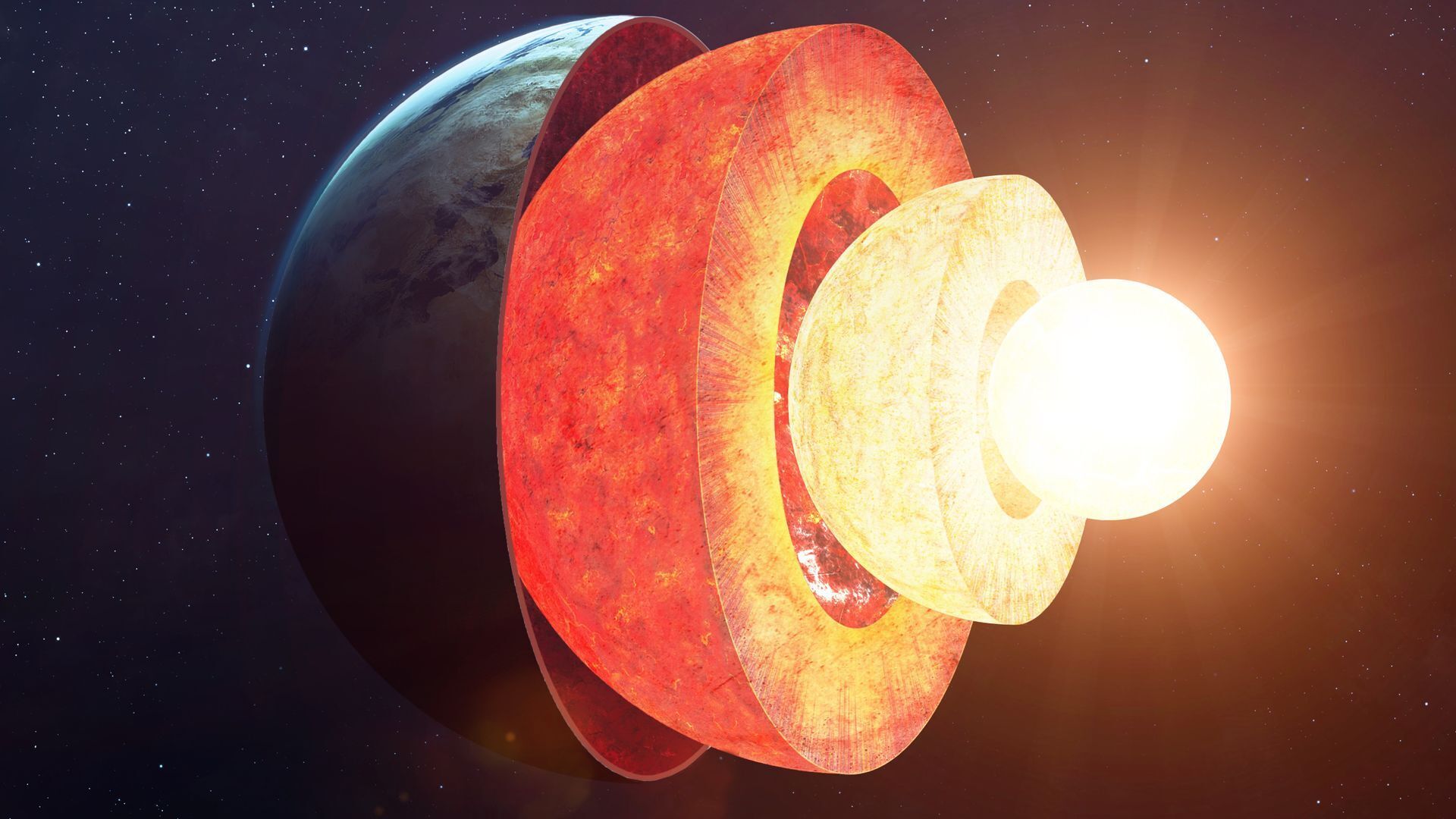
The surface of Earth's inner core may be shape-shifting, new research suggests.

The study, published Feb. 10 in the journal Nature, looked at earthquake waves that have skimmed the edge of the inner core, 3,200 miles (5,150 kilometers) deep. It revealed that, even when the core had rotated into a previously observed position, there were often subtle differences.

These differences suggest that the inner core's surface, while solid, could be quite changeable over short periods.

"The most likely thing is the flow in the outer core is stirring up the outermost inner core a little bit and changing the topography," said John Vidale, the leader of the study and a seismologist at the University of Southern California Dornsife.

The outer core is molten metal — mostly iron and nickel. It cushions the solid inner core, which is also mostly iron and nickel. Each year, a tiny bit of the liquid outer core crystallizes and adds to the solid inner core, which is growing at a rate of about a millimeter per year.


Comment: Further reading:


Brain

Elon Musk put a chip in this paralysed man's brain. Now he can move things with his mind. Should we be amazed - or terrified?

Arbaugh
© Steve Craft/The Guardian/adevarul.roNoland Arbaugh, the first human recipient of Neuralink's brain chip
An accident left Noland Arbaugh paralysed, but Musk's Neuralink brain implant allows him to control computers with his thoughts. Is it a life-changing innovation that could help millions - or the start of a dystopia where a billionaire can access our thoughts?

Noland Arbaugh's life changed in a fraction of a second in June 2016. He was a 22-year-old student, working at a kids' summer camp in upstate New York, when he went swimming in a lake. He can't tell me exactly what happened, but thinks one of his friends must have accidentally struck him very hard in the side of his head as they ran into the water and plunged beneath the surface.

When he woke up face down in the water, unable to move or breathe, Noland immediately knew he was paralysed. But he didn't panic. He felt no fear at all, he says.
"You never know what you're going to do in those high-stress situations. I found out that day that it's hard to shake me. I am very, very calm under pressure."
Elon Musk would ultimately turn this quality to his advantage when, after nearly eight years of being quadriplegic, Noland agreed to allow the world's richest man to implant an electronic chip into his brain. In January 2024, Noland became the first human recipient of a brain-computer interface (BCI) developed by Musk's company, Neuralink. If it worked, it would allow him to control a computer using only the power of his mind.

Microchip

Rutgers undergrad upends a 40-year-old data science conjecture

computer hash table graphic
© Nash Weerasekera for Quanta Magazine“Tiny pointers,” which show the way to a piece of stored data, inspired the creation of a new kind of faster hash table.
A young computer scientist and two colleagues show that searches within data structures called hash tables can be much faster than previously deemed possible.

Introduction

Sometime in the fall of 2021, Andrew Krapivin, an undergraduate at Rutgers University, encountered a paper that would change his life. At the time, Krapivin didn't give it much thought. But two years later, when he finally set aside time to go through the paper ("just for fun," as he put it), his efforts would lead to a rethinking of a widely used tool in computer science.

The paper's title, "Tiny Pointers," referred to arrowlike entities that can direct you to a piece of information, or element, in a computer's memory. Krapivin soon came up with a potential way to further miniaturize the pointers so they consumed less memory. However, to achieve that, he needed a better way of organizing the data that the pointers would point to.

Cassiopaea

Astronomers investigate the evolution of a newly detected supernova

SN 2024jlf
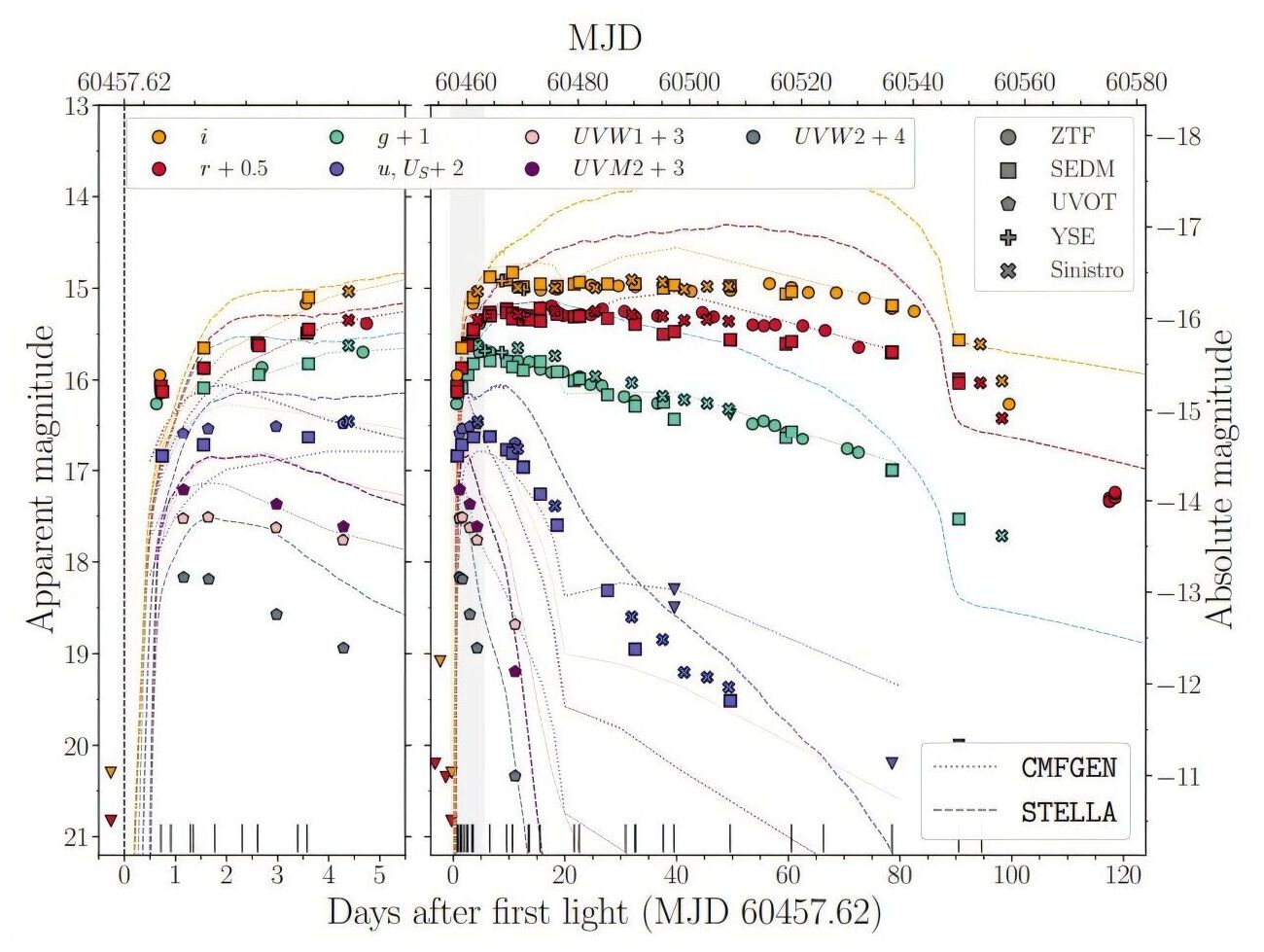
© arXiv (2025). DOI: 10.48550/arxiv.2501.18686Multi-band light curve of SN 2024jlf and best fit model light curves.
An international team of astronomers has investigated a newly detected Type II supernova designated SN 2024jlf. The new study, detailed in a paper published Jan. 30 on the arXiv pre-print server, yields important information regarding the evolution of this supernova and the nature of its progenitor.

Type II supernovae (SNe) are the results of rapid collapse and violent explosion of massive stars (with masses above 8.0 solar masses). They are distinguished from other SNe by the presence of hydrogen in their spectra.

Based on the shape of their light curves, they are usually divided into Type IIL and Type IIP. Type IIL SNe show a steady (linear) decline after the explosion, while Type IIP exhibit a period of slower decline (a plateau) that is followed by a normal decay.

SN 2024jlf was first spotted on May 28, 2024 using the Zwicky Transient Facility (ZTF), with a brightness of 15.88 mag. The supernova occurred in NGC 5690 — an edge-on spiral galaxy at a redshift of 0.0058.

Subsequent observations of SN 2024jlf after its discovery have revealed that its spectrum shows a blue continuum with weak flash features, indicating a young core-collapse supernova of Type II. A search for the progenitor of SN 2024jlf has also been conducted. However, no source has been identified in the location of this supernova.

Bulb

AI, Green Energy, & The Science Problem

AI, Green Energy, & The Science Problem
While most people were distracted by China's new flavors of AI, something even bigger was happening.

China's EAST experimental fusion reactor ran at temps 6X hotter than sun's core for almost 18 whole minutes, doubling its previous record.

Well, who cares??

You do! More people are realizing that current "Green Energy" push isn't all it's cracked up to be, and fusion reactors could provide nearly infinite energy with no radioactive waste.

But the most interesting thing is the curious link between AI and fusion, and what it says about technology itself...

Telescope

Astronomers discover 'Quipu', the single largest structure in the known universe

supercluster
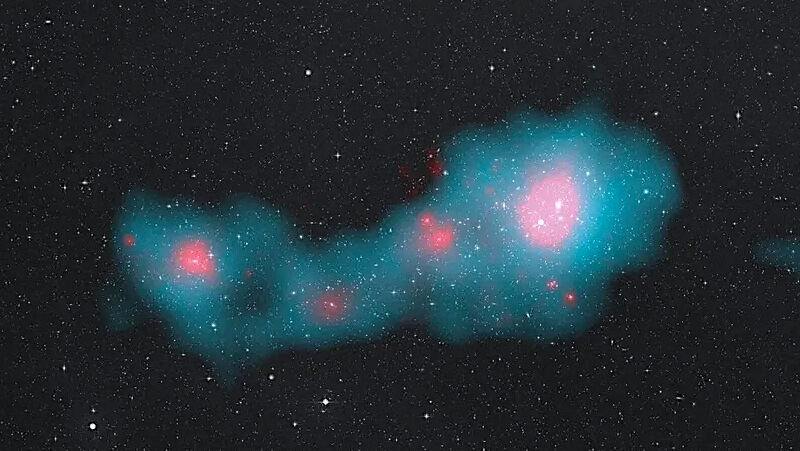
© ESA & Planck Collaboration/Rosat/Digitised Sky SurveyThe Shapley supercluster was one of five giant structures detected in a new study of the local universe. Previously regarded as the largest superstructure in space, it has now been eclipsed by at least four others, including Quipu.
Astronomers have discovered what may be the largest-scale structure in the known universe — a group of galaxy clusters and clusters of galaxy clusters that spans roughly 1.3 billion light-years across and contains a mind-boggling 200 quadrillion solar masses.

The newfound structure is dubbed Quipu after an Incan system of counting and storing numbers using knots on cords.

Like a Quipu cord, the structure is complex, made up of one long filament and multiple side filaments. It spans roughly 1.3 billion light-years (more than 13,000 times the length of the Milky Way), potentially making it the largest object in the universe in terms of length, beating out previous record-holders such as the Laniākea supercluster.

The discovery was shared in a new paper posted on the preprint website ArXiv on Jan. 31. (The paper has not yet been published in a peer reviewed journal, but has been accepted by the journal Astronomy and Astrophysics.)

"Quipu is actually a prominent structure readily noticeable by eye in a sky map of clusters in the target redshift range, without the help of a detection method," the team wrote in the paper.

Satellite

JWST surprises the world with colliding neutron star discovery

neutron star heavy elements
© ESO/L. Calçada/M. KornmesserThe Universe itself, through a variety of nuclear processes involving stars and stellar remnants, as well as other means, can naturally copiously produce nearly 100 elements of the periodic table. Neutron star mergers are known to produce the heaviest elements, such as gold, in great abundances, but the neutron star merger rate observed by LIGO is too low, at present, to explain the observed abundances of gold and other similar elements today. It's possible that long-period gamma-ray bursts are also caused by merging neutron stars, which would then bring the predicted vs. observed abundances back into agreement.
From LIGO, there weren't enough neutron star-neutron star mergers to account for our heavy elements. With a JWST surprise, maybe they can.

Key Takeaways
  • In 2017, two neutron stars collided just 140 million light-years away: sending both light and gravitational wave signals for us to observe.
  • When we examined the remnant of this event spectrally, we discovered an enormous number of heavy elements, indicating that the heaviest elements were likely produced by these cataclysms.
  • In all the time since, we've never seen another such event directly, throwing the idea that neutron star collisions make the heaviest elements into doubt. But thanks to JWST, the idea is back on the table as our #1 option.
Where do the heaviest elements in the Universe come from? If you were like most astrophysicists during the 20th century, you might've said from supernova explosions: stellar cataclysms that occur either within the cores of massive stars or from stellar corpses (white dwarfs) that undergo destructive, energy-releasing events that trigger a rapid succession of nuclear fusion reactions. Unfortunately, a comprehensive study of these classes of events — including both type II (core-collapse) and type Ia (exploding white dwarf) supernovae — showed that, although they do produce large sets of fusion reactions, they really only produce elements up to about zirconium (element #40) on the periodic table.

Frog

Darwinists are still dodging the main issue in the Cambrian Explosion

trilobite fossile cambrian explosion
© markchentx/iStockAn intriacately preserved fossil of Arctinurus Trilobite
Concerning the well-known and persistent problem of the Cambrian explosion, Stephen Meyer stated the issue as clearly and succinctly as possible in his best-selling book Darwin's Doubt: "the origin of new biological information" (p. ix). He has repeated this issue in videos, interviews, debates, articles and speeches before and after 2013, the book's publication date. Indeed, it was the central issue in Meyer's Smithsonian paper that led to Richard Sternberg's ouster in 2004. With scientists in the ID movement stating this issue continually for more than two decades, evolutionary biologists cannot claim ignorance of it. Yet to the present day, they dodge it. In three recent papers, we see how they talk about everything and anything but the issue: the origin of new biological information. Let's consider these papers in order of publication.

Molecular Clock Fiddling

Last November, Philip C. J. Donoghue of the University of Bristol (mentioned by Bechly here) with three colleagues struggled to calibrate the Ediacaran and Cambrian fossil record to the "molecular clock" hypothesis (see my discussion of the molecular clock here). Getting these two data sources to fit has been a pervasive challenge along the entire evolutionary timeline. The abstract of their paper in Science Advances1 claims success, but ends with a quizzical statement:

Comment:


Info

A warning from the trees

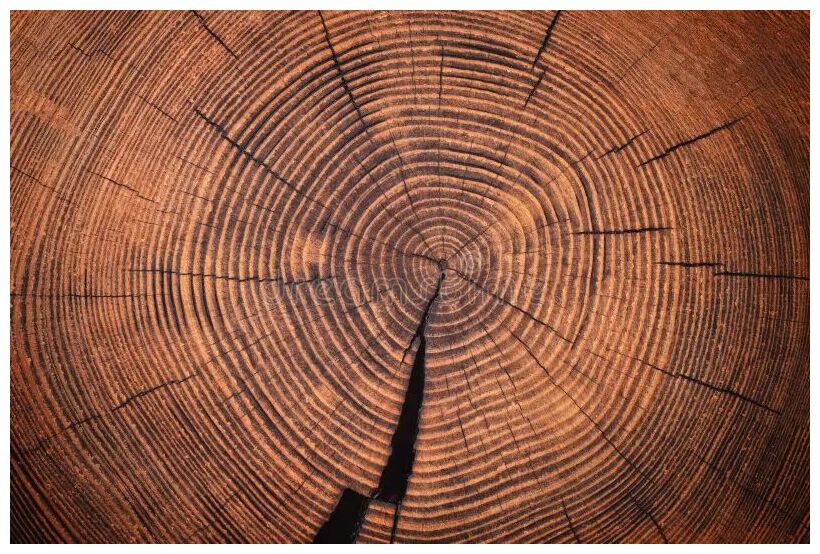
How bad can a solar storm be? Just ask a tree. Unlike human records, which go back hundreds of years, trees can remember solar storms for millennia.
Tree Rings
© Spaceweather
Nagoya University doctoral student Fusa Miyake made the discovery in 2012 while studying rings in the stump of a 1900-year-old Japanese cedar. One ring, in particular, drew her attention. Grown in the year 774-75 AD, it contained a 12% jump in radioactive carbon-14 (14C), about 20 times greater than ordinary fluctuations from cosmic radiation. Other teams confirmed the spike in wood from Germany, Russia, the United States, Finland, and New Zealand. Whatever happened, trees all over the world experienced it.

Most researchers think it was a solar storm — an extraordinary one. Often, we point to the Carrington Event of 1859 as the worst-case scenario for solar storms. The 774-75 AD storm was at least 10 times stronger; if it happened today, it would floor modern technology. Since Miyake's initial discovery, she and others have confirmed five more examples (12,450 BC, 7176 BC, 5259 BC, 664-663 BC, 993 AD). Researchers call them "Miyake Events."

Blue Planet

Scientists discover nearby 'super-Earth' that could sustain life

planet orbit
© Gabriel Pérez/IAC“It is among the closest Earth analogues we know about and given its peculiar orbit,” exclaimed Cretignier, who first detected the planet two years ago.
Are they exo terrestrials?

Mars is apparently not the only planet on our radar capable of sustaining life. UK researchers have confirmed the existence of a "super-Earth" located 20 light-years away that could reveal the existence of extraterrestrial beings, per a cosmic study published in the journal Astronomy & Astrophysics.

Dr. Michael Cretignier — a scientist with Oxford University, who first detected the potential interstellar oasis in 2022 — said in a press release:
"I'm now very enthusiastic to hear what other scientists can tell us about this newly discovered planet. Excitingly, its proximity with us - only 20 light-years - means there is hope for future space missions to obtain an image of it. It is among the closest Earth analogues we know about and given its peculiar orbit."
An international team then analyzed highly-precise measurements recorded over two decades by Chile's HARPS (High Accuracy Radial Velocity Planet Searcher) spectrograph and its successor ESPRESSO to confirm that the unidentified object was an exo-planet, defined as a planet located beyond our solar system.