
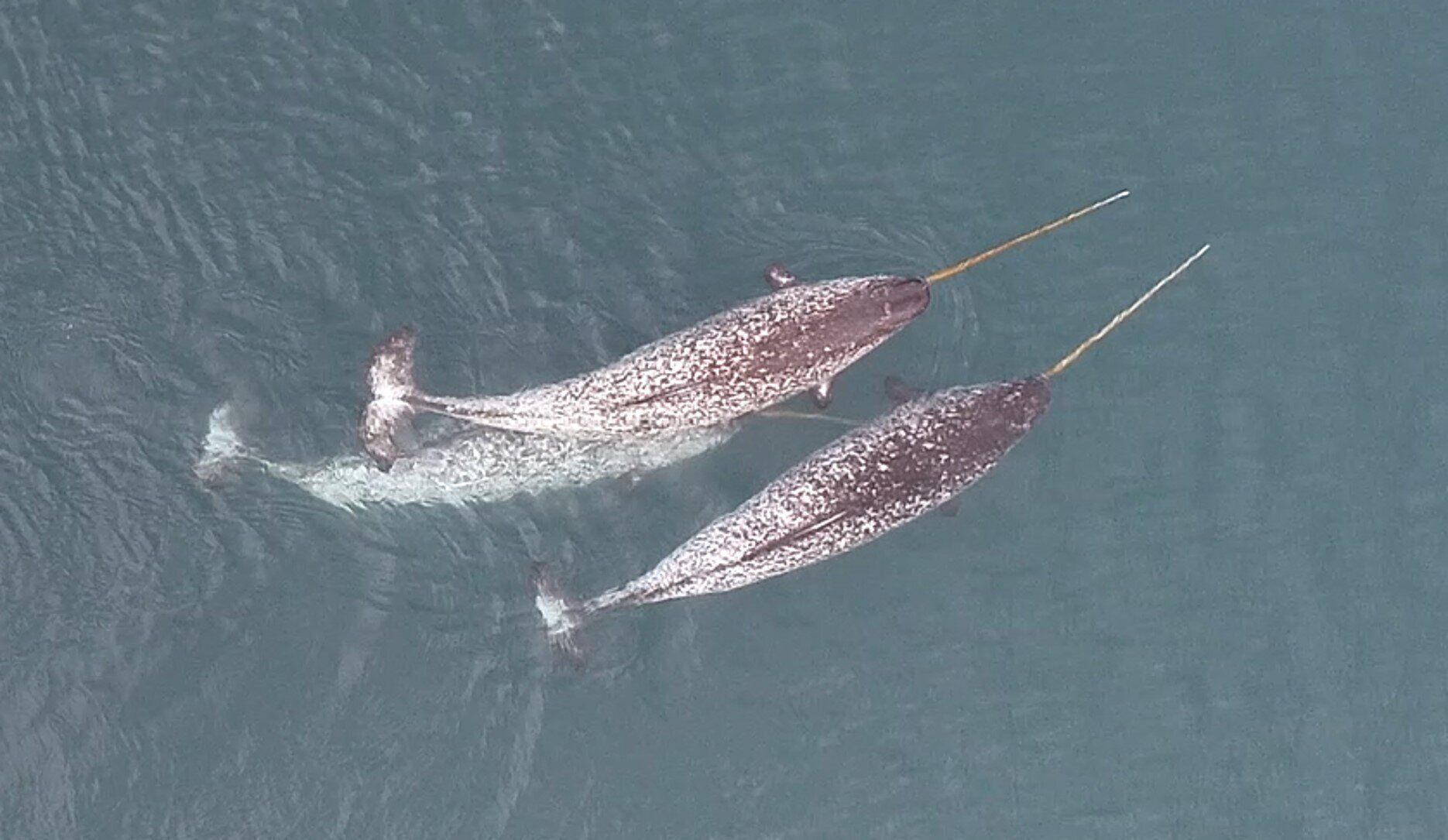
© O'Corry-Crowe, FAU/Watt, DFOThe Arctic's iconic narwhal, renowned for its long, spiral tusk, is one of nature's most fascinating creatures. Yet, few have witnessed how these elusive animals use their tusks in the wild.
Limited field observations also mean that little is known about many other aspects of the behavior of this highly gregarious Arctic whale, including social and reproductive behaviors, how they adapt to changing environmental conditions, or whether narwhals engage in behaviors that are not linked directly to fitness, like play.
Using drones, researchers from Florida Atlantic University's Harbor Branch Oceanographic Institute, and Canada's Department of Fisheries and Oceans, in partnership with Inuit communities in Nunavut in Canada's High Arctic, provide the first evidence of narwhals using their tusks in the wild to investigate, manipulate and influence the behavior of Arctic char (Salvelinus alpinus), including delivering sufficient force with their tusks to stun and possibly kill the fish. Researchers captured 17 distinct behaviors, which shed light on the dynamics between the narwhal, its prey and avian competitors.


















Comment: Space.com adds: