Science & TechnologyS


Bizarro Earth

Oceanic plate between Arabian and Eurasian continental plates is breaking away

Arabian and Eurasian plates
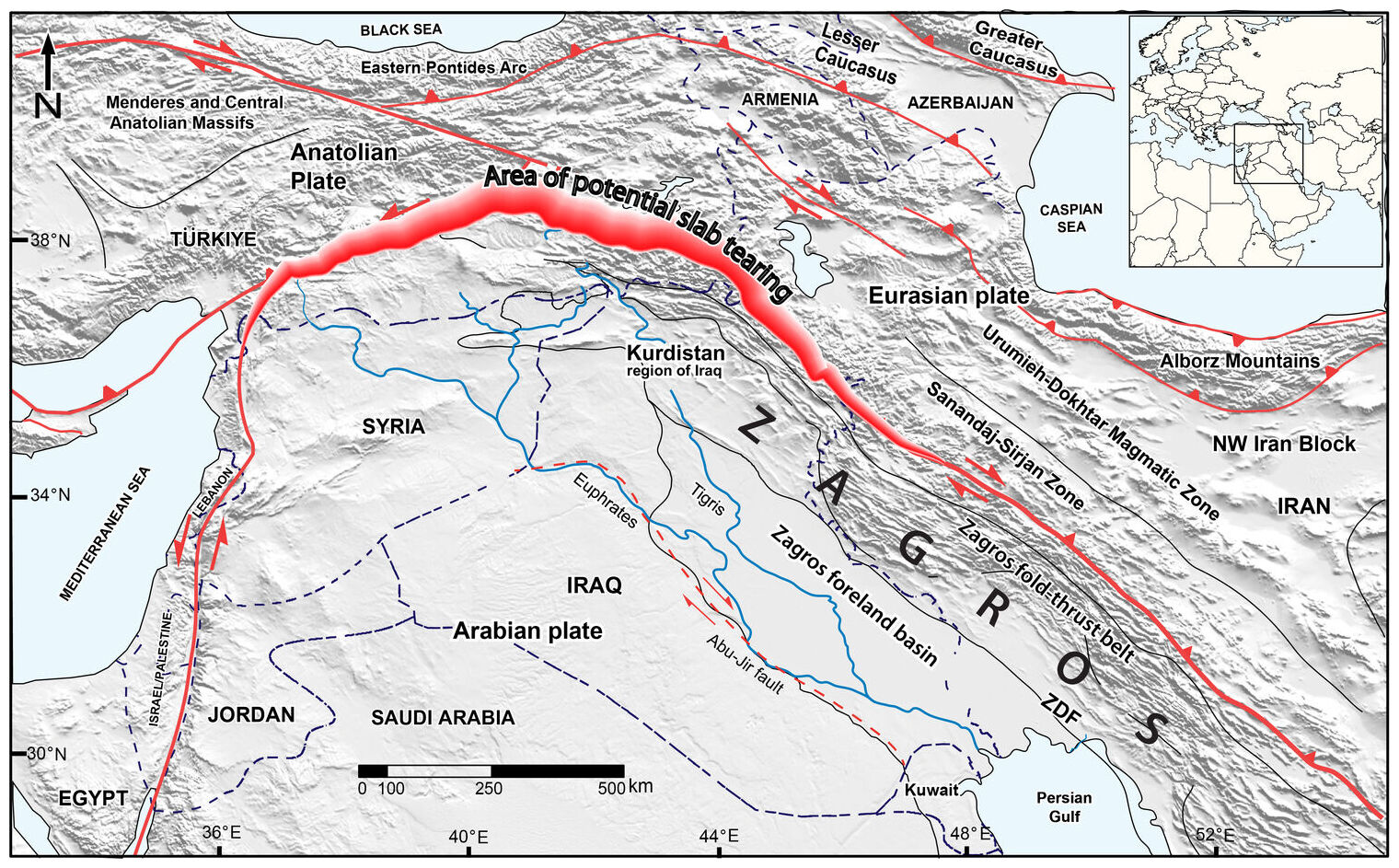
© Available under Creative Commons 4.0 license from Solid Earth (https://doi.org/10.5194/se-15-1365-2024) and edited by Renas KoshnawMap of the northern Middle East showing the Arabian and Eurasian plates and their collision zone, as well as the study area, the Kurdistan region of Iraq.
An international research team led by the University of Göttingen has investigated the influence of the forces exerted by the Zagros Mountains in the Kurdistan region of Iraq on how much the surface of the Earth has bent over the last 20 million years. Their research revealed that in the present day, deep below the Earth's surface, the Neotethys oceanic plate - the ocean floor that used to be between the Arabian and Eurasian continents - is breaking off horizontally, with a tear progressively lengthening from southeast Turkey to northwest Iran. Their findings show how the evolution of the Earth's surface is controlled by processes deep within the planet's interior. The research was published in the journal Solid Earth.

When two continents converge over millions of years, the oceanic floor between them slides to great depths beneath the continents. Eventually, the continents collide, and masses of rock from their edges are lifted up into towering mountain ranges. Over millions of years, the immense weight of these mountains causes the Earth's surface around them to bend downward. Over time, sediments eroded from the mountains accumulate in this depression, forming plains such as Mesopotamia in the Middle East. The researchers modelled the downward bend of the Earth's surfaces based on the Zagros Mountain's load where the Arabian continent is colliding with Eurasia. They combined the resulting size of the depression with the computed topography based on the Earth's mantle to reproduce the unusually deep depression in the southeastern segment of the study area. The researchers found that the weight of the mountains alone cannot account for the 3-4 km deep depression that has formed and been filled with sediment over the past 15 million years.

Syringe

Russian lab touts MRNA cancer vaccine by end of year

Gamaleya Research Institute of Epidemiology and Microbiology
© Ramil Sitdikov; RIA NovostiLaboratory of Russia's Gamaleya Research Institute of Epidemiology and Microbiology
A breakthrough personalized cancer vaccine developed by Russia's Gamaleya Research Institute could receive regulatory approval as early as this summer, potentially allowing patients to begin treatment in September, the institute's director Alexander Gintsburg has told RIA Novosti.

"According to the roadmap plan that we submitted to the Ministry of Health, although it has not yet been finally approved, we will likely receive permission at the end of August so that we can begin treating people in September," Gintsburg told the news agency.

The Gamaleya Research Institute of Epidemiology and Microbiology had previously developed Sputnik V, world's first registered Covid-19 vaccine. In 2022, the center applied mRNA technology, the basis for other Covid vaccines, to develop a new type of cancer drug.

Fireball 5

Newly discovered asteroid has slight chance of Earth impact in 2032

The discovery marks only the second time that an asteroid's impact risk has reached greater than a 1% chance.
Risk Corridor
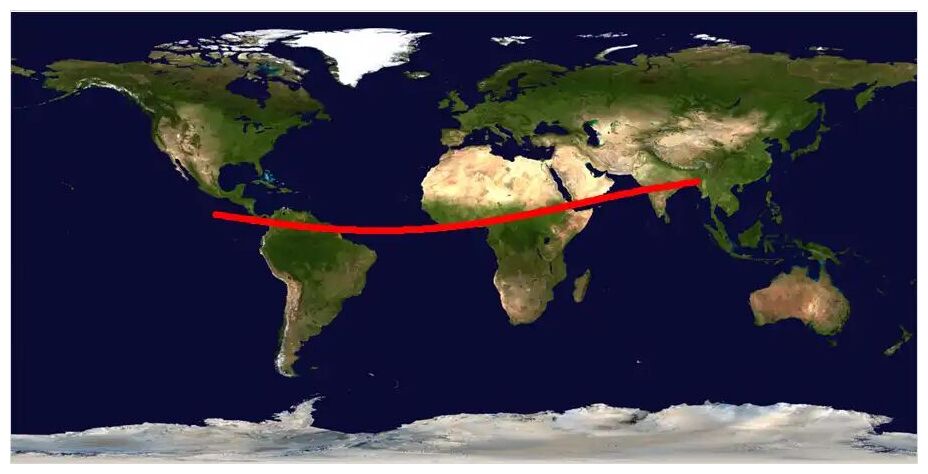
© Daniel BambergerThe "risk corridor" (in red) outlines possible places where the newly discovered asteroid might impact, given current observations. Note that the impact chance currently stands at about 1%, and further observations are needed to refine the object's orbit.
Astronomers — professional and amateur alike — have turned their attention to an asteroid with a slight chance of impacting Earth in 2032, based on current observations. While the possibility is slim, and more observations are needed, the object itself might be large enough to devastate a city, motivating follow-up observations as well as archival searches for pre-discovery observations.

The asteroid, designated 2024 YR4, was first noticed on December 27, 2024, by the Asteroid Terrestrial-impact Last Alert System (ATLAS); searches quickly revealed that ATLAS had already imaged it two days earlier. Then, as observations accumulated, astronomers could roughly determine its orbit. That's when the realization dawned: The object has some chance of striking Earth.

On Monday, January 27th, NASA's Sentry impact-tracking system officially raised the asteroid to a level 3 on the Torino scale. This is only the second time that an asteroid has merited a rating greater than 2 on the 10-point Torino scale, created in 1999 to convey the risk of an impact. At this level, an object has more than 1% chance of striking Earth.

Only one other object, asteroid 99942 Apophis, discovered in 2004, has ever reached that high on the scale. That asteroid peaked at 4, with a possibility of impact in 2029. But additional observations soon ruled that out, sending it back to a Torino rating of 0 — meaning no possible impact within the next century.

The chance of impact for 2024 YR4 is still slim: NASA's Jet Propulsion Laboratory estimates 1.2%. But if it does happen, German astronomer Daniel Bamberger (Northolt Branch Observatories) has used observations in hand to constrain the possible impact in time and location: The impact would take place on December 22, 2032, somewhere along a long line that extends from the Pacific Ocean off the coast of Mexico, through Ecuador and northern South America, across the Atlantic, through central Africa (from Kenya to Somalia), and then across to northern India.

The possible impact track covers big stretches of ocean as well as populated areas and some large cities. "I'd be really excited to see an impact," Bamberger says, "but I don't want it to be this one. Something over Antarctica, please!"

Mars

We may finally know what causes Mars' gigantic, planet-wide dust storms

Marsx2
© JPL/NASAA global dust storm that originated in Mars' southern hemisphere in May 2018 (L) completely blanketed the planet until July (R)
Mars' southern hemisphere absorbs a lot of the sun's energy during the Red Planet's spring, and that may be causing Mars' dust storms, a new study suggests.

Monstrous dust storms often ravage Mars, engulfing the Red Planet for months. Now, a new study suggests these global storms may be related to a peculiar energy imbalance recently discovered across the Martian surface.

The solar system's planets and moons absorb energy from the sun, but they also emit energy back into space. The difference between these two is called the radiative energy budget, or REB. "The REB and its spatial distribution [across latitudes] directly influence the thermal characteristics of the surface and atmosphere" of planets, Liming Li, a professor of physics at the University of Houston and the study's second author, told Live Science via email. This means a planet's REB determines its climate.

Bulb

Best of the Web: How To Think About Climate Change

blue sky
The best way to think about the frenzy over climate is to consider it a modern version of the medieval Crusades. You may remember that the motto of the crusaders was "Deus vult!", "God wills it!" It is hard to pick a better virtue-signaling slogan than that. Most climate enthusiasts have not gone so far, but some actually claim that they are doing God's work. After decades of propaganda, many Americans, perhaps including some of you here today, think there really is a climate emergency. Those who think that way, in many cases, mean very well. But they have been misled.

As a scientist who actually knows a lot about climate (and I set up many of our climate research centers when I was at the Department of Energy in the early 1990s) I can assure you that there is no climate emergency. There will not be a climate emergency. Crusades have always ended badly. They have brought discredit to the supposed righteous cause. They have brought hardship and death to multitudes. Policies to address this phony climate emergency will cause great damage to American citizens and to their environment.

Telescope

Mysterious 'Fast Radio Bursts' traced to edge of ancient, dying galaxy

fast radio bursts frb ancient galaxy mystery
© Gemini ObservatoryThe location of the fast radio burst, indicated by the oval outlines, is on the outskirts of a massive elliptical galaxy, the yellow oval at right.
A recent fast radio burst calls into question what astronomers believed they knew

Astronomer Calvin Leung was excited last summer to crunch data from a newly commissioned radio telescope to precisely pinpoint the origin of repeated bursts of intense radio waves — so-called fast radio bursts (FRBs) — emanating from somewhere in the northern constellation Ursa Minor.

Leung, a Miller Postdoctoral Fellowship recipient at the University of California, Berkeley, hopes eventually to understand the origins of these mysterious bursts and use them as probes to trace the large-scale structure of the universe, a key to its origin and evolution. He had written most of the computer code that allowed him and his colleagues to combine data from several telescopes to triangulate the position of a burst to within a hair's width at arm's length.

The excitement turned to perplexity when his collaborators on the Canadian Hydrogen Intensity Mapping Experiment (CHIME) turned optical telescopes on the spot and discovered that the source was in the distant outskirts of a long-dead elliptical galaxy that by all rights should not contain the kind of star thought to produce these bursts.

Telescope

First-ever documented supersonic winds are ripping through exoplanet WASP-127b

Wasp 127b exoplanet supersonic winds
© ESO/L. CalçadaArtist’s impression of supersonic winds On Wasp 127b
The jet winds are moving at nearly six times the speed of the exoplanet's rotation.

The farthest planet from the Sun, Neptune, is the windiest place in the solar system, with winds that whip through at speeds reaching more than 0.3 miles per second (0.5 kilometers per second). That's a relatively pleasant wind speed compared to a giant, puffy planet located around 500 lightyears away from Earth.

Supersonic winds on this exoplanet, designated WASP-127b, travel at a mind-bending 5.5 miles per second (9 kilometers per second). The speed of sound on Earth is roughly 0.21 miles per second (0.34 km/sec), making these winds supersonic by our terrestrial standards. The recently discovered extraterrestrial jet stream is the fastest ever measured on a planet, providing new insight into extreme weather that pummel other worlds.

Info

Potentially deadly 'chirping waves' detected in baffling location near Earth, and scientists are stumped

Chorus waves are mysterious, chirping signals produced by spiraling plasma inside our planet's magnetic field. But a new detection suggests scientists may understand less about them than first thought.
The northern lights
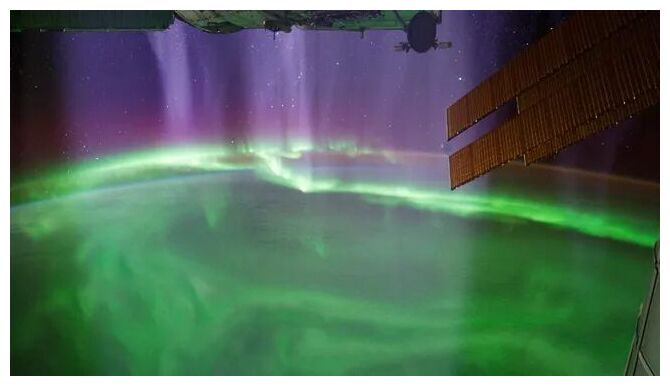
© Courtesy of NASA/Mokko StudioThe northern lights as seen from the International Space Station.
Scientists have detected strange chirping waves — which resemble the dawn chorus of birds — thousands of miles from Earth, and they could pose big problems for future spaceflight.

Chorus waves, named because of their resemblance to birdsong when converted to audio signals, are perturbations in Earth's electromagnetic field capable of accelerating particles to potentially deadly speeds for spacecraft and astronauts.

Yet while these mysterious waves have been spotted coming from Earth and other planets since the 1960s, scientists previously assumed they only occurred nearby.

Now, in a discovery that challenges existing theories, a new team of researchers has spotted the waves at a distance of 100,000 miles (165,000 kilometers) from Earth, roughly three times further than they were detected before. The researchers published their findings Jan 22. in the journal Nature.

Chorus waves (or whistler-mode chorus waves) are bursts of energy lasting just a few tenths of a second that ping across Earth's magnetosphere, the magnetic field that envelops our planet. The waves were first detected by World War I radio operators who heard them while listening for enemy signals.

In the decades since, chorus waves have been picked up by radio receivers, as well as by NASA's Van Allen Probe spacecraft, which detected the chirrups coming from Earth's radiation belts. The waves have also been spotted surrounding Mercury, Jupiter, Saturn, Uranus and Neptune (all planets with global magnetic fields) as well as Mars and Venus, which do not have magnetic fields.

Info

Astronomers thought they understood fast radio bursts. A recent one calls that into question.

The new ability to pinpoint sources of fast radio bursts places one recent burst in a surprising location.
The CHIME telescopes in British Columbia
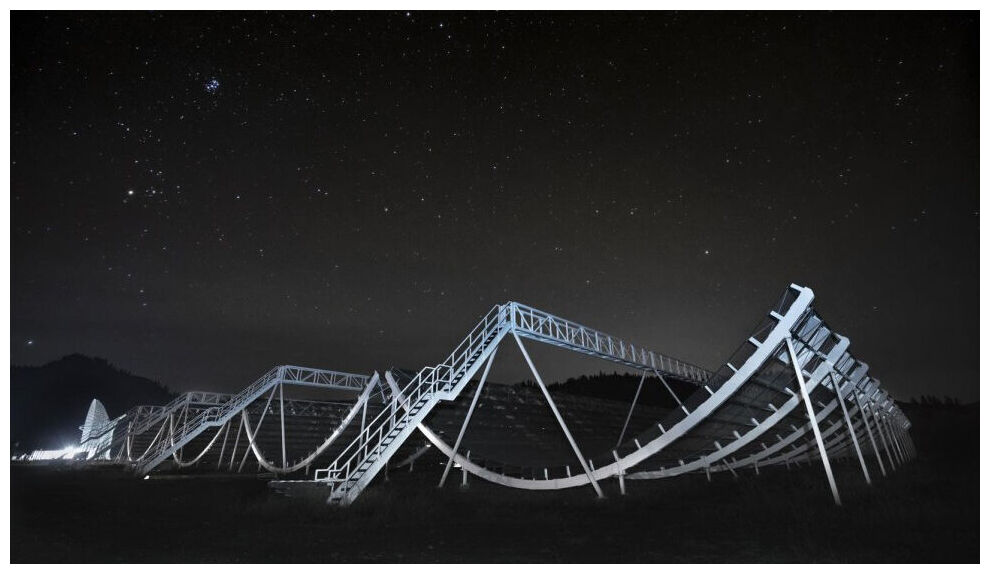
© CHIME, Andre Renard, Dunlap Institute for Astronomy & Astrophysics, University of TorontoThe CHIME telescopes in British Columbia detected the unusual fast radio burst, dubbed FRB 20240209A, in February 2024.
Astronomer Calvin Leung was excited last summer to crunch data from a newly commissioned radio telescope to precisely pinpoint the origin of repeated bursts of intense radio waves — so-called fast radio bursts (FRBs) — emanating from somewhere in the northern constellation Ursa Minor.

Leung, a Miller Postdoctoral Fellowship recipient at the University of California, Berkeley, hopes eventually to understand the origins of these mysterious bursts and use them as probes to trace the large-scale structure of the universe, a key to its origin and evolution. He had written most of the computer code that allowed him and his colleagues to combine data from several telescopes to triangulate the position of a burst to within a hair's width at arm's length.

The excitement turned to perplexity when his collaborators on the Canadian Hydrogen Intensity Mapping Experiment (CHIME) turned optical telescopes on the spot and discovered that the source was in the distant outskirts of a long-dead elliptical galaxy that by all rights should not contain the kind of star thought to produce these bursts.

Instead of finding an expected "magnetar" — a highly magnetized, spinning neutron star left over from the core collapse of a young, massive star — "now the question was: How are you going to explain the presence of a magnetar inside this old, dead galaxy?" Leung said.

The young stellar remnants that theorists think produce these millisecond bursts of radio waves should have disappeared long ago in the 11.3-billion-year-old galaxy, located 2 billion light years from Earth and weighing more than 100 billion times the mass of the sun.

Info

New evidence suggests megaflood refilled the Mediterranean Sea five million years ago

Ridge Erosion
© Kevin Sciberras and Neil PetroniAerial photo of a ridge eroded by the megaflood located north-east of Masseria del Volpe, south-east Sicily.
A new study provides compelling new evidence that a colossal 'megaflood' refilled the Mediterranean Sea, ending a period during which the Med was a vast expanse of salt flats.

The study suggests the Zanclean Megaflood ended the Messinian Salinity Crisis, which lasted between 5.97 and 5.33 million years ago.

An international team of scientists, including the University of Southampton, have identified a series of geological features around South East Sicily that point to a massive flood taking place across the region.

"The Zanclean megaflood was an awe-inspiring natural phenomenon, with discharge rates and flow velocities dwarfing any other known floods in Earth's history," said Dr. Aaron Micallef, lead author of the study and researcher at the Monterey Bay Aquarium Research Institute in California. "Our research provides the most compelling evidence yet of this extraordinary event."

During the Messinian Salinity Crisis, the Mediterranean Sea became isolated from the Atlantic Ocean and evaporated, leading to vast salt deposits which reshaped the region's landscape.

For years, scientists had thought that this dry period ended gradually, with the Mediterranean refilling over a period of 10,000 years. But this idea was challenged by the discovery of an erosion channel stretching from the Gulf of Cadiz to the Alboran Sea in 2009. The finding pointed to a single, massive flooding event, lasting between two and 16 years, which became known as the Zanclean megaflood.

Estimates suggest the megaflood had a discharge from 68 to 100 Sverdrups (Sv), with one Sv equal to one million cubic metres per second.