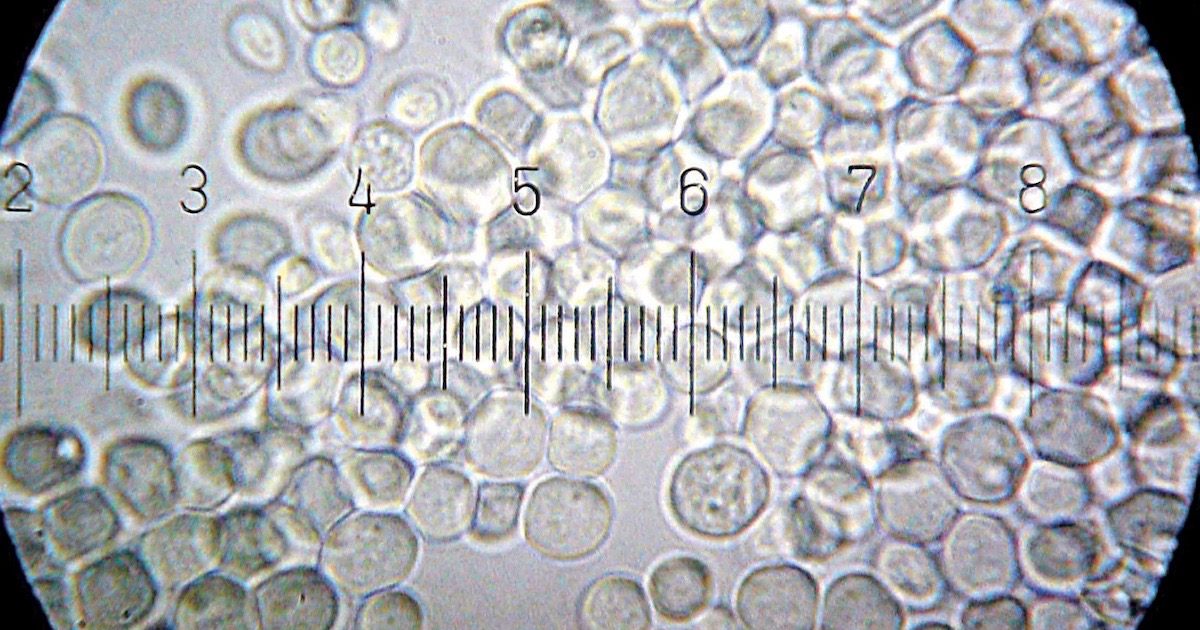
© Bob Blaylock / CC BY-SASaccharomyces cerevisiae, laboratory yeast
An interesting paper that strongly reinforces the lessons of
Darwin Devolves was recently published in
Nature Ecology and Evolution.
1 University of Michigan biologists Piaopiao Chen and Jianzhi Zhang looked at the effect of changing environments on the evolution of laboratory yeast
Saccharomyces cerevisiae.
They grew 12 replicate cultures of a pure yeast strain separately for 1,120 generations in each of five disparate, challenging environments: 1) in the presence of the carcinogenic dye Congo Red; 2) in the presence of copper ion; 3) at pH 8; 4) in the presence of hydrogen peroxide; and 5) in the presence of the antibiotic neomycin. They also grew replicate cultures successively for 224 generations apiece in the five conditions — that is, the first 224 generations in condition 1, the next 224 in condition 2, and so on, for a total of 1,120 generations.
Chen and Zhang were interested in determining
whether adaptive mutations might be lost when conditions were changed, because lab evolution experiments seem to show a lot more adaptive mutations than are seen in the wild. Sure enough, the authors saw that
some helpful mutations that arose and were being selected in condition 1 were lost when the yeast was switched to condition 2, and different helpful mutations were gained. Then some of those were lost in condition 3 while others were gained, and so on. At the end of 1,120 generations, the yeast culture that had been rotated through the five environments had significantly fewer net mutations than the sum of all those that had come and gone during the course of the experiment. Chen and Zhang concluded that beneficial mutations can be undercounted in changing environments, both in the lab and in nature.














Comment: See also: