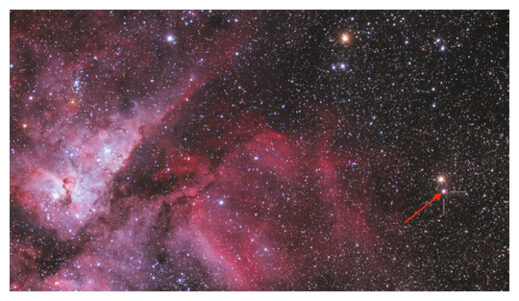
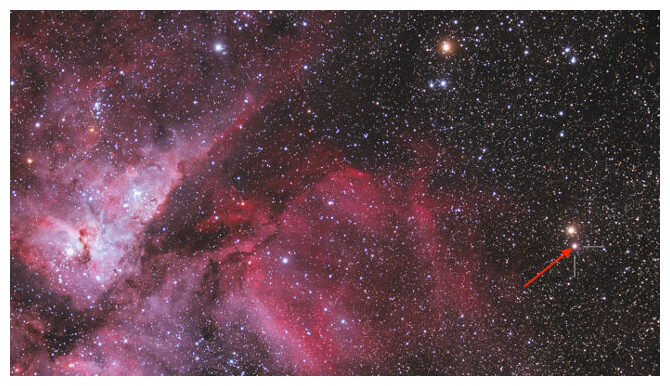
© Copyright 2018 by W. Paech + F. Hofmann, Team Chamaeleon, Chamaeleon and Onjala Observatory, NamibiaImage of V906 Carinae about 18 days after its discovery.
Astronomers have long believed that the bright light of novae comes from thermo-nuclear explosions.
Now, an international team, including researchers from the University of Copenhagen, has for the first time demonstrated that most of their brightness comes from shockwaves created in a unique and a previously unknown process. The finding ends a decades-old understanding of novae — and may help solve one of the greatest riddles in astrophysics.
Classical novae have been among the most extensively studied astrophysical phenomena since humans first began wondering about twinkling points in the night sky. Yet we continue to learn new things, as evidenced by new research conducted by the University of Copenhagen, among others.
Novae are explosions that occur when a white dwarf star and its companion star in a binary system orbit closer and closer around one another. As the two stars approach, gas from the companion star is stripped away and onto the white dwarf's surface, where it builds up like a gas shell. Eventually, after thousands of years, the piled up gas shell explodes in a nuclear fusion reaction.
For decades, astronomers believed that this thermo-nuclear explosive event is what caused white dwarves to suddenly shine up to a million times brighter — making them appear to be entirely new stars. Hence the name 'nova', meaning 'new' in Latin. But now, for the first time, an international team of researchers has demonstrated that it is the "shock", not the explosion itself, which mainly causes a nova to blaze brightly in the night sky.
"It's a whole new understanding of how a nova works. Indeed, it changes the more than 45-year-old perception that novae only get their light from the nuclear reaction," states Luca Izzo, co-author of the study — now published in
Nature Astronomy. Izzo is an astrophysicist and post-doctoral fellow at the University of Copenhagen's Niels Bohr Institute.
The new evidence comes from observations of 'V906 Carina', a nova discovered in 2018 roughly 13,000 light-years from Earth.















Comment: See also: