Science & TechnologyS


Sun

Coronal Holes

Image
© Hinode X-ray Telescope
A solar wind stream flowing from the indicated coronal hole should reach Earth on May 6th or 7th.

Document

Allegations of climate science fraud at Albany - the Wang case

Professor Wei-Chyung Wang is a star scientist in the Atmospheric Sciences Research Center at the University at Albany, New York. He is a key player in the climate change debate (see his self-description here). Wang has been accused of scientific fraud.

I have no inclination to "weigh in" on the topic of climate change. However the case involves issues of integrity that are at the very core of proper science. These issues are the same whether they are raised in a pharmaceutical clinical trial, in a basic science laboratory, by a climate change "denialist" or a "warmist". The case involves the hiding of data, access to data, and the proper description of "method" in science.

The case is also of interest because it provides yet another example of how *not* to create trust in a scientific misconduct investigation. It adds to the litany of cases suggesting that Universities cannot be allowed to investigate misconduct of their own star academics. The University response has so far been incoherent on its face.

Blackbox

Mission Impossible: The Code Even the CIA Can't Crack

Image
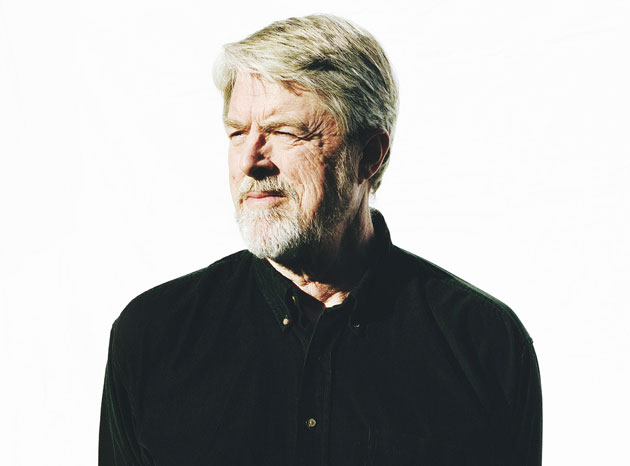
© Adrian Gaut"People call me an agent of Satan," says artist Sanborn, "because I won't tell my secret."
The most celebrated inscription at the Central Intelligence Agency's headquarters in Langley, Virginia, used to be the biblical phrase chiseled into marble in the main lobby: "And ye shall know the truth, and the truth shall make you free." But in recent years, another text has been the subject of intense scrutiny inside the Company and out: 865 characters of seeming gibberish, punched out of half-inch-thick copper in a courtyard.

It's part of a sculpture called Kryptos, created by DC artist James Sanborn. He got the commission in 1988, when the CIA was constructing a new building behind its original headquarters. The agency wanted an outdoor installation for the area between the two buildings, so a solicitation went out for a piece of public art that the general public would never see. Sanborn named his proposal after the Greek word for hidden. The work is a meditation on the nature of secrecy and the elusiveness of truth, its message written entirely in code.

Almost 20 years after its dedication, the text has yet to be fully deciphered. A bleary-eyed global community of self-styled cryptanalysts - along with some of the agency's own staffers - has seen three of its four sections solved, revealing evocative prose that only makes the puzzle more confusing. Still uncracked are the 97 characters of the fourth part (known as K4 in Kryptos-speak). And the longer the deadlock continues, the crazier people get.

Whether or not our top spooks intended it, the persistent opaqueness of Kryptos subversively embodies the nature of the CIA itself - and serves as a reminder of why secrecy and subterfuge so fascinate us. "The whole thing is about the power of secrecy," Sanborn tells me when I visit his studio, a barnlike structure on Jimmy Island in Chesapeake Bay (population: 2). He is 6'7", bearded, and looks a bit younger than his 63 years. Looming behind him is his latest work in progress, a 28-foot-high re-creation of the world's first particle accelerator, surrounded by some of the original hardware from the Manhattan Project. The atomic gear fits nicely with the thrust of Sanborn's oeuvre, which centers on what he calls invisible forces.

Info

Dark matter 'highway' funnels gas into galactic pileup

Image
© X-ray (NASA/CXC/IfA/C Ma et al.); Optical (NASA/STScI/IfA/C Ma et al.)The remnants of four different galaxy clusters comprise the large cluster MACSJ0717. The galaxy cluster labelled "C" is thought to be the "original" cluster, while the motions (arrows) of clusters B, D, and A are all thought to have been funnelled into the cluster from an attached filament (lower left). (The cluster labelled "A" is thought to have moved through the larger cluster once and is now falling back towards its centre.)
The first tantalising signs of gas within a filament of dark matter have been glimpsed at the site of a cataclysmic collision between galaxy clusters. If future observations confirm the preliminary detection, it would provide an important test of computer simulations that show how large-scale cosmic structures form.

The simulations suggest that matter is distributed in a cosmic web, with material flowing along filamentary structures and pooling where the filaments intersect. Dark matter is thought to act as the scaffolding for this web, and researchers say as much as 40% of all dark matter in the universe may lie in the filaments.

But although observations have found that galaxies and galaxy clusters do indeed lie in filaments, so far no gas or dark matter have been confirmed in the highway-like structures.

"It's only logical that the gas and the dark matter trace the same structure, but quantitatively, we do not know whether the simulations and the observations match," says Harald Ebeling of the University of Hawaii.

Sun

What the latest lull in sunspots means for our weather

Image
© NASAScientists say fewer sunspots than expected have been appearing on the solar surface recently.
A continuing low in sunspot activity on the sun's surface has scientists speculating on whether the lull will continue, and if it extends for decades, as has happened in the past, whether the planet would see another "Little Ice Age."

Centuries of observations have shown that sunspot activity goes through a 22-year cycle, with an 11-year period of sunspot activity from greatest to least, then an ascent to another peak.

The sun currently is in an 11-year valley, or solar minimum. However, it seems to be idling there, rather than ticking back upward. The least active stage for sunspots was in August 2008, which led scientists to expect an uptick by March of this year - but it hasn't yet occurred.

Sunspots are evidence of solar regions with increased magnetic activity. They can have a strength thousands of times stronger than the Earth's magnetic field. They usually come in groups, normally with two sets of spots, and are the sources of solar flares, coronal mass ejections, and intense ultraviolet radiation.

Monkey Wrench

Large Hadron Collider 'mostly repaired'

LHC
© PAThe LHC is designed to collide sub-atomic particles together at energies never before attained
Engineers have finished the major work of fixing the broken "Big Bang" machine, the largest scientific instrument ever built.

The last of 53 replacement magnets for the Large Hadron Collider (LHC) has been lowered into the 16-mile tunnel straddling the Swiss-French border which houses the machine.

Scientists said they were on track to re-start the particle accelerator in the autumn.

The LHC, based at the Swiss headquarters of the European nuclear research organisation Cern, was switched on in September last year amid a fanfare of publicity.

Magnify

A Tiny Hominid With No Place on the Family Tree

Image
© Barron Storey
Stony Brook, N.Y. - Six years after their discovery, the extinct little people nicknamed hobbits who once occupied the Indonesian island of Flores remain mystifying anomalies in human evolution, out of place in time and geography, their ancestry unknown. Recent research has only widened their challenge to conventional thinking about the origins, transformations and migrations of the early human family.

Indeed, the more scientists study the specimens and their implications, the more they are drawn to heretical speculation.

Image
© New York Times
Were these primitive survivors of even earlier hominid migrations out of Africa, before Homo erectus migrated about 1.8 million years ago? Could some of the earliest African toolmakers, around 2.5 million years ago, have made their way across Asia?

Magnify

Shedding light on the Catacombs of Rome

Image
The scanner sends out millions of light pulses that bounce off every surface.
Rome's underground Christian, Jewish and pagan burial sites, the Catacombs, date back to the 2nd Century AD.

There are more than 40 of them stretching over 170km (105 miles).

But, until now, they have never been fully documented, their vast scale only recorded with handmade maps.

That is now changing, following a three-year project to create the first fully comprehensive three-dimensional image using laser scanners.

Meteor

Newly Discovered Nearby Asteroid Found Orbiting Sun Backwards

Image
© NASA/JPL
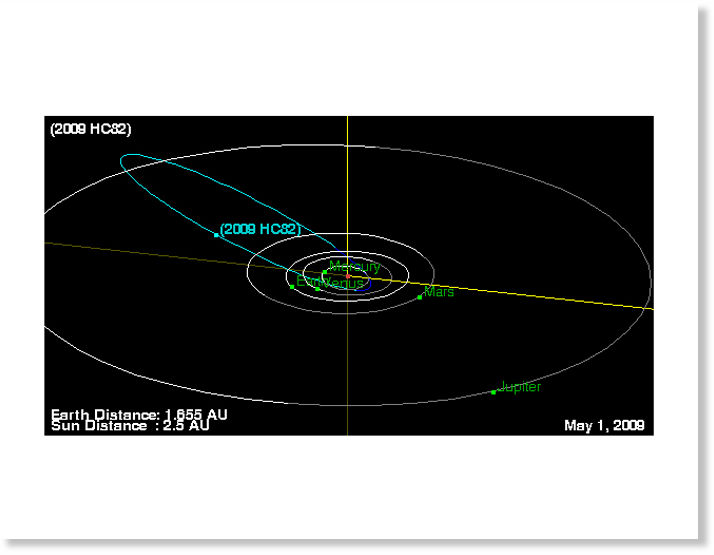
The discovery of a 2- to 3-kilometre-wide asteroid in an orbit that goes backwards has set astronomers scratching their heads. It comes closer to Earth than any other object in a 'retrograde' orbit, and astronomers think they should have spotted it before.

The object, called 2009 HC82, was discovered by the Catalina Sky Survey in Arizona on the morning of 29 April.

From observations of its position by five different groups, Sonia Keys of the International Astronomical Union's Minor Planet Center calculated it orbits the sun every 3.39 years on a path that ventures within 3.5 million km of the Earth's orbit. Combined with its size, that makes 2009 HC82 a potentially hazardous asteroid.

What's really unusual is that the calculated orbit is inclined 155° to the plane of the Earth's orbit. That means that as it orbits the Sun, it actually travels backwards compared to the planets. It is only the 20th asteroid known in a retrograde orbit, a very rare group. None of the others comes as close to the Earth.

Light Sabers

Propaganda Level 6: The internet is draining world's power

Image
© Dan ChungThis was the photo chosen by the Guardian to accompany this article. Note the suggestion being made here: too many internet users are gobbling too little finite resources i.e. China
The internet's increasing appetite for electricity poses a major threat to companies such as Google, according to scientists and industry executives.

Leading figures have told the Guardian that many internet companies are struggling to manage the costs of delivering billions of web pages, videos and files online - in a "perfect storm" that could even threaten the future of the internet itself.

"In an energy-constrained world, we cannot continue to grow the footprint of the internet ... we need to rein in the energy consumption," said Subodh Bapat, vice-president at Sun Microsystems, one of the world's largest manufacturers of web servers.