Science & TechnologyS


Beaker

LHC spots no black holes, eliminates some versions of string theory

lhcbh
© ArsTechnica
The results continue to pour out of the LHC's first production run. This week, the folks behind the CMS detector have announced the submission of a paper to Physics Letters that describes a test of some forms of string theory. If this form of the theory were right, the LHC should have been able to produce small black holes that would instantly decay (and not, as some had feared, devour the Earth). But a look at the data obtained by CMS shows that a signature of the black holes' decay is notably absent.

String theory is an attempt to deal with the fact that the two major theories in physics, quantum mechanics and relativity, are fundamentally incompatible. It manages to merge the two by positing a set of extra dimensions beyond the usual four. We don't see these because they're tightly wrapped within a tiny radius that is inapproachable at normal energies.

In one form of string theory - the paper calls it the ADD model because Arkani-Hamed, Dimopoulos, and Dvali proposed it - this unification has consequences for gravity. Normally, gravity is very weak relative to the other forces, such that it could only become unified with the rest of them at energies many orders of magnitude higher than the LHC could reach. But, in the ADD model, gravity only looks weak because portions of it are caught up in the remaining dimensions. This drops the energies down to something right in the heart of the LHC's capabilities.

Meteor

Earth's Final Growth Spurt

Image
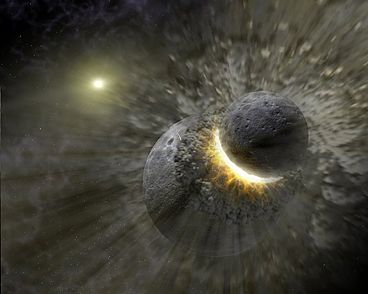
© NASA/Jet Propulsion Laboratory-CaltechMassive planetesimals — some as large as 2,000 miles in diameter — may have struck other objects in space, including possibly Earth, Mars and the Moon, in a similar fashion to this artist's rendering of a space collision.
NASA team suggests that massive projectiles added mass to Earth, Mars and the Moon during final phase of planet formation

What led to water on the interior of the Moon or the formation of the Borealis basin that covers 40 percent of the surface of Mars? And what caused at least some of Earth's tilt - without which there would be no change of seasons?

New research from NASA's Lunar Science Institute points to the same culprit: rocky bodies known as planetesimals that populated the solar system billions of years ago and eventually clumped together to form planets. As the planets and the Moon (which was created by a massive impact between a Mars-sized body and the young Earth) continued to cool several hundred million years after their formation, planetary scientists believe that planetesimals struck them again.

Info

Cryosat Ice Mission Returns First Science

Cryosat-2
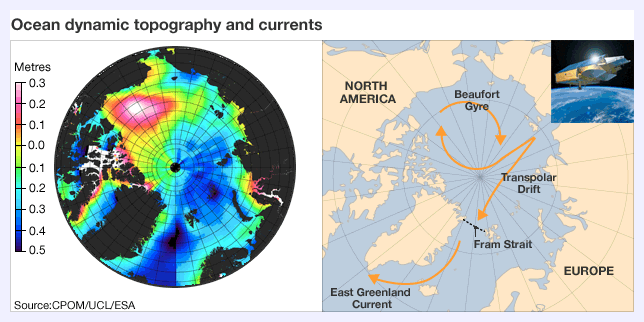
© CPOM/UCL/ESACryosat data.

The Cryosat-2 spacecraft has produced its first major science result.

Radar data from the European satellite has been used to make a map of ocean circulation across the Arctic basin.

Cryosat's primary mission is to measure which has been in sharp decline in recent decades.

But its ability also to map the shape of the sea surface will tell scientists if Arctic currents are changing as a result of winds being allowed to blow more easily on ice-free waters.

"Nobody really knows how the Arctic is going to behave as the ice retreats, but we do anticipate that significant changes will occur," said Dr Seymour Laxon, a Cryosat science team member from University College London, UK.

"This is just the first data, and it shows we now have the tool to monitor what is happening," he told BBC News.

Dr Laxon presented the first Cryosat result in San Francisco at the American Geophysical Union (AGU) Fall Meeting, the world's largest annual gathering of Earth and planetary scientists.

The European Space Agency (Esa) satellite was launched in April.

It carries one of the highest resolution synthetic aperture radars ever put in orbit.

The instrument sends down pulses of microwave energy which bounce off both the top of the Arctic sea-ice and the water in the cracks, or leads, which separate the floes.

By measuring the difference in height between these two surfaces, scientists will be able, using a relatively simple calculation, to work out the overall volume of the marine ice cover in the far north.

Sherlock

Two Ancient Imperial Mausoleums Located in North China

Chinese archaeologists determined on Thursday the exact location of two ancient imperial mausoleums dating back 1,300 years following explorations in north China's Hebei Province.

Seated in Longyao County of Xingtai City, the mausoleums belonged to Li Xi and Li Tianci in the South-north Dynasty (420-581), the second great grandfather and great grandfather of the founding emperor of the Tang dynasty (618-907), Li Yuan.

Made up of staff from the Cultural Relics Institute of Hebei Province and historic preservation station of Longyao County, the exploration team started their work on November 14.

"Covering more than 4 square kilometers, the mausoleums have similar layouts as Chang'an City." said Guo Jiqiao, leader of the exploration team.

The ancient city of Chang'an was the capital for the Tang Dynasty, which was located in today's Xi'an City of northwest China's Shaanxi Province.

"We also found some stone sculptures at the site, such as stone horses, stone men and stone lions." Guo said.

Sherlock

Ancient Maya Temples Were Giant Loudspeakers?

Image
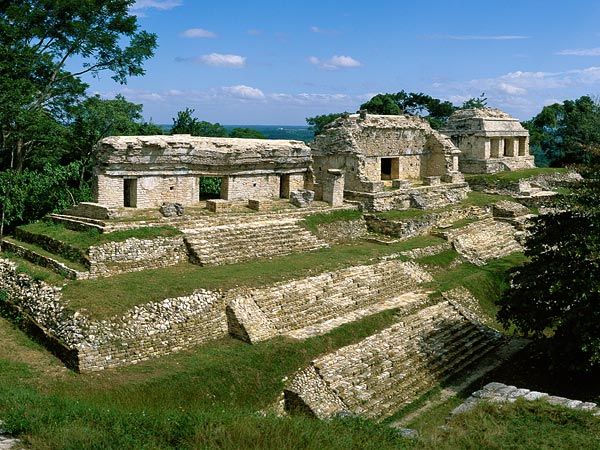
© Panoramic Images/National GeographicMaya temple ruins in the Northern Group complex at Palenque, Mexico.
Complexes may have used acoustic design to broadcast - and disorient.

Centuries before the first speakers and subwoofers, ancient Americans - intentionally or not - may have been turning buildings into giant sound amplifiers and distorters to enthrall or disorient audiences, archaeologists say.

Temples at the ancient Maya city of Palenque in central Mexico, for example, might have formed a kind of "unplugged" public-address system, projecting sound across great distances, according to a team led by archaeologist Francisca Zalaquett of the Universidad Nacional Autónoma de México.

Zalaquett's team recently discovered that Palenque's Northern Group of public squares and temples - built around roughly A.D. 600 - is especially good at projecting the human voice as well as sounds like those that would have been made by musical instruments found at the site.

The Maya built many types of musical instruments, including rattling gourds filled with seeds or stones, turtle shells played with deer antlers, as well as whistles, ocarinas, modified seashells, and other wind instruments, said Zalaquett, who presented the Palenque findings at a recent meeting of the Acoustical Society of America in Cancún, Mexico.

Telescope

All Clear in the Stratosphere for the Eclipse

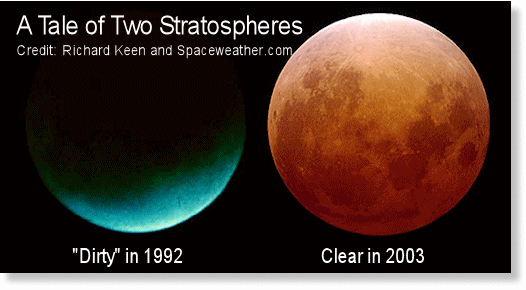
Earth's stratosphere is as clear as it's been in more than 50 years. University of Colorado climate scientist Richard Keen knows this because he's been watching lunar eclipses. "Since 1996, lunar eclipses have been bright, which means the stratosphere is relatively clear of volcanic aerosols. This is the longest period with a clear stratosphere since before 1960." Consider the following comparison of a lunar eclipse observed in 1992 after the Philippine volcano Pinatubo spewed millions of tons of gas and ash into the atmosphere vs. an "all-clear" eclipse in 2003:

Image
© Richard Keene / Space Weather
Keen explains why lunar eclipses can be used to probe the stratosphere: "At the distance of the Moon, most of the light refracted into the umbra (Earth's shadow) passes through the stratosphere, which lies 10 to 30 miles above the ground. When the stratosphere is clear, the umbra (and therefore, the eclipsed Moon) is relatively bright. On the other hand, if the atmospheric lens that illuminates the Moon becomes dirty enough, light will be blocked and the eclipse will appear dark."

Telescope

Rare Event: Upcoming Full Moon to Align With Solstice

winter solstice
© Space.com
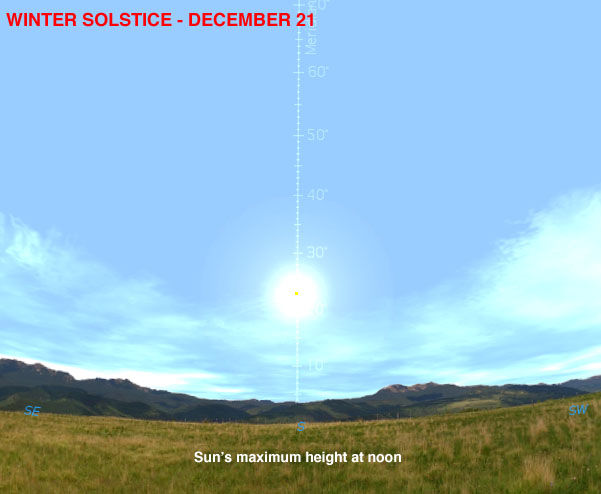
The upcoming Dec. 21 full moon - besides distinguishing itself from the others in 2010 by undergoing a total eclipse - will also take place on the same date as the solstice (the winter solstice if you live north of the equator, and the summer solstice if you live to the south).

Winter solstice is the shortest day of the year in the Northern Hemisphere and marks the official beginning of winter. The sun is at its lowest in our sky because the North Pole of our tilted planet is pointing away from it.

So, how often does the December full moon coincide with the solstice? To answer this question, let's use Universal Time (UT), also sometimes referred to as Greenwich Mean Time (GMT). We do this because in answering this question, it's important to define a specific time zone.

For example, if you live in Honolulu, this December's full moon does not fall on the date of the solstice. Hawaii Time runs 10 hours behind GMT and the full moon occurs on Dec. 20 at 10:13 p.m. local time, while the solstice comes the following day at 1:38 p.m. Alaska, too, will have the full moon and the solstice occur on these respective dates, but in a time zone one hour later than Hawaii.

Magic Wand

4 in 10 Americans Still Hold Creationist Views

Image
© unknown
If you're in a room of 100 people, odds are likely about 40 think God created humans about 10,000 years ago, part of a philosophy called creationism, according to a Gallup poll reported Friday (Dec. 17). That number is slightly lower than in years past and down from a high of 47 percent in both 1993 and 1999.

And 38 percent of Americans, the poll estimates, believe God guided the process that brought humans from "cavemen" to today's incarnation over millions of years, while 16 percent think humans evolved over millions of years, without any divine intervention.

This secular view, while a relatively small number, is up from 9 percent in 1982, according to Gallup.

Like most American attitudes, Gallup wrote, views on human origins have political consequences. For instance, debates and clashes over which explanations for human origins should be included in school textbooks have persisted for decades. And with 40 percent of Americans continuing to hold to an anti-evolutionary belief about the origin of humans, it is highly likely that these types of debates will continue, according to Gallup.

Telescope

Pluto Has Oceans Under Ice?

Pluto water
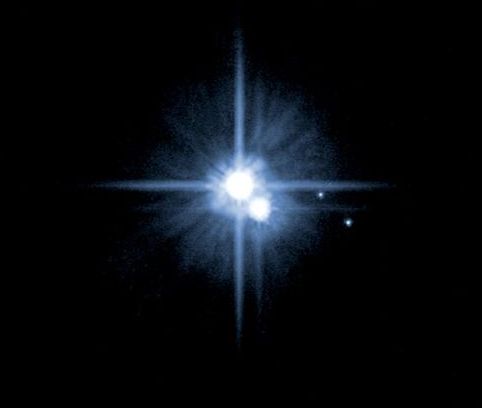
© NASA/ESA/H. Weaver (JHU/APL)/A. Stern (SwRI)/HST Pluto Companion Search TeamPluto (center) and its three known moons, Charon, Nix, and Hydra (file picture).
Radioactive heat may warm Pluto's core, model suggests.

Frigid Pluto, home to some of our solar system's chilliest real estate, may well harbor an ocean beneath its miles-thick ice shell, new research suggests.

Despite its extreme cold, the dwarf planet still appears to be warm enough to "easily" have a subsurface ocean, according to a new model of the rate at which radioactive heat might still warm Pluto's core.

And that ocean wouldn't be a mere puddle, noted planetary scientist Guillaume Robuchon of the University of California, Santa Cruz.

Rather, the ocean could be 60 to 105 miles (100 to 170 kilometers) thick beneath a 120-mile (200-kilometer) layer of ice, Robuchon said at an annual meeting of the American Geophysical Union in San Francisco earlier this week.

Info

Ancient Waves of Mountain Building Discovered

Mountains
© polarpaul / Creative CommonsFor the new study, Stanford experts analyzed samples taken from dozens of basins around the western United States.

Isotopic ratio analyses conducted on old raindrops have revealed that the onset of a large wave of mountain building began more than 49 million years ago in British Columbia, Canada. The work also showed that the phenomenon then began rolling southwards, towards Mexico.

The ancient raindrops that were used to derive this conclusions were sampled from soils and lake sediments at various locations by researchers at the Stanford University, in the United States.

One of the major implications of the new discoveries is proving the idea that a Tibet-like plateau once existed in North America to be false. For many years, experts believed that the erosion of such structure produced the mountains we can observe today.

Stanford geochemists say that the wave of mountain formation began in Canada, but add that, over the next 22 million years, it spread to Mexico, and as far east as modern-day Nebraska. Geologically speaking, the event took place very fast.

The previous theory had it that a massive plateau developed in the western United States, as well as in Canada and Mexico, and also that simultaneous erosion taking place in all these areas at once carved up the modern mountain ranges.

In order to get a clear picture of what actually happened, the research team analyzed the isotopic ratios of chemicals in raindrops that fell to the Earth from 65 to 28 million years ago. This basically means that they covered a time span that began immediately after the dinosaurs disappeared.

"Where we got a huge jump in isotopic ratios, we interpret that as a big uplift. We saw a major isotopic shift at around 49 million years ago, in southwest Montana," explains expert Hari Mix.