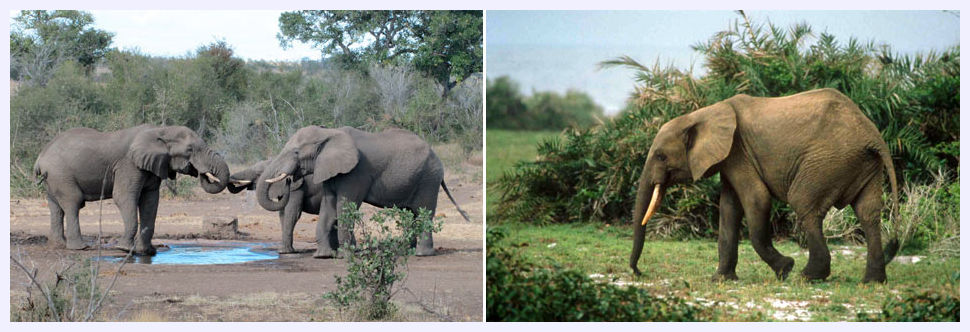
© (left, savanna) A. Schaefer; (right, forest) N. GeorgiadisSplit. African forest elephants (right) are a separate species from their savanna brethren (right), say genetic researchers.
It would be hard to confuse Africa's forest elephants and savanna elephants. Forest elephants, found in dense West African forests, have longer, straighter tusks and round, not pointed, ears. They're also 1 meter shorter and weigh half as much as the savanna elephants, which range from South to East Africa. Yet for years, scientists have classified the two as the same species, arguing that they were slightly different populations that mingled on the edges of the forest. A new genetic analysis, however, finds that forest and savanna elephants are as different from each other as modern Asian elephants are from ancient mammoths. The findings, which split the elephants into two species, could improve the conservation of African elephants overall, say researchers.
The study is not the first to analyze the elephants' DNA. In 2001, researchers
compared the mitochondrial DNA (mtDNA) of forest and savanna elephants and reached much the same conclusion. (mtDNA is inherited only from the mother and is found in mitochondria, the cell's energy factories.) And a
subsequent study of the forest and savanna elephants' nuclear DNA showed that the two had diverged more than 3 million years ago. Both studies concluded that forest and savanna elephants are separate species, but they did not sway all taxonomists, who felt that certain data suggested that some forest and savanna elephants shared a recent maternal ancestor.
Many studies use mtDNA to determine whether a species designation is valid. But mtDNA has its limitations. It represents only a small fraction of an animal's genome (the rest is nuclear DNA), and because it is transmitted only from the mother, it reveals just the genetic history of females.