Science & TechnologyS


Chart Pie

US Undermining China's Monopoly on Rare Earth Elements

Image
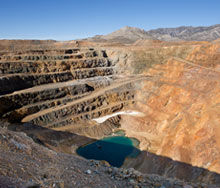
© Technology Review Magnet mine: Molycorp is restarting active mining at this site in Mountain Pass, California.
Full operations will start at a U.S. mine by the end of next year.

Molycorp has secured the permits and funding needed to restart production at a mine in Mountain Pass, California, that would become the first U.S. source of rare earth elements in more than a decade. The mine is one of the world's richest deposits of these elements, which are critical for making components found in a wide range of technologies. On Tuesday, the company announced that it will partner with Hitachi Metals of Japan to turn materials from the mine into high-strength magnets, which are vital in electric vehicles, wind turbines, and many other products.

China currently has a lock on the market for rare earth materials: in 2009 it provided 95 percent of the world's supply, or 120,000 tons. This concentration of supply has become a major issue in recent months, particularly after China temporarily blocked exports of these materials to Japan in September. A Critical Materials Strategy document issued by the U.S. Department of Energy last week points to the "risk of supply disruption" in the short term. Worldwide demand for rare earth elements was 125,000 tons in 2010 and is expected to rise to 225,000 tons by 2015.

Sherlock

Ancient City Unearthed in Socotra Island

socotra island
© Unknown
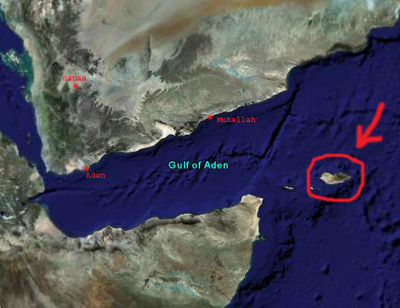
Russian archaeological team has unearthed an ancient city in Socotra Island, the state-run 26sep.net reported on Friday.

After four-year archaeological excavations, the Russian team managed to discover an ancient city called "Khajlah" and located near Hidibu city, the main city in the island.

The city is dated back to the second century AD, according to the team's expectation.

The team said that the remains of the exposed ancient houses, roads, alleys and squares indicated that the city had been an administrative, religious and cultural area for the entire island.

Info

Where Unconscious Memories Form

Brain
© iStockphotoIllustration of brain.
A small area deep in the brain called the perirhinal cortex is critical for forming unconscious conceptual memories, researchers at the UC Davis Center for Mind and Brain have found.

The perirhinal cortex was thought to be involved, like the neighboring hippocampus, in "declarative" or conscious memories, but the new results show that the picture is more complex, said lead author Wei-chun Wang, a graduate student at UC Davis.

The results were published Dec. 9 in the journal Neuron.

We're all familiar with memories that rise from the unconscious mind. Imagine looking at a beach scene, said Wang. A little later, someone mentions surfing, and the beach scene pops back into your head.

Declarative memories, in contrast, are those where we recall being on that beach and watching that surf competition: "I remember being there."

Info

Three Billion-Year-Old Genomic Fossils Deciphered

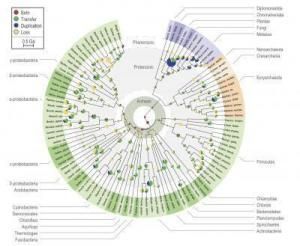
About 580 million years ago, life on Earth began a rapid period of change called the Cambrian Explosion, a period defined by the birth of new life forms over many millions of years that ultimately helped bring about the modern diversity of animals. Fossils help palaeontologists chronicle the evolution of life since then, but drawing a picture of life during the 3 billion years that preceded the Cambrian Period is challenging, because the soft-bodied Precambrian cells rarely left fossil imprints. However, those early life forms did leave behind one abundant microscopic fossil: DNA.
Gene evolution
© Lawrence DavidThe figure shows the evolution of gene families in ancient genomes across the Tree of Life. The sizes of the little pie charts scale with the number of evolutionary events in lineages, slices indicate event types: gene birth (red), duplication (blue), horizontal gene transfer (green), and loss (yellow). The Archean Expansion period (3.33 to 2.85 billion years ago) is highlighted in green.

Info

Mom's Voice Plays Special Role in Activating Newborn's Brain

A mother's voice will preferentially activate the parts of the brain responsible for language learning, say researchers from the University of Montreal and the Sainte-Justine University Hospital Research Centre. The research team made the discovery after performing electrical recordings on the infants within the 24 hours following their birth.
Baby with electrodes
© Sainte-Justine University Hospital Research CentreResearchers applied electrodes to babies' heads to analyze their brain activity.

The brain signals also revealed that while the infants did react to other women's voices, these sounds only activated the voice recognition parts of the brains. "This is exciting research that proves for the first time that the newborn's brain responds strongly to the mother's voice and shows, scientifically speaking, that the mother's voice is special to babies," said lead researcher Dr. Maryse Lassonde of the University of Montreal's Department of Psychology and the Sainte-Justine University Hospital Research Centre.

Better Earth

Cache in Chinese Mountain Reveals 20,000 Prehistoric Fossils

Ichthyosaur
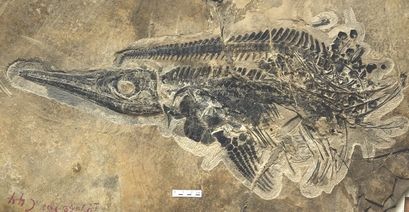
© Shixue Hu, Chengdu Geological Center in ChinaA fossil of the dolphin-bodied marine reptile known as an ichthyosaur, discovered as part of a giant cache of nearly 20,000 fossils in China

A giant cache of nearly 20,000 fossil reptiles, shellfish and a host of other prehistoric creatures unearthed from a mountain in China is now revealing how life recovered after the most devastating mass extinction on Earth.

This research could help point out which species might be more or less susceptible to extinction nowadays, and how the world might recover from the damage caused by humanity, scientists added.

Life was nearly completely wiped out approximately 250 million years ago by massive volcanic eruptions and devastating global warming. Only one in 10 species survived this cataclysmic end-Permian event.

Meteor

Bright Prospects for Comet Elenin?

It doesn't look like much now - just a 19th-magnitude smudge tucked away in southwestern Virgo - but a newly discovered comet could become something special 10 months from now.

Comet Elenin
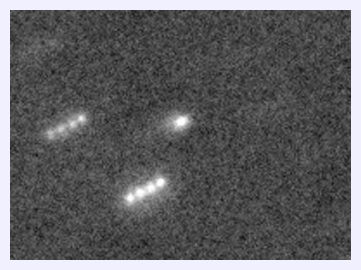
© Leonid Elenin / ISON-NMComet Elenin (C/2010 X1) appears as a tiny, faint smudge in this stack of four 240-second exposures taken on the morning of December 10, 2010, with a remote-controlled telescope in New Mexico. (The quadrupled stars are due to the comet's motion between exposures.)
Comet Elenin (C/2010 X1) made its debut on December 10th when Leonid Elenin, an observer in Lyubertsy, Russia, remotely acquired four 4-minute-long images using an 18-inch (45-cm) telescope at the ISON-NM observatory near Mayhill, New Mexico. Follow-up images by Aleksei Sergeyev and Artem Novichenko at Maidanak Observatory in Uzbekistan revealed more about the new find: a teardrop-shaped, very diffuse coma just 6 arcseconds across and a tiny tail.

What's gotten hearts beating a little faster since the discovery is that Comet Elenin is still more than 4 astronomical units (375 million miles) from the Sun and headed inbound. It's still early, and the orbit is certain to change in the weeks ahead, but right now it appears the comet's perihelion will occur well inside Earth's orbit, about 0.45 a.u. (42 million miles) from the Sun, on September 5th.

Right now, odds are that Comet Elenin will become an easy target for binoculars around mid-August and reach naked-eye visibility for a couple of weeks around perihelion. The comet's elongation from the Sun shrinks to just 1° following perihelion, but soon thereafter the comet gets enough separate to position itself nicely for viewing in the predawn sky.

Info

How Iapetus Got Its Ridge

Iapetus
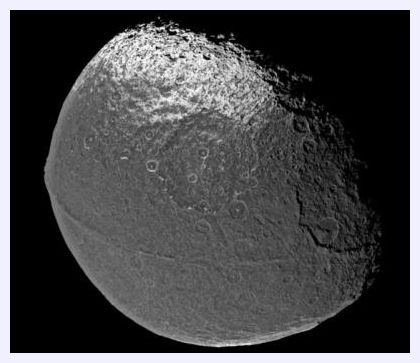
© NASA/JPL/SSIA ridge that follows the equator of Saturn's moon Iapetus gives it the appearance of a giant walnut. The ridge, photographed in 2004 by the Cassini spacecraft, is 100 kilometers (62 miles) wide and at times 20 kilometers (12 miles) high. (The peak of Mount Everest, by comparison, is 5.5 miles above sea level.) Scientists are debating how the ridge might have formed.

For centuries, people wondered how the leopard got its spots. The consensus is pretty solid that evolution played a major role.

But it's only been five years since the arrival of high-resolution Cassini Mission images of Saturn's bizarre moon Iapetus that the international planetary community has pondered the unique walnut shape of the large (735 kilometer radius) body, considered by many to be one of the most astonishing features in the solar system.

And there's no consensus as to how a mysterious large ridge that covers more than 75 percent of the moon's equator was formed. It's been a tough nut to crack.

But now a team including an outer solar system specialist from Washington University in St. Louis has proposed a giant impact explains the ridge, up to 20 kilometers tall and 100 kilometers wide.

William B. McKinnon, PhD, Washington University professor of earth and planetary sciences in Arts & Sciences, and his former doctoral student, Andrew Dombard, PhD, associate professor of earth and environmental sciences at the University of Illinois Chicago (UIC), propose that at one time Iapetus itself had a satellite, or moon, created by a giant impact with another big body. The sub-satellite's orbit, they say, would have decayed because of tidal interactions with Iapetus, and it would have gradually migrated towards Iapetus. At some point, the researchers say, the tidal forces would have torn the sub-satellite apart, forming a ring of debris around Iapetus that would eventually slam into the moon near its equator.

Bizarro Earth

Hitler's Christmas Party: Rare Photographs Capture Leading Nazis Celebrating in 1941

Image
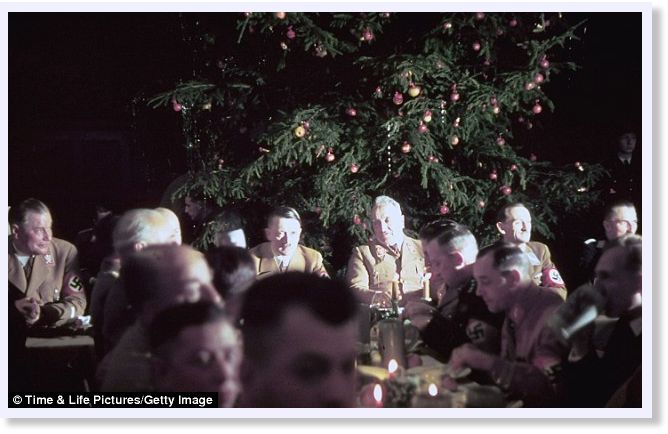
© Time & Life Pictures/Getty ImageHigh command: Adolf Hitler and other Nazi officials celebrate Christmas at the Lowenbraukeller restaurant in Munich on December 18, 1941.
A less festive bunch it's hard to imagine.

This is Hitler and his henchmen celebrating Christmas in 1941 - not that you'd know it from their glum expressions.

These probably had something to do with the recent dispiriting failure of Nazi attempts to seize Moscow and take control of Russia.

The pictures from December 18, which have only just come to light, show Hitler and his generals at a party for SS officer cadets in Munich.

But the Nazi Christmas was far from traditional.

Hitler believed religion had no place in his 1,000-year Reich, so he replaced the Christian figure of Saint Nicholas with the Norse god Odin and urged Germans to celebrate the season as a holiday of the 'winter solstice', rather than Christmas.

Out of sight at the top of the tree behind Hitler was a swastika instead of an angel, and many of the baubles carried runic symbols and iron cross motifs. The remarkable pictures were captured by Hugo Jaeger, one of the Fuhrer's personal photographers.

Sherlock

Pills Found in a 2,000-Year-Old Shipwreck Give Clues to Ancient Medicine

Scientists had discovered pills in a 2,000-year-old shipwreck around 21 years ago.

Now they are trying to unravel the mystery of whether the pills were, in fact, created and used as effective plant-based medicines.

Around 130 B.C., a ship, identified as the Relitto del Pozzino, sank off Tuscany, Italy. Among the artifacts found on board in 1989 were glass cups, a pitcher and ceramics.

Its cargo also included a chest that contained various items related to the medical profession: a copper bleeding cup and 136 boxwood vials and tin containers, reports AOL News.

Inside one of the tin vessels, archaeologists found several circular tablets, many still completely dry.

Using DNA sequencing, Robert Fleischer, an evolutionary geneticist with the Smithsonian's Center for Conservation and Evolutionary Genetics in Washington, D.C, has identified some of the plant components in the tablets - carrot, radish, parsley, celery, wild onion, cabbage, alfalfa, oak and hibiscus.