Science & TechnologyS


Sun

Vast Hole in The Sun's Atmosphere

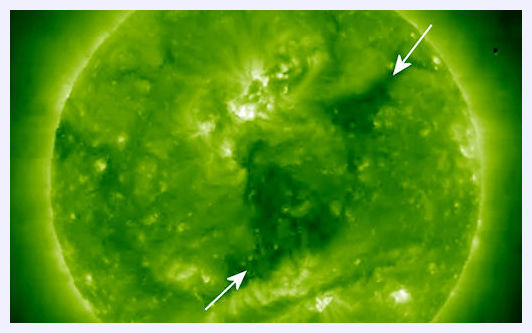
NASA's STEREO-B spacecraft is monitoring a vast hole in the sun's atmosphere--a "coronal hole." It's the dark region denoted by arrows in this extreme ultraviolet image taken during the early hours of Dec. 30th.

Coronal Hole
© SpaceWeather.com
Coronal holes are places in the sun's atmosphere where the solar magnetic field opens up and allows solar wind to escape. A stream of solar wind flowing from this coronal hole should reach Earth on Jan. 2nd or 3rd--the first solar wind stream of the New Year! High-latitude sky watchers should be alert for auroras.

Info

Astronomers Discover New Planet in Planetary System Very Similar to Our Own

New Planet
© Space Aero

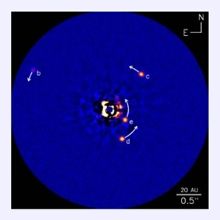
An international team of astronomers has discovered and imaged a fourth giant planet outside our solar system, a discovery that further strengthens the remarkable resemblances between a distant planetary system and our own.

The research is published 8 December in the advance online version of the journal Nature.

The astronomers say the planetary system resembles a supersized version of our solar system.

"Besides having four giant planets, both systems also contain two 'debris belts' composed of small rocky or icy objects, along with lots of tiny dust particles," said Benjamin Zuckerman, a UCLA professor of physics and astronomy and co-author of the Nature paper.

Our giant planets are Jupiter, Saturn, Uranus and Neptune, and our debris belts include the asteroid belt between the orbits of Mars and Jupiter and the Kuiper Belt, beyond Neptune's orbit.

Satellite

Russian Space Officials Fired Over Satellite Crash

Image
© Reshetnev CompanyGLONASS-M
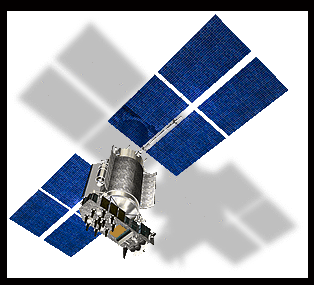
President Dmitry Medvedev fired two senior Russian space officials Wednesday over the loss of three navigation satellites that crashed into the sea this month.

The GLONASS satellites, intended for Russia's rival to the American GPS system, a project dear to the Kremlin, were lost because the Proton M rocket carrying them into orbit was loaded with too much fuel, a investigating commission found.

A Kremlin spokeswoman said the deputy head of the Russian space agency Roskosmos, Viktor Remishevsky, and the deputy head of the Russian rocket manufacturer Energia, Vyacheslav Filin, had both been fired over the calculation error.

Medvedev also issued an official reprimand to Roskosmos head Anatoly Perminov.

The satellites were to be the last of 24 needed for Russia to fully deploy GLONASS -- short for Global Navigation System -- next year.

Alarm Clock

Americans Turn To Technology To Control Impulsive Behavior

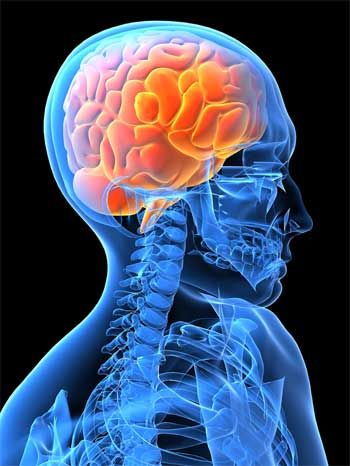
illumined brain graphic
© unknown
Dan Nainan can't trust himself to work at his computer without clicking on distractions, so he uses an Internet-blocking program to shut down his Web access twice a day.

"I'm sorry, but try as I might, I could never, ever do this on my own," said the New York City comedian who's struggling to finish a book. "I wish I could, but I just don't have the discipline."

Nainan's system of two, two-hour blocks is one example of how Americans are trying to control their impulses using technology that steps in to enforce good behavior.

With the new year days away, many tools are now available to help people stay in line, including a GPS-enabled app that locks down texting once a car gets rolling and a program that cuts off credit-card spending. Another device monitors your workout and offers real-time voice feedback.

Have we entered an era in which electronics serve as mother, cop and coach because we can't manage our own desires?

Yep, said Ann Mack, a trend-watcher for JWT Intelligence, an arm of the marketing giant. She named "outsourcing self-control" and "de-teching" as two top trends for the new year.

"The thing is we're becoming more aware of these behaviors, and as a result, we're trying to seek help to circumvent some of our more base impulses," Mack said. "We're bombarded more and more with temptations on a regular basis, and it's getting increasingly difficult to deal with that."

Tools to cope with temptation are everywhere.

Sun

Solar Max Could Spell Trouble

Our Sun
© ComstockAt its angriest, the sun can emit tides of electromagnetic radiation and charged matter known as coronal mass ejections, or CMEs, emitting electromagnetic burts that could disrupt satellites and other technology.

The coming year will be an important one for space weather as the sun pulls out of a trough of low activity and heads into a long-awaited and possibly destructive period of turbulence.

Many people may be surprised to learn that the sun, rather than burn with faultless consistency, goes through moments of calm and tempest.

But two centuries of observing sunspots -- dark, relatively cool marks on the solar face linked to mighty magnetic forces -- have revealed that our star follows a roughly 11-year cycle of behavior.

The latest cycle began in 1996 and for reasons which are unclear has taken longer than expected to end.

Now, though, there are more and more signs that the sun is shaking off its torpor and building towards "Solar Max," or the cycle's climax, say experts.

"The latest prediction looks at around midway 2013 as being the maximum phase of the solar cycle," said Joe Kunches of NASA's Space Weather Prediction Center.

But there is a prolonged period of high activity, "more like a season, lasting about two and a half years," either side of the peak, he cautioned.

At its angriest, the sun can vomit forth tides of electromagnetic radiation and charged matter known as coronal mass ejections, or CMEs.

Robot

S.Korea Schools Get Robot English Teachers

Robot Teacher
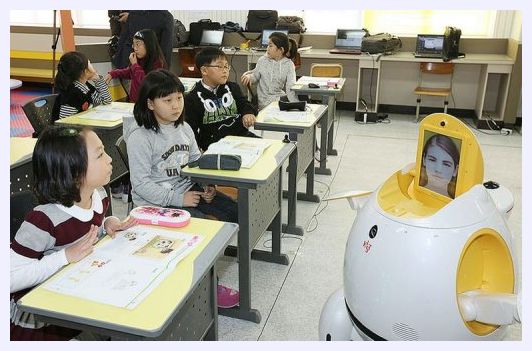
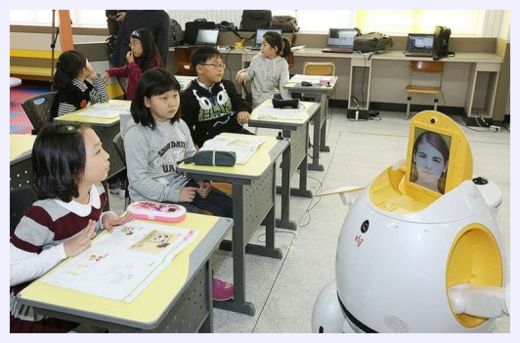
© PhysorgAn English-teaching robot (R), "Engkey", stands in front of children at an elementary school in Daegu, southeast of Seoul. The 29 robots, about one metre (3.3 feet) high with a TV display panel for a face, wheeled around the classroom while speaking to the students, reading books to them and dancing to music by moving their head and arms.

Almost 30 robots have started teaching English to youngsters in a South Korean city, education officials said Tuesday, in a pilot project designed to nurture the nascent robot industry.

Engkey, a white, egg-shaped robot developed by the Korea Institute of Science of Technology (KIST), began taking classes Monday at 21 elementary schools in the southeastern city of Daegu.

The 29 robots, about one metre (3.3 feet) high with a TV display panel for a face, wheeled around the classroom while speaking to the students, reading books to them and dancing to music by moving their head and arms.

The robots, which display an avatar face of a Caucasian woman, are controlled remotely by teachers of English in the Philippines -- who can see and hear the children via a remote control system.

Cameras detect the Filipino teachers' facial expressions and instantly reflect them on the avatar's face, said Sagong Seong-Dae, a senior scientist at KIST.

"Well-educated, experienced Filipino teachers are far cheaper than their counterparts elsewhere, including South Korea," he told AFP.

Apart from reading books, the robots use pre-programmed software to sing songs and play alphabet games with the children.

"The kids seemed to love it since the robots look, well, cute and interesting. But some adults also expressed interest, saying they may feel less nervous talking to robots than a real person," said Kim Mi-Young, an official at Daegu city education office.

Network

Living Earth Simulator Aims to 'Simulate Everything'

The Earth
© APThe Living Earth Simulator will collect data from billions of sources
It could be one of the most ambitious computer projects ever conceived.

An international group of scientists are aiming to create a simulator that can replicate everything happening on Earth - from global weather patterns and the spread of diseases to international financial transactions or congestion on Milton Keynes' roads.

Nicknamed the Living Earth Simulator (LES), the project aims to advance the scientific understanding of what is taking place on the planet, encapsulating the human actions that shape societies and the environmental forces that define the physical world.

Cell Phone

EU one step closer to global standard mobile-phone charger

The days of e-mailing the whole office to ask if anyone has a mobile-phone charger that fits your phone are numbered, as European standardization bodies on Wednesday released harmonized standards for a common charger. The move is the latest in the European Union's plans to introduce a global common mobile-phone charger, sparing business travelers in particular the frustration of being unable to find a suitable charger as their phone battery runs out.

The European Committee for Electrotechnical Standardization (CENELEC) and the European Telecommunications Standards Institute (ETSI) have released the standards for interoperability needed for the manufacture of data-enabled mobile phones compatible with a new common charger. The compatibility will be on the basis of Micro-USB connectors. The new standards take into account safety risks and electro-magnetic emissions and ensure that common chargers have sufficient immunity to external interference.

As well as inconvenience for consumers, incompatibility of chargers is also a considerable environmental problem as users who change their mobile phones must usually acquire a new charger and dispose of the old one.

Meteor

2000th Comet Spotted By SOHO

200th Comet
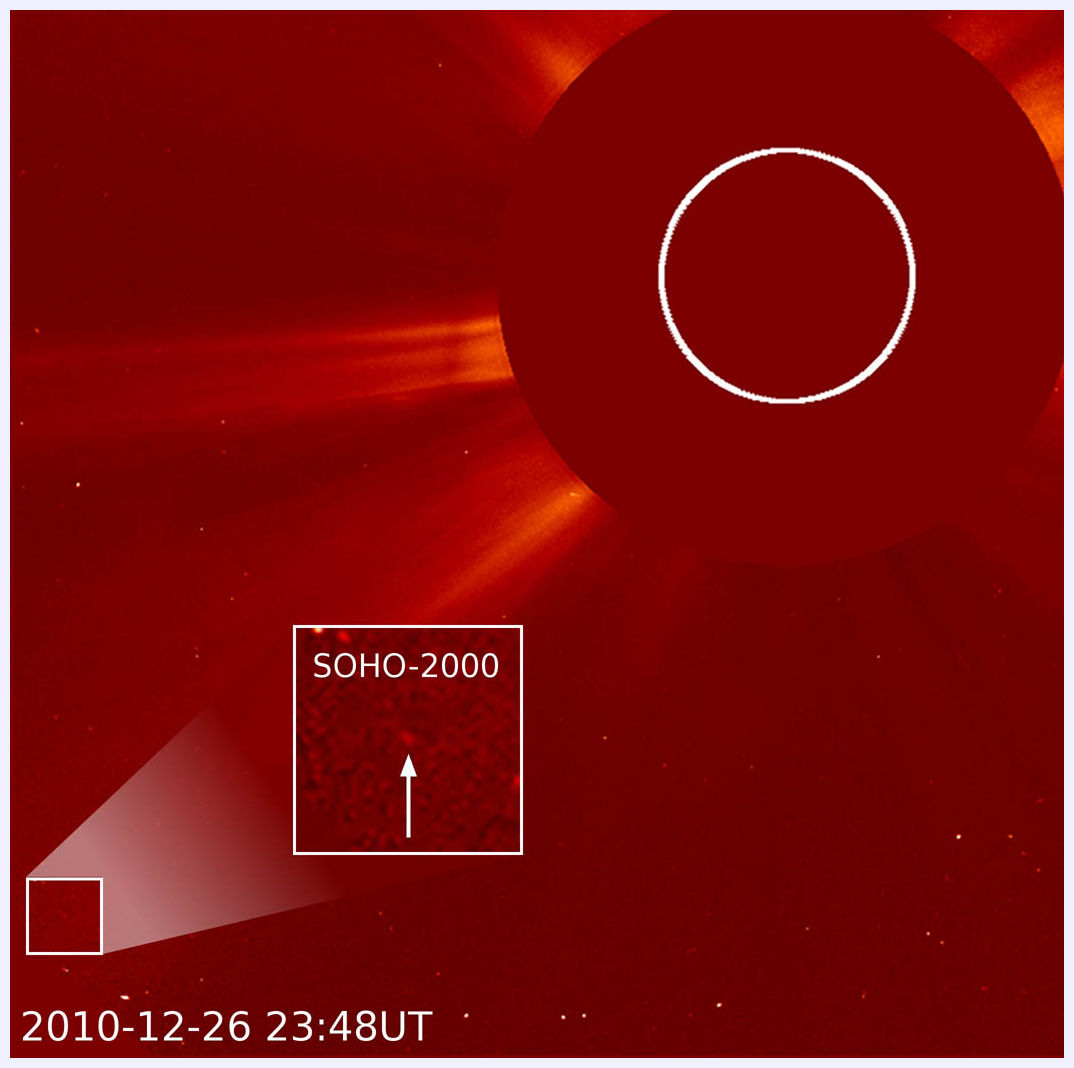
© SOHO/Karl BattamsSOHO's 2000th comet, spotted by a Polish amateur astronomer on December 26, 2010.
As people on Earth celebrate the holidays and prepare to ring in the New Year, an ESA/NASA spacecraft has quietly reached its own milestone: on December 26, the Solar and Heliospheric Observatory (SOHO) discovered its 2000th comet.

Drawing on help from citizen scientists around the world, SOHO has become the single greatest comet finder of all time. This is all the more impressive since SOHO was not specifically designed to find comets, but to monitor the sun.

"Since it launched on December 2, 1995 to observe the sun, SOHO has more than doubled the number of comets for which orbits have been determined over the last three hundred years," says Joe Gurman, the U.S. project scientist for SOHO at NASA's Goddard Space Flight Center in Greenbelt, Md.

Of course, it is not SOHO itself that discovers the comets -- that is the province of the dozens of amateur astronomer volunteers who daily pore over the fuzzy lights dancing across the pictures produced by SOHO's LASCO (or Large Angle and Spectrometric Coronagraph) cameras. Over 70 people representing 18 different countries have helped spot comets over the last 15 years by searching through the publicly available SOHO images online.

The 1999th and 2000th comet were both discovered on December 26 by Michal Kusiak, an astronomy student at Jagiellonian University in Krakow, Poland. Kusiak found his first SOHO comet in November 2007 and has since found more than 100.

Info

Managing Scientific Inquiry in a Laboratory the Size of the Web

Hanny van Arkel
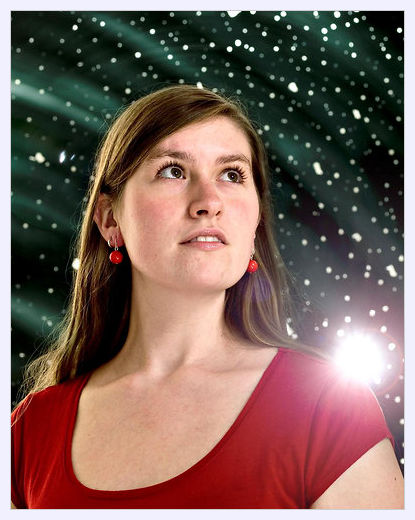
© Adrie MouthaanThe namesake Hanny van Arkel, a Dutch schoolteacher, discovered the body known as Hanny’s Voorwerp by studying deep-space images.

Hanny van Arkel had been using the Galaxy Zoo website less than a week when she noticed something odd about the photograph of IC 2497, a minor galaxy in the Leo Minor constellation. "It was this strange thing," she recalled: an enormous gas cloud, floating like a ghost in front of the spiral galaxy.

A Dutch schoolteacher with no formal training in astronomy, Ms. van Arkel had joined tens of thousands of other Web volunteers to help classify photographs taken by deep-space telescopes. Stumped by the unusual image on her computer screen, she e-mailed the project staff for guidance. Staff members were stumped, too. And thus was christened the celestial body now known to astronomers worldwide as Hanny's Voorwerp (Dutch for "object").

Stories like Ms. van Arkel's are becoming more common, as the Internet opens up new opportunities for so-called citizen scientists. And as millions of people get involved in these participatory projects, scientists are grappling with how best to harness the amateurs' enthusiasm.

Some critics argue that citizen science projects are often little more than ploys to stimulate public interest rather than advance scientific knowledge. Others fret over the quality of data generated by nonspecialists. But scientists must weigh such risks against the benefits of a powerful new research tool: a vast computer network that can parcel out complex projects into small tasks that can be completed by individuals with relatively limited training.