
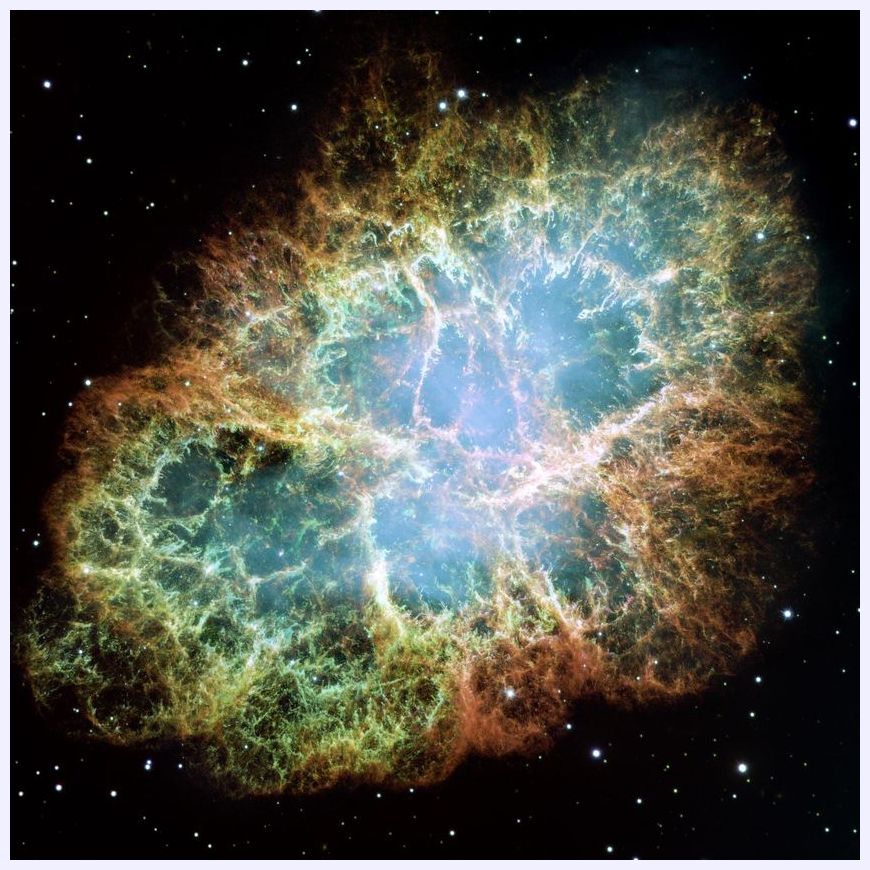
© NASA/ESAFermi's Large Area Telescope has recently detected two short-duration gamma-ray pulses coming from the Crab Nebula, which was previously believed to emit radiation at very steady rate. The pulses were fueled by the most energetic particles ever traced to a discrete astronomical object.
The Crab Nebula, one of our best-known and most stable neighbors in the winter sky, is shocking scientists with a propensity for fireworks - gamma-ray flares set off by the most energetic particles ever traced to a specific astronomical object. The discovery, reported today by scientists working with two orbiting telescopes, is leading researchers to rethink their ideas of how cosmic particles are accelerated.
"We were dumbfounded," said Roger Blandford, who directs the Kavli Institute for Particle Astrophysics and Cosmology, jointly located at the Department of Energy's SLAC National Accelerator Laboratory and Stanford University. "It's an emblematic object," he said; also known as M1, the Crab Nebula was the first astronomical object catalogued in 1771 by Charles Messier. "It's a big deal historically, and we're making an amazing discovery about it."
Blandford was part of a KIPAC team led by scientists Rolf Buehler and Stefan Funk that used observations from the Large Area Telescope, one of two primary instruments aboard NASA's Fermi Gamma-ray Space Telescope, to confirm one flare and discover another. Their report was posted online today in Science Express alongside a report from the Italian orbiting telescope Astro‐rivelatore Gamma a Immagini LEggero, or AGILE, which also detected gamma-ray flares in the Crab Nebula.
The Crab Nebula, and the rapidly spinning neutron star that powers it, are the remnants of a supernova explosion documented by Chinese and Middle Eastern astronomers in 1054. After shedding much of its outer gases and dust, the dying star collapsed into a pulsar, a super-dense, rapidly spinning ball of neutrons that emits a pulse of radiation every 33 milliseconds, like clockwork.












Comment: Though controversy always surrounds any invention claiming to produce "perpetual motion", it is the mandate of true science to investigate these claims. How many other such inventions have not been examined either to be authenticated or disproved?