Science & TechnologyS


Telescope

Most detailed image of night sky unveiled

Image
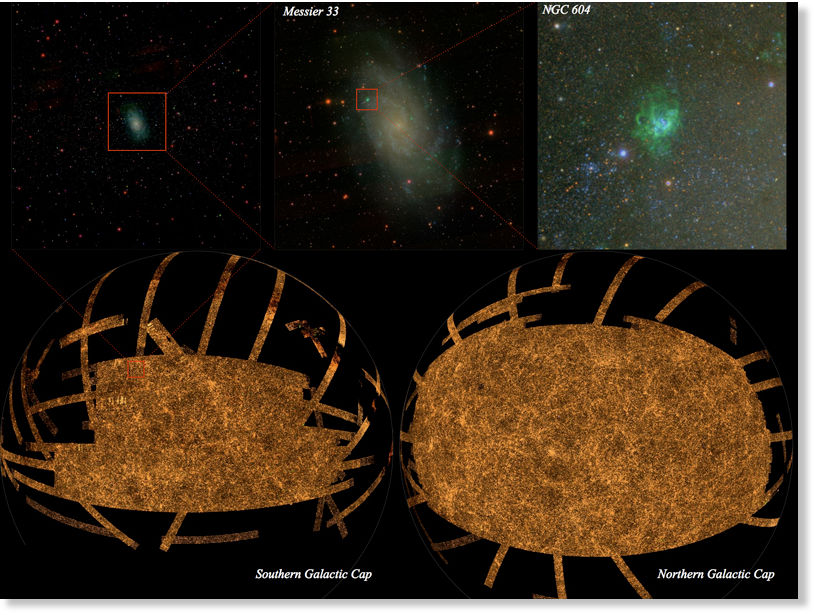
© M. Blanton and SDSS-IIIImages of the northern and southern hemispheres of our galaxy (bottom) reveal "walls" of galaxies that are the largest known structures in the universe. Zooming in on a patch of sky in the southern hemisphere reveals the spiral galaxy M33 (top left). Zooming in further (top centre) reveals a region of intense star formation known as NGC 604 (green swirls, top right)
It would take 500,000 high-definition TVs to view it in its full glory. Astronomers have released the largest digital image of the night sky ever made, to be mined for future discoveries.

It is actually a collection of millions of images taken since 1998 with a 2.5-metre telescope at Apache Point Observatory in New Mexico. The project, called the Sloan Digital Sky Survey, is now in its third phase, called SDSS-III.

Altogether, the images in the newly released collection contain more than a trillion pixels of data, covering a third of the sky in great detail.

"This is one of the biggest bounties in the history of science," says SDSS team member Mike Blanton of New York University in New York City. "This data will be a legacy for the ages."

Cloud Lightning

Thunderstorms Shoot Antimatter Beams Into Space

"This is a fundamental new discovery about how our planet works," expert says.

Image
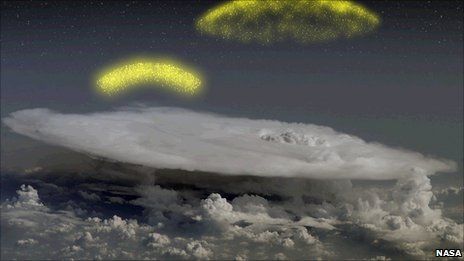
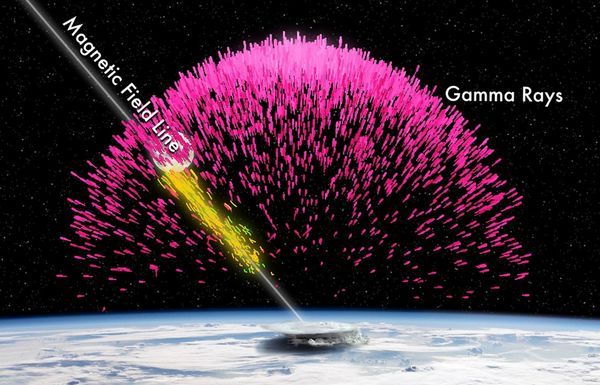
© J. Dwyer/FIT, NASAAn illustration shows high-energy electrons and positrons from Earth traveling into space.
Thunderstorms can shoot beams of antimatter into space - and the beams are so intense they can be spotted by spacecraft thousands of miles away, scientists have announced.

Most so-called normal matter is made of subatomic particles such as electrons and protons. Antimatter, on the other hand, is made of particles that have the same masses and spins as their counterparts but with opposite charges and magnetic properties.

Recently, radiation detectors on NASA's Fermi Gamma-ray Space Telescope lighted up for about 30 milliseconds with the distinctive signature of positrons, the antimatter counterparts of electrons.

Scientists were able to trace the concentrated burst of radiation to a lightning flash over Namibia, at least 3,000 miles (5,000 kilometers) away from the Earth-orbiting telescope, which was passing above Egypt at the time.

"This is a fundamental new discovery about how our planet works," said Steven Cummer, a lightning researcher from Duke University who was not part of the study team.

Chalkboard

Antimatter caught streaming from thunderstorms on Earth

Image
© National Aeronautics and Space AdministrationArtist's conception of rising electrons Electrons racing up electric field lines give rise to light, then particles, then light
A space telescope has accidentally spotted thunderstorms on Earth producing beams of antimatter.

Such storms have long been known to give rise to fleeting sparks of light called terrestrial gamma-ray flashes.

But results from the Fermi telescope show they also give out streams of electrons and their antimatter counterparts, positrons.

The surprise result was presented by researchers at the American Astronomical Society meeting in the US.

It deepens a mystery about terrestrial gamma-ray flashes, or TGFs - sparks of light that are estimated to occur 500 times a day in thunderstorms on Earth. They are a complex interplay of light and matter whose origin is poorly understood.

Telescope

Hubble Telescope Zeroes in on Green Blob in Space

Image
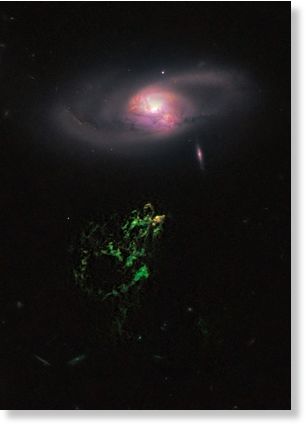
© Associated Press/Hubble Space Telescope Science InstituteThis handout photo provided by NASA, taken April 12, 2010 by the Hubble Space Telescope, shows an unusual, ghostly green blob of gas appears to float near a normal-looking spiral galaxy. NASA released Monday the Hubble Space Telescope’s first picture of the mysterious giant glowing green blob of gas called Hanny’s Voorwerp. The blob is the size of our Milky Way galaxy and is 650 million light years away. Each light year is about 6 trillion miles. The blob was discovered in 2007 by Dutch school teacher Hanny van Arkel.
The Hubble Space Telescope got its first peek at a mysterious giant green blob in outer space and found that it's strangely alive.

The bizarre glowing blob is giving birth to new stars, some only a couple million years old, in remote areas of the universe where stars don't normally form.

The blob of gas was first discovered by a Dutch school teacher in 2007 and is named Hanny's Voorwerp (HAN'-nee's-FOR'-vehrp). Voorwerp is Dutch for object.

NASA released the new Hubble photo Monday at the American Astronomical Society meeting in Seattle.

Parts of the green blob are collapsing and the resulting pressure from that is creating the stars. The stellar nurseries are outside of a normal galaxy, which is usually where stars live.

That makes these "very lonely newborn stars" that are "in the middle of nowhere," said Bill Keel, the University of Alabama astronomer who examined the blob.

The blob is the size of our own Milky Way galaxy and it is 650 million light years away. Each light year is about 6 trillion miles.

The blob is mostly hydrogen gas swirling from a close encounter of two galaxies and it glows because it is illuminated by a quasar in one of the galaxies. A quasar is a bright object full of energy powered by a black hole.

Eye 1

Methane from BP spill goes missing

Image
© Dave Valentine, UCSB

Methane, the predominant hydrocarbon produced by the BP blowout last year, has all but vanished from Gulf of Mexico waters, a new study reports - presumably eaten up by marine bacteria. That hadn't been expected to happen for years.

Two-thirds of the hydrocarbons released by the BP accident were forms of natural gas: largely methane, ethane and propane. While Gulf microbes quickly began devouring the larger gas molecules, they initially left tiny methane - which accounted for an estimated 87.5 percent of the gas initially emitted - largely untouched.

Some of the authors of the new paper had reported in the Oct. 8 Science finding almost no microbial breakdown of BP methane in June, about a month and a half into the 83-day gusher.

Info

Fermi Telescope Catches Thunderstorms Hurling Antimatter into Space


Scientists using NASA's Fermi Gamma-ray Space Telescope have detected beams of antimatter produced above thunderstorms on Earth, a phenomenon never seen before.

Scientists think the antimatter particles were formed in a terrestrial gamma-ray flash (TGF), a brief burst produced inside thunderstorms and shown to be associated with lightning. It is estimated that about 500 TGFs occur daily worldwide, but most go undetected.

"These signals are the first direct evidence that thunderstorms make antimatter particle beams," said Michael Briggs, a member of Fermi's Gamma-ray Burst Monitor (GBM) team at the University of Alabama in Huntsville (UAH). He presented the findings Monday, during a news briefing at the American Astronomical Society meeting in Seattle.

Fermi is designed to monitor gamma rays, the highest energy form of light. When antimatter striking Fermi collides with a particle of normal matter, both particles immediately are annihilated and transformed into gamma rays. The GBM has detected gamma rays with energies of 511,000 electron volts, a signal indicating an electron has met its antimatter counterpart, a positron.

Saturn

ESA releases splendid new space-scope pic of Andromeda

Neighbouring spiral galaxy refulgent in X-ray, infrared

The European Space Agency (ESA) has released an impressive composite snap of the closest spiral galaxy to the Milky Way - an infrared and X-ray mélange showing Andromeda in all its glory:

andromeda
© The Register

Telescope

NASA Ames scientists discover Earth-sized planet

The place is inhospitable, with molten temperatures and possibly clouds of melted silicon. But a discovery across the galaxy is giving hope to searchers of intelligent life.

A team led by NASA Ames researchers has confirmed the existence of the first rocky planet outside our solar system. Kepler-10b is closest in size to Earth of 519 extra-solar planets discovered so far. It is about 1½ times the Earth's diameter and speeding around a star similar to our sun in the constellation Cygnus, about 560 light-years away.

"It's unquestionably a rocky world orbiting a star outside our solar system," said Natalie Batalha, deputy science team lead for the Kepler Mission at NASA Ames. She and about 50 other scientists are publishing their discovery today in the Astrophysical Journal.

Unlike the majority of the so-called exoplanets detected so far, Kepler-10b is solid and not gaseous. "It's something you can stand on," she said.

Its size and composition are significant because an Earth-sized, solid planet is more likely to harbor water, essential for life. Kepler-10b, which is 20 times closer to its star than Mercury is to the sun, can't sustain life. But it still has astronomers excited.

In September, astronomers led by a UC Santa Cruz professor announced they had found what was probably a rocky planet, called Gliese 581g. But other scientists discounted the discovery, pointing to an error in data analysis. So its existence is unconfirmed.

Black Cat

Invisible tanks could be on battlefield within five years

invisible tank
Unlike conventional forms of camouflage, the images on the hull would change in concert with the changing environment always insuring that the vehicle remains disguised

Armoured vehicles will use a new technology known as "e-camouflage" which deploys a form "electronic ink" to render a vehicle "invisible".

Highly sophisticated electronic sensors attached to the tank's hull will project images of the surrounding environment back onto the outside of the vehicle enabling it to merge into the landscape and evade attack.

The electronic camouflage will enable the vehicle to blend into the surrounding countryside in much the same way that a squid uses ink to help as a disguise.

Info

Babies Actually 'Speak' Like Adults Do

Baby understands
© Brad.K on FlickrBabies understand the words they hear.

Most new parents adopt baby talk when addressing their children, but they should know that their babies, even if they are too young to talk, understand many of the words adults say, since their brains process them in a grown-up way.

Scientists at the University of California, San Diego, used MRI and MEG technologies to show that babies barely over a year old process the words they hear with the same brain structures as adults do, and during the same amount of time too.

Also, the babies' brains are not just processing the words as if they were sounds, but are actually seizing their meaning.

MEG - an imaging process that measures tiny magnetic fields emitted by neurons in the brain, was used to establish whether babies use the same functional networks to process word meaning as adults, and MRI helped estimate the brain activity of babies aged 12 to 18 months.

In the first of the two experiments, the babies listened to a series of words and to sounds that were similar to those words but had no meaning, so that researchers could see whether they were able to make the difference between the two or not.

Then, the scientists wanted to see whether the babies were able to understand the meaning of these words, so they showed them pictures of familiar objects and played either matched or mismatched words - for example after a picture of a ball, they would play the word 'ball' or another word, like dog.

The amplitude of brain activity showed that the infants were capable of detecting the mismatch between a picture and a word - the MRI showed a brain response in the same left frontotemporal areas that process word meaning in adults.

Adults underwent the same tests to confirm the brain responses in the same brain areas.