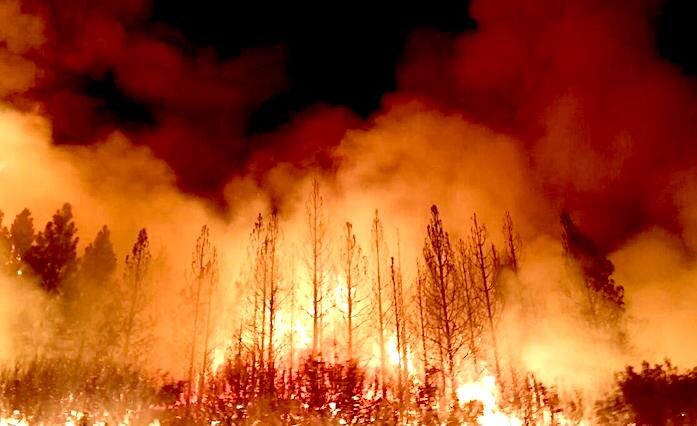
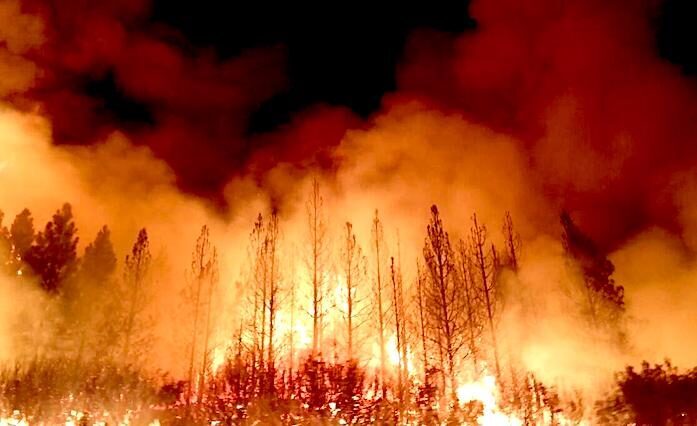
© US Forest ServiceThe Rim Fire Stanislaus National Forest, California 2013
Last Wednesday, Matt McGrath
reported on the BBC that the amount of tree cover being burned has nearly doubled over the past 20 years. Of the 9.3 million hectares burnt globally, Russia was alleged to account for more than a half. Of course,
climate change was said to be a "key factor" in the increase. There is no factual basis for this claim, needless to say. Take the word of Greenpeace, which
recently reported Russian government statistics that showed
"nine out of ten wildfires in the country were caused by humans".McGrath, of course, was complying with the Corporation's strictly-enforced agenda that says that almost every natural disaster and episode of extreme weather
should be blamed on humans burning fossil fuel. The ultimate political agenda is the command-and-control
Net Zero fantasy. Climate change was said to be the key factor by McGrath because it leads to higher temperatures and drier conditions. Except, it might be added,
when global temperatures pause, as they have throughout most of the 21st century,
droughts turn into floods, etc., etc.The
data on tree loss comes from
Global Forest Watch (GFW), which uses information taken from orbiting satellites. Last year was said to be the second worst year on record. "It's roughly twice what it was just 20 years ago. It is kind of astonishing just how much fire activity has increased over such a short amount of time," said James MacCarthy, an analyst with GFW.
The data used by GFW is taken from a number of Landstat satellites and processed by the Global Land Analysis and Discovery (GLAD) laboratory at the
University of Maryland.
But the GLAD data comes with a number of important warnings and caveats. The first satellites used in the 20-year record provided less data and there are gaps in the record. There was improved performance from 2012, but GLAD warned that
"such changes in the mapping method can result in year-to-year inconsistencies". Additionally,
"models have been iterated to improve performance in the 2012-forward period". Care must be taken when comparing change across any interval, it cautioned.













Comment: More on Klinefelter syndrome from wiki: See also: