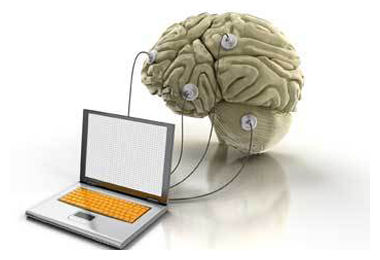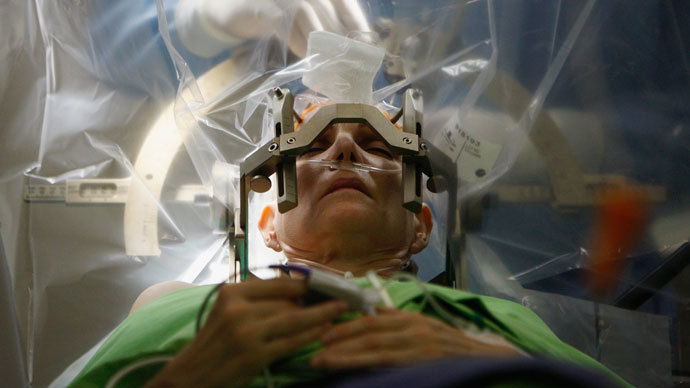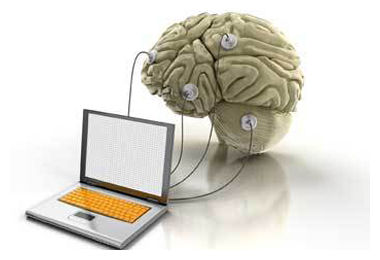
© BrainGate 2, www.braingate2.orgSome futurists predict humans will be able to upload their consciousness to computers in the near future.
New York - By 2045, humans will achieve digital immortality by uploading their minds to computers - or at least that's what some futurists believe. This notion formed the basis for the Global Futures 2045 International Congress, a futuristic conference held here June 14-15.
The conference, which is the brainchild of Russian multimillionaire Dmitry Itskov, fell somewhere between hardcore science and science fiction. It featured a diverse cast of speakers, from scientific luminaries like Ray Kurzweil, Peter Diamandis and Marvin Minsky, to Swamis and other spiritual leaders.
In the year 2045Kurzweil - an inventor, futurist and now director of engineering at Google - predicts that by 2045, technology will have surpassed human brainpower to create a kind of superintelligence - an event known as
the singularity. Other scientists have said that
robots will overtake humans by 2100.
According to Moore's law, computing power doubles approximately every two years. Several technologies are undergoing similar exponential advances, from genetic sequencing to
3D printing, Kurzweil told conference attendees. He illustrated the point with a series of graphs showing the inexorable upward climb of various technologies.
By 2045, "based on conservative estimates of the amount of computation you need to functionally simulate a human brain, we'll be able to expand the scope of our intelligence a billion-fold," Kurzweil said.
Itskov and other so-called "transhumanists" interpret this impending singularity as digital
immortality. Specifically, they believe that in a few decades, humans will be able to upload their minds to a computer, transcending the need for a biological body. The idea sounds like sci-fi, and it is - at least for now. The reality, however, is that neural engineering is making significant strides toward modeling the brain and developing technologies to restore or replace some of its biological functions.