
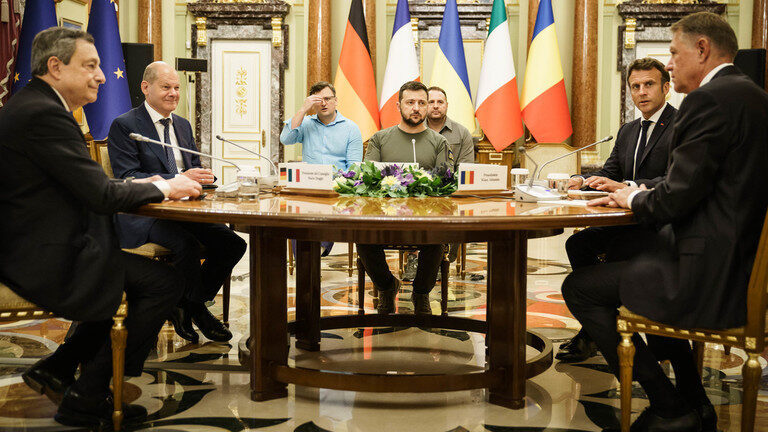
© Jesco Denzel/Getty ImagesGerman Chancellor Olaf Scholz (2nd L) sits at the table with Mario Draghi (L), Italy's Prime Minister, Volodymyr Selensky, Ukrainian President, (C) Emmanuel Macron, France's President, (2nd R) and Klaus Iohannis, Romania's President (R) on June 16, 2022 in Kyiv, Ukraine.
If for President Vladimir Zelensky Ukraine's failures in Washington represent a serious disappointment after all the promises he was made earlier, for the EU the slowdown in money represents an opportunity to negotiate with the US.
The EU, both internally and externally, is in such a state currently that the start of negotiations on the accession of Ukraine or Moldova cannot cause serious damage. However, given the weak hand that the bloc has at its disposal, even such a flimsy agreement can be considered a small foreign policy success by its leaders.
The EU summit's decision doesn't change anything. It was all about relations with the main actors on the international stage - the US, Russia, and China - and had nothing to do with the bloc's own development for the benefit of its citizens. Indeed, this has long since ceased to be the goal of European politicians, who do not particularly link their personal prospects to the future of the states they lead.
Officially, Hungary was the main obstacle to positive decisions on aid to Ukraine and potential membership for Kiev. In reality, the situation is much more complicated, and Brussels' main interlocutor here is its ally - the US. For the Western Europeans themselves, it is not a big problem to allocate funds to Kiev or to start negotiations with it on EU membership.
First of all, we should probably start with the fact that €50 billion - which Budapest held up - is not a huge amount of money in itself. For example, it is 12 times less than the first announced part of the EU fund set up in 2020 to help the countries and sectors most affected by the coronavirus pandemic.
We know very well how the EU likes to spend its money, and there is no doubt that a lot of it will be divided among European companies and various consultancies that provide services to the Ukrainian government. The Ukrainian economy itself will get very little if the funds are allocated. All the more so because the proposal is to spread everything over a number of years, which will make it possible to stop spending if political circumstances change.
The main question for EU countries is therefore what the Americans will or will not give to Kiev. Western Europeans rightly see the conflict with Russia over Ukraine as a US affair. The German or French authorities are ready to help Kiev's leaders with arms and money, but they have no illusions about where their true loyalties lie. Berlin, Paris and Rome realize that the EU's influence in Ukraine has long been lost and that they are paying for a regime that serves the interests of the US and, to a lesser extent, the UK.
The situation in the US is currently uncertain as the struggle between the main political forces intensifies. The level of future assistance to Ukraine depends on the domestic political situation, which is dominated by preparations for the 2024 presidential election. Domestic issues, in particular immigration policy, are therefore coming to the fore.
Recent visits by Ukrainian officials to Washington have brought no tangible results: it is becoming increasingly clear how far their problems are from what the American establishment really cares about. And while for Kiev this is a serious disappointment after all the promises made earlier, for the EU the slowdown in American aid is an opportunity to negotiate with Washington.
Despite the fact that anti-Russian sentiment dominates in Western European political circles, no one in the EU, with the exception of some in Poland and the former Soviet Baltic republics, sees the conflict with Russia as a personal matter. And while the US is unable to make a decision on further aid to Kiev, the major EU countries have no reason to rush into decisions on sending their own money. Of course, nobody in Germany or France will talk about it openly
In this sense the presence of a country like Hungary in the EU only helps them: everything can be blamed on Budapest's intransigence.
There is every reason to believe that the bloc will postpone any concrete decisions until the US has made up its mind.
The issue of opening negotiations with Kiev and Chisinau on EU accession was a hotly debated one even on the outside. At the same time, the position of the majority of Western European countries is based on the fact that starting negotiations does not necessarily mean they will conclude in the foreseeable future. The EU has decades of experience with the never-ending process of preparing for Turkey's accession. That is why Germany and France see the start of the negotiation process as a completely non-binding decision, which Emmanuel Macron has openly stated. But it can be seen in the context of relations with the US, Russia and China.
In the first case, Brussels and Western European capitals will present their positive decision as an important step towards fulfilling Washington's wishes. As far as relations with Moscow are concerned, the statement on negotiations with Kiev and Chisinau is also seen from a purely political point of view: it can give the EU bargaining chips for future negotiations. The bloc also believes that it will demonstrate the seriousness of its intentions to China, which is closely monitoring the development of the conflict in Eastern Europe. In any case, the question of the future of Ukraine and Moldova is a third priority here. Joining the EU has long been no guarantee of receiving the benefits enjoyed by its core states.
In general, no one knows with certainty what a 'united Europe' will look like in 20-30 years' time. Politicians have long understood the need to think about how to preserve their union in a changing international environment. But they are unable to do so seriously: there is too much uncertainty within the EU countries themselves, and the prospects for their economic development and relations with the US are unclear. The European integration we know from the achievements of the 1990-2000s is long gone. What will replace it is unclear, even in general terms. Many seem to be prepared to make it so loose and politically fragmented that even the formal membership of Ukraine and Moldova will not be a particular problem.
This article was first published by 'Vzglyad' newspaper, translated and edited by the RT ream



Comment:
EU weakness with respect to the US is hardly a new concept, below are a few indications:
- Is the Turkish minister right on that point, or is he exaggerating?
- Putin accuses EU of being a doormat for US
- Fresh anti-Russia sanctions to cause more damage to EU: Moscow
- Europe's role in Ukraine's war: EU's hand in the 2014 coup
- Macron issues warning on Europe's future
- What happens when you take a psycho's advice - 'Europe to pay for the whole mess in Ukraine'
- Lavrov: US and UK want 'real war' between Russia and EU
- To avoid losing control of Europe, the U.S. has a war plan for Europe and Russia
- West using 'Russia threat' as pretext to destabilize Europe: Lavrov
- Putin: EU is turning a blind eye to the fact that the Ukrainian troops are "directly targeting" civilians
- European Parliament bows to US masters, seeks hostile relations with Russia
- Germany buckles under new US sanctions: Abandons 5 projects of the Nord Stream-2
- No shame: US official Vicky 'f*ck the EU' Nuland praises Nord Stream 2 destruction
- Nord Stream 2 work in Germany is complete: 'We won't do US bidding, even if Biden is in charge', FM Maas says Well, Germany did do the US bidding, or was forced to accept the bombing of the pipeline, and more or less keep quiet about it.
- US denies 'preposterous' claim they 'sabotaged' Nord Stream 2 - as Trump shares video of Biden promising to 'bring an end' to pipeline
- The Empire sets 30-day deadline for European contractors to withdraw from Nord Stream 2 gas project: Obey immediately or face sanctions
- US State Department spokeswoman threatens to sanction European firms involved in Russian Nord Stream 2 pipeline
- Germany sees Russia as stable energy partner while US threatens Europe with sanctions unless it dumps Nord Stream 2 pipeline
- 'Very serious threats': US ramps up pressure on Nord Stream 2 contractors
- America's billion-dollar gas game: Nord Stream 2 threatens US energy exports to Europe
- EU Commissioner Oettinger: Nord Stream 2 is 'Unstoppable'
- A war Russia is set to win: The Europeans have been nicely played by the Americans - Former ambassador for India
- Bully at work: Firm laying Nord Stream 2 pipeline halts activity faced with 'crushing' US sanctions
- 'Unfair competition': Moscow blasts US move to enable sanctioning of Nord Stream 2 and TurkStream pipelines
- Kremlin tells Türkiye to wise up about EU
- Supreme Leader's advisor: Europe must wean itself from US 'dictate' or it will 'lose' (This is coming from Iran.)
- The EU doesn't know how to not be a vassal of the US any more
- US vassal state Germany approves first steps in trade deal with Canada, precursor to horrendous TTIP
- Merkel let the NSA in, turned Germany into another vassal of the US - German lawmaker
- US calls on vassal states in EU to put sanctions on Iranians developing missile program
- Top vassal country Denmark aims for NATO spending target with huge Ukraine aid package
- Poland continues to prove itself as a US vassal
- Vassal state Poland claims that paying more for US LNG over cheaper Russian gas 'increases sovereignty'
- Germany and Russia should be natural partners - but one of them is a US vassal state and the other is not
- Wishful thinking? Vassal state Germany suffers economic setback after Russian embargo, says only temporary
- U.S.-German secret treaty means Berlin is Washington's vassal until 2099
- Former German intelligence chief: In 1949 West Germany signed up to become United States vassal, NATO contemplated false-flag nuclear attack to 'cement' deal
- Skripal saga: Another chapter in the West's ongoing black propaganda war to force Russia into becoming one more imperial vassal state
- Lavrov: US efforts to turn Russia into its vassal are doomed to failure
- UK is becoming a vassal state to the US, says French presidential candidate
-
- "Britain lived in an equilibrium with Europe. But now it is becoming a vassal state, meaning it is becoming the junior partner of the United State," Macron said in an interview with France Culture radio on Friday, according to Reuters. (This was in 2017!)
- Being a US vassal state is expensive: France to pay €1.1 bn to Russia for cancelled Mistral ships
- Biden flies to Brussels to tell European vassal states that he finds them expressing their own thoughts on Russian sanctions to be 'inappropriate and annoying'
- Paul Craig Roberts: Paris attack designed to shore up France's US vassal status
Will the EU show more independence from the US with respect to Gaza, compared to what they have done so far regarding Ukraine, considering:Biden has damned the United States over Israel's Gaza genocide
The U.S. is complicit with Israel in the genocide in Gaza
If the EU countries wanted to fit even better into the US vassal role, what steps should the countries take?
If on the other hand, they wanted more independence, how might they go about that?