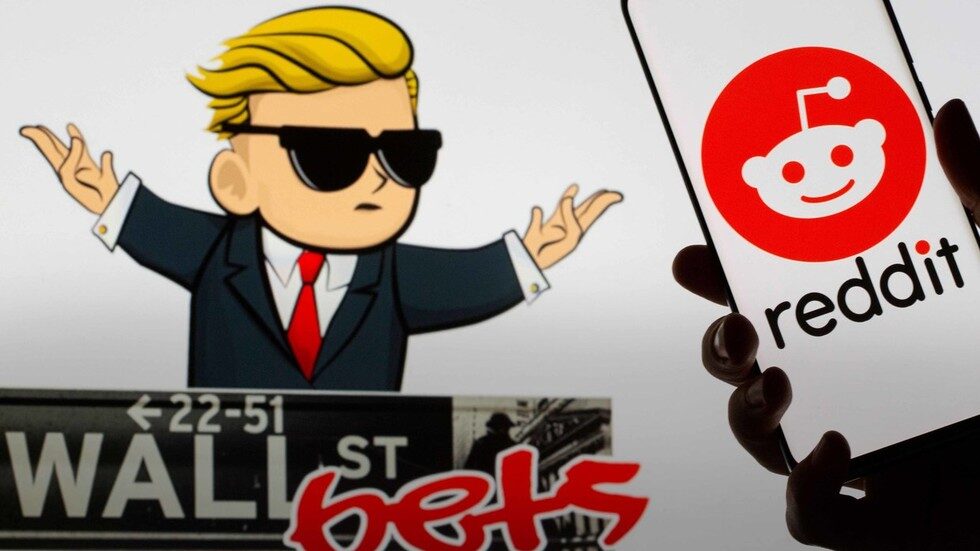
© REUTERS / Dado RuvicThe Reddit logo is seen on a smartphone in front of a displayed Wall Street Bets logo in this illustration taken January 28, 2021.
Potentially the biggest thing to rock the US financial system since the 2008 meltdown, it all started with GameStop, a bricks-and-mortar video game retailer. Already under pressure from the competing digital-purchase model, the firm found itself really struggling last year, with the lockdowns and subsequent economic slowdown severely affecting its business. Smelling the blood in the water, the Wall Street sharks started circling and shorting the company stock.
Short squeezeFor those not familiar with financial market terms, shorting means betting that something traded in a market will fall in price and trying to capitalize on it. The speculator borrows the thing - GameStop shares, in this case - at an interest and sells it at the current price. When the price falls (naturally or with a bit of nudging from interested parties), they buy the thing and return it to whomever they borrowed it from, pocketing the difference.
However, if the gamble goes wrong and the price goes up, the speculator loses money. Since stock can be overshorted -
with more shares borrowed by speculators than there exist on the market - any professional investor knows there is no limit to how much one can lose.
If traders panic, they will try to cut losses and rush to buy at a raised price, fueling an even faster growth, which is called a short squeeze.
GameStop shares experienced a short squeeze this month, largely thanks to a Reddit
community called WallStreetBets, which, as of now, has more than 5.6 million subscribers. Members decided the company was not doomed at all, based on some positive news, such as Microsoft agreeing in November to share with GameStop part of its digital revenues, or e-tailer billionaire Ryan Cohen investing in the company and then joining its board. Redditers took a contrarian strategy, buying GameStop stock and, thanks to their sheer numbers, pushing up its price.
Manipulation by the wrong people?The big losers in the big squeeze were the hedge fund Melvin Capital and the investment consultancy Citron, both of which shorted heavily against GameStop. Melvin even needed a $2.75 billion bailout to close its positions. Neither was happy about the loss, but one could argue that the reaction from them and other top players would not be as strong as it was if they had been had by some other large player and not a bunch of self-described
"degenerates."Stylistically speaking, WallStreetBets is the polar opposite of those well-compensated market creatures wearing expensive suits and moving about billions of their rich clients' wealth. The Redditers compare themselves to members of the anonymous online board 4chan but with
"a Bloomberg terminal illness," post memes, and use lingo an outsider might view as crazy, and insist that nothing in their community constitutes
"investment advice" - a disclaimer to ward off regulatory attention of the US Securities & Exchange Commission.
Predictably, the American financial elites have rallied to fix the situation. As GameStop stock skyrocketed this week, Nasdaq paused trading, saying it was necessary to stop
"manipulation" by the amateur traders. The bourse's CEO, Adena Friedman, went to CNBC to
discuss whether more regulation was necessary -
a notion that critics say would be angrily rejected if it were a Wall Street fat cat doing the manipulation.Banhammer!The ire of the 1 percent seems to have materialized in a series of decisions limiting the ability of the WallStreetBets community to do their thing with GameStop stock and other assets they perceive as undervalued.
Video messaging platform Discord banned the group for allegedly allowing "hateful and discriminatory content," claiming the ouster had nothing to do with the short squeeze. It failed to convince many. The subreddit itself briefly became private, however, reportedly after being pressured by the website administration.
More astoundingly, trading app Robinhood shut down the buying of those stocks earmarked by the Reddit investors. The app, which touts itself as an everyman's gate to the financial markets and was one of the primary venues for the community's trade, claimed it was necessary to curb volatility and save clients from losing their investments. But
many commenters believe it's nothing short of market manipulation meant to shield shorting corporate types from further harm.Fingers were pointed at the brokerage Citadel Securities, to which Robinhood outsources its trading and from which it received tens of millions of dollars in investments in 2020, as possibly having a hand. The company denied the accusations. Nevertheless, the app landed in hot water, with politicians from both sides of the political aisle condemning the move and calling for an
investigation and a class-action lawsuit filed against it.
Despite the pressure, the mood at WallStreetBets remains upbeat and dare-devilish. People there are posting memes and
calling on others
"to hold the line" and keep squeezing. Contrary to what the establishment
seems to think, anger and frustration rather than greed and boredom may be the driving forces here. To cite another popular meme,
"It's not about money, it's about sending a message."
Comment: The Reddit community remains
defiant in the rough-and-tumble language of the r/wallstreetbets board:
A tug of war emerged late last week after short-seller Citron Research said it had placed a bet against the stock and that the company was "pretty much in terminal decline". In response, the Reddit day traders pushed the price of the stock through the roof.
The war is still to be won, but the battle victory certainly appears to have gone to the Redditors.
The gains caused by the Redditors have been so great that they have forced hedge funds to take heavy losses as they unloaded short positions.
The short squeeze was so sharp that funds were selling long positions in stocks to pay for the losses, which sparked a 1 per cent slide in Wall Street's main indexes.
An open letter to American broadcast network CNBC, posted on Reddit by a user earlier this week, made it clear the Redditors were not ready to give up.
"We don't have billionaires to bail us out when we mess up our portfolio risk and a position goes against us," the user wrote. "We can't go on TV and make attempts to manipulate millions to take our side of the trade. If we mess up as bad as they [Citron Research] did, we're wiped out, we have to start from scratch and are back to giving handjobs behind the dumpster at Wendy's.
"Seriously. Mother**** these people. I sincerely hope they suffer. We want to see the loss porn," the user added.
In the meantime the trading platform Robinhood has come under
increasing scrutiny for its possibly illegal actions, viewed as shielding the the big funds, especially Citadel with which it has a relationship:
When Cuomo referenced Robinhood's connections with Citadel Securities, a firm that facilitates trades on the app and that bailed out Melvin Capital, the hedge fund targeted by the Redditors, Tenev maintained its relationships with any other company had "nothing to do with" its decision to halt trading.
"Robinhood, as a brokerage, has lots of financial requirements, SEC [the US Securities and Exchange Commission] requirements," Tenev said, though Cuomo shot back that the SEC "hasn't said you had to do this."
Tenev concluded by denying that Robinhood took action on the orders of any other market entity, and again blamed the decision on unspecified requirements.
Viewers were not convinced by Tenev's excuses, however, lambasting the CEO in CNN's YouTube comments, with some accusing him of "lying" and "dodging every single question."
Disgruntled Robinhood clients filed a class-action
lawsuit against the platform, which seemed to finally catch the attention of the NY AG Latitia James and even Washington hack Maxine Waters:
"We are aware of concerns raised regarding activity on the Robinhood app, including trading related to the GameStop stock. We are reviewing this matter," James said in a statement on Thursday.
The announcement came hours after a group of investors slapped Robinhood with a class action lawsuit in New York's Southern District court, alleging the financial app "willingly and knowingly" halted purchases for GameStop shares "in the midst of an unprecedented stock rise," thereby "manipulating the open market."
In an effort to stem the buying campaign, Robinhood froze purchases of several companies' shares on Thursday, GameStop among them, a move it called a "risk-management decision," denying that it was done at the behest of the financial companies that facilitate the app's trades.
...[t]he Democratic chair of the House Financial Services Committee, Maxine Waters (California), said she would convene a hearing on the matter, focused on hedge fund short selling and online trading sites.
"We must deal with the hedge funds whose unethical conduct directly led to the recent market volatility and we must examine the market in general and how it has been manipulated by hedge funds and their financial partners to benefit themselves while others pay the price," Waters said in a statement.
One big tech firm looks after another as Google tries to
salvage the Robinhood app's now-abysmal rating with manipulation. Its excuse for doing so is beyond rich:
After Robinhood controversially stepped in and made the "risk management decision" to block the purchasing of stocks being made unusually popular thanks to the r/WallStreetBets subreddit, its app on Google Play was inundated with reviews from unsatisfied customers.
The app's near-perfect rating stumbled to just one star on Thursday after over 100,000 reviews came in. Google has now deleted enough of those reviews, however, that the app's rating has jumped to over four stars (out of five).
Google admitted to actively deleting the reviews, as they violate a policy the company has on reviews that are published specifically to manipulate a company's overall rating.
Representatives of the financial big-wigs on the other side of the battle have taken to the airwaves to alternately rage,
cry and threaten their opponents:
People "sitting at home getting their checks from the government, trading their stocks" are the problem, Leon Cooperman said on Thursday.
In a lengthy appearance on CNBC's Fast Money: Halftime Report, the CEO of the New York-based Omega Advisors took aim at the small investors buying up stocks the "more knowledgeable" short-sellers had undervalued, blaming the Federal Reserve's low interest rates and even the government's coronavirus stimulus checks.
Later in the show, Cooperman griped about the market conditions that led to this situation, denouncing calls from the ruling Democrats for the rich to pay a "fair share" in taxes.
Others got even more hysterical, with US Securities and Exchange Commission (SEC) official Laura Unger
comparing the Gamestop rout to the Capital Hill "riots":
"If you don't have the police in there at the right time, things go a little crazy," she said. She did acknowledge, however, that the happenings in the stock market were a kind of crazy of a "lesser degree" than the violence the country saw in Washington, DC earlier this month.
It is, however, the same "platform-created frenzy that people are operating under," she added, saying Wall Street was living through "trying times."
Unger's comparison of the stock fluctuations to a violent political rally has not found much support on social media, given the fact she's comparing people using legal tools to purchase stock to people illegally entering a government building and causing chaos.
And finally, The Motley Fool financial information site offers an overview of the
possible fallout:
There is an old Cambodian proverb: When elephants fight, ants get killed.
That, at its core, is what's going on with GameStop shares.
[...]
On some level, it's hard not to root for the little guys. There was also a fundamental element at play: People who paid attention (including my buddy Jim Gillies) realized that GameStop was definitely not dying, and its results have been pretty good whenever new gaming consoles were released, which is happening right now.
GameStop shares have been rising quickly over the last month or so, and then this past week, they went parabolic. Melvin Capital Management is down at least 30% for the year and announced on Monday that it had raised $2.75 billion from Citadel Capital Management and others.
This may actually be the nastiest part of the whole story. Citadel Capital is the largest purchaser of order flow from Robinhood (once again, if you get anything for free it's because you are the product, not the customer). So Citadel buys the order flow (a transaction called "payment for order flow," or PFOF) that fuels the surge in GameStop shares, and turns around and bails out Melvin when it gets hit by losses from GameStop.
Underpants Gnomes version of Citadel's playbook:
- Buy order flow from Robinhood.
- As r/wallstreetbets begins manipulating GameStop, Citadel is front-running them based on the PFOF** it buys from Robinhood.
- Await another hedge fund to teeter, and step in to rescue it at fire-sale prices.
- Think we're done? Oh, no. Citadel is still getting order flow information from Robinhood, and there are other shoes to drop.
I use Citadel here, but it doesn't have to be Citadel. There is a tried-and-true model for hedge funds. They love situations where they are trading against a counterparty that is forced to transact. That's Melvin Capital Management, and probably a host of other funds that suddenly find that their short hedges are destroying their capital. It is not for nothing that these massive surges in GameStop, AMC, National Beverage, and other heavily shorted stocks are happening at the same time as a pretty decent move down in some of the biggest winning names from the last 10 months. Some huge shareholders are having to rebalance, and are being forced to transact.
And that's the moral of the story. This isn't the little guys against the big guys. I'm not a lawyer, but my guess is if a licensed broker/dealer did what the r/wallstreetbets folks are doing, they'd probably go to jail. Steve Madden and Martha Stewart did time for much lesser transgressions. (By the way, my "gosh, I wish I were there" desire right now is to be in the corporate headquarters of GameStop watching this happen. I'm also amused by the thought that some staffer at Treasury has had to brief incoming Secretary Janet Yellen on what r/wallstreetbets is.)
Meanwhile, Citadel and other elephants get to sit in the middle, buying order flow, printing money on the efforts of these individual investors.
No idea where it will stop. Someone is probably breaking a law, but what is certainly happening is that every hedge fund is looking at its risk book for evidence of this brand-new black swan.
Also, there are some individuals who have turned $50,000 into eight-figure bonanzas. Amazing. I hope they manage to hold on to them.
As for me, I'm just going to sit back and watch the elephants fight.
**
Wikipedia:
In financial markets, payment for order flow (PFOF) refers to the compensation that a broker receives, not from its client, but from a third party that wants to influence how the broker routes client orders for fulfillment.[1] It is a controversial practice that has been called a "kickback".[2] In general, market makers such as dealers and securities exchanges are willing to pay brokers for the right to fulfill small retail orders, since these can be matched more easily than large orders.[3] The payment can be in the form of a direct cash incentive, a non-monetary service, or a reciprocal arrangement between broker-dealers to route particular order classes to each other. Market orders are typically preferred
"Payment for order flow was pioneered by Bernard Madoff. He described it as a way for market-makers to outsource the task of finding orders to fulfill, and compared it to retail arrangements in which a supplier pays for the rack on which its products are displayed."






You heard of “The Great Reset”...now have a look at The Greater Reset [Link] #PowerToThePeople