
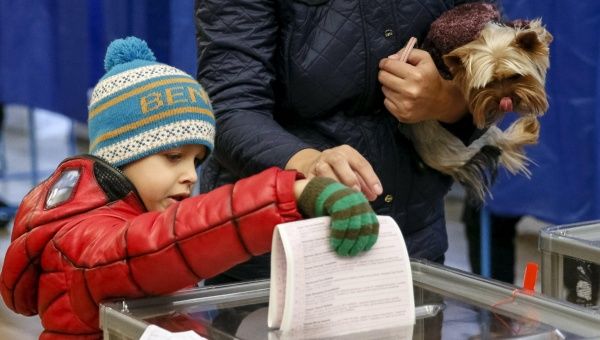
© ReutersA child casts his mother's ballot during a regional election at a polling station in Kiev.
"As of 1 p.m. (local time), 342 notifications of incidents related to the election process have been received. Thirty-six cases of vote buying have been registered," the ministry said in a statement.
The ministry added that many of the breaches were in Kiev and the western Zakarpattia region. Voting started at 8 a.m. local time across the country to elect 10,000 mayors and 160,000 members of regional and local councils. According to local media, the turnout is expected to be around 69 percent. The final results are expected no earlier than Oct. 28.
Earlier Sunday, Ukrainian authorities delayed local elections in the strategic port city of Mariupol, in the Donbass region of eastern Ukraine, as the ballots did not arrive at polling stations. Analysts say that by not allowing elections, the sovereignty of Donetsk and Luhansk is being violated.
Some 10 percent of polling stations failed to open on time due to situations with the ballots, according to Stanislav Zholudev of Voters' Committee of Ukraine. After the presidential and parliamentary polls in 2014, Sunday marks the third set of elections in Ukraine since the coup that ousted pro-Russian President Viktor Yanukovych in February 2014.
The rebel-held territory in the self-proclaimed republics of Donetsk and Luhansk will not participate in the electoral process since they postponed elections to 2016. A total of 132 political parties have been registered for local elections. However, three communist parties have been banned from participating in today's elections as part of a decree signed by the country's Justice Minister Pavel Petrenko in July. But the parties' leaders had vowed to defy the ban and participate. The ban used the de-communization law signed by Ukraine's President Petro Poroshenko on May 15. The legislation includes a ban on Soviet symbols and denouncing Communist ideology.
The elections are seen as a test for the government of pro-Western President Poroshenko and his Prime Minister Arseniy Yatsenyuk, whose approval ratings reported at a few percentage points above zero. Yatsenyuk's People's Front party, which was formed in 2014, is not fielding any candidates because of its low popularity.



I'm not sure if the country has had any leadership short of a ruling Gangster Elite, since it was founded after the breakup of the former Soviet Union.
It surely tops the list of places one should steer clear of.