
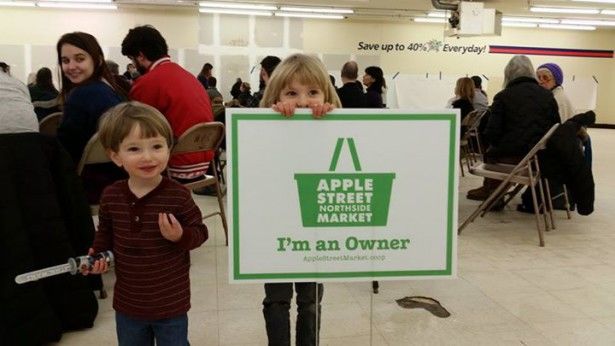
© Facebook / Apple Street MarketCommunity members gathered for an owners meeting at Apple Street Market in February.
The 1worker1vote network has developed and is beginning to implement a "union co-op" model, which calls for a business structure that combines worker, and sometimes community, ownership with union representation. With the model, 1worker1vote hopes to demonstrate the viability of a democratic economy, both in terms of ownership and management, capable of eventually replacing the corporate-managed economy that generates astounding wealth for those at the top while leaving nearly a quarter of the country living in poverty and half the population stuck in a debt trap with zero net assets.
"Profit should be for people, not for profit's sake, and capital, while important, is subordinate to labor," explained Ellen Vera, a founding member of both 1worker1vote and one of its member coops, the Cincinnati Union Cooperative Initiative, or CUCI.
The claim conjures images of the clashes between labor and capital of a bygone era, and, more recently, growing grassroots protest for a democratic global economy that began in 1994 with the Zapatistas in Chiapas, Mexico and have continued during the first years of the new millennium with the global justice and Occupy movements. Although protest can bring people together and demonstrate popular support for addressing problems, only new, or reformed, institutions can deliver lasting solutions. Situated within a broader movement for a "new economy," the CUCI and 1worker1vote are beginning to move beyond rhetoric and protest to explore what can and should happen after the protesters inevitably return home.
Founded in 2011, the CUCI, a Cincinnati-based network of cooperatives, hopes to bring what it calls "family-sustaining jobs," with livable wages and hours and full benefits, to Cincinnati — a city that exemplifies our country's long-term, corporate-driven economic decay. Beginning in the 1960s, American investment capital has increasingly financed the globalization of multinational corporate operations, a practice made possible by the ongoing logistics revolution fueled by rapid innovation in transportation and communication technologies.
Cincinnati, along with the rest of the deindustrialized American rust belt, has born the brunt of this globalized corporate economic management. The city, which now has a poverty rate exceeding 30 percent, possesses our country's second-highest citywide childhood poverty rate of 53.1 percent (currently, one out of three children in the United States live in poverty).
This crisis, without an end in sight, inspired the CUCI's founding.
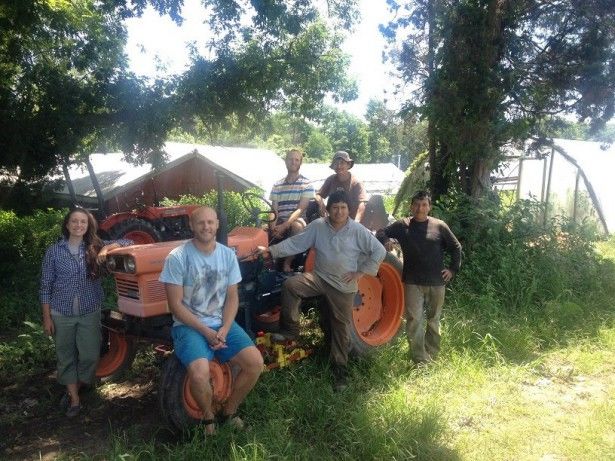
© Facebook / Our Harvest CooperativeThe farm team at Our Harvest Cooperative.
So far the CUCI has launched two worker-owned cooperatives, Our Harvest, a local farming and food distribution network, and Sustainergy, a construction company that installs renewable energy technology and improves the energy efficiency of commercial, industrial, institutional and residential properties. The two co-ops currently employ just over 20 people, a number the CUCI plans to increase significantly in the coming years as the existing co-ops attain scale and others are seeded and begin to operate.
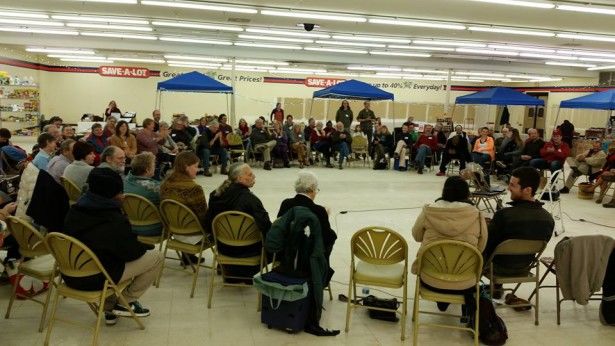
© Facebook / Apple Street MarketCommunity members gathered for a meeting in January in the space where Apple Street Market will soon open.
Additionally, two Cincinnati-based non-profits — the Sarah Center, a women's jewelry making and education center, and Yucky Cookies, a cookie bakery — will convert to CUCI co-ops. A third non-profit, Renting Partnerships, which helps low-income people build equity through affordable housing rental, works closely with the CUCI network.
The network has received support from labor unions — including the USW, the United Food and Commercial Workers, or UFCW, and the AFL-CIO. Experts in alternative economic enterprise — the Ohio Employee Ownership Center and the Ohio Cooperative Development Center — national social justice organizations, such as the NAACP and the Center for Community Change, and progressive Ohio politicians, like Senator Sherrod Brown, have also worked with the co-ops. And the CUCI is embedded in Cincinnati's civic community, as it works closely with the Cincinnati AFL-CIO labor council and faith and community organizing groups associated with the Ohio Organizing Collaborative.
Read more about this excellent initiative here






All "good" systems are dependent on the population being educated to the point of sustainment. If the population forgets the guiding principles, there goes the system. We see what's happening in the United States with the people no longer educated in civics and the Constitution & Bill of Rights.