
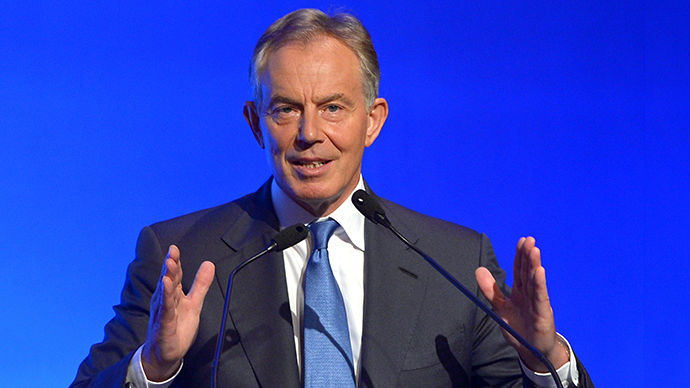
© AFP Photo / Pornchai KittiwongsakulFormer British Prime Minister Tony Blair
In fact, the former prime minister describes at length how it's necessary to rid oneself of any feeling of responsibility that the crumbling country and region have been pushed over the edge by well-meaning Western interventionism.
An extensive essay of Blair's, posted on his website argues that the crisis in Iraq involving the explosive expansion of the jihadist Sunni militant group the Islamic State of Iraq and the Levant (ISIL/ISIS) is actually the fault of Prime Minister Nouri al-Maliki's Shiite minority government, as well as the war in Syria.
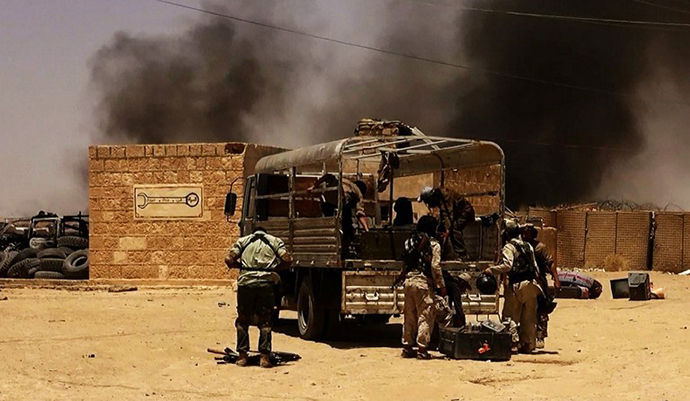
© AFPAn image made available by the jihadist Twitter account Al-Baraka news on June 9, 2014 allegedly shows Islamic State of Iraq and the Levant (ISIL) militants taking position at a Iraqi border post on the Syrian-Iraqi border between the Iraqi Nineveh province and the Syrian town of Al-Hasakah.
The essay comes shortly after revelations that the US has been supplying both the Syrian political and civilian opposition with "lethal aid."
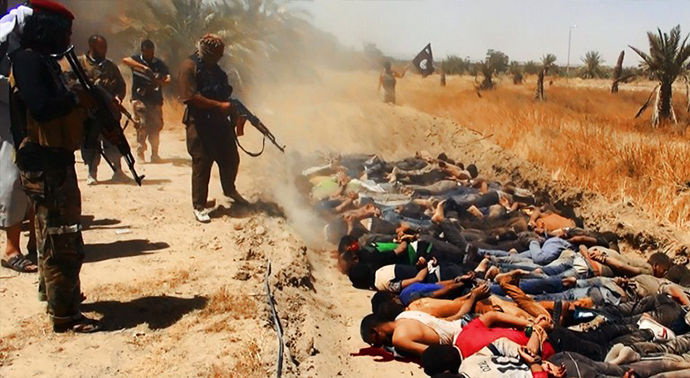
© AFPAn image uploaded on June 14, 2014 on the jihadist website Welayat Salahuddin allegedly shows militants of the Islamic State of Iraq and the Levant (ISIL) executing dozens of captured Iraqi security forces members at an unknown location in the Salaheddin province.
But while the former PM offers a series of causes and effects, there is a huge and tedious focus on Islamic fundamentalism as being somehow in its own vacuum and arising out of itself, a result of exclusive views of Islam by religious sects, which, sadly, the West could not help eradicate even when it tried to instigate regime change and get everyone to live peacefully together.
Blair accurately zeroes in on the problem - extremism. And in order to heed the lessons of the past, the former PM believes that "We have to liberate ourselves from the notion that 'we' have caused this. We haven't. We can argue as to whether our policies at points have helped or not; and whether action or inaction is the best policy and there is a lot to be said on both sides. But the fundamental cause of the crisis lies within the region not outside it."
Blair, who went ahead with the United States and offered support in the form of British troops in 2003, resents being associated with any negative outcomes currently affecting Iraq and the surrounding region. If Saddam Hussein had stayed in power, the former PM argues, the upheaval would have been just as brutal - even more so, because you'd have Shias ruling in one country, Sunnis in another, and as a result the region would turn into a battle between national armies of different religious affiliations.
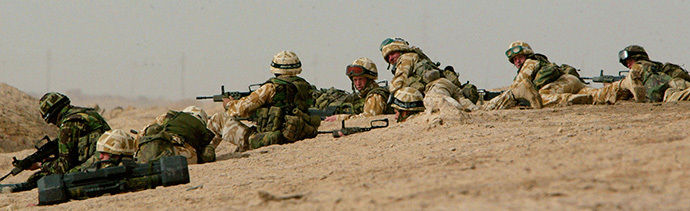
© Reuters / Stephen HirdA reconnaissance party from 29 Commando Regiment Royal Artillery land on the al-Faw Peninsular in southern Iraq to establish the gun position ahead of 105mm guns arriving, March 21, 2003.
"The whole of the Middle East is under threat" as the war in Syria has its associated outcome in the way the state disintegrates.
Now, while admitting that there were no weapons of mass destruction to be found in Iraq - a premise on which the entire invasion rested, Blair goes on to compare Saddam Hussein to President Bashar Assad of Syria, who was allegedly caught in the act of using chemical weapons on his people. "We only discovered this when he used them. We also know, from the final weapons inspectors' reports, that though it is true that Saddam got rid of the physical weapons, he retained the expertise and capability to manufacture them," Blair writes.
It must be noted here that no concrete proof that the chemical attacks were carried out by Assad's forces has been presented to this day. In fact, the majority of evidence points in the opposite direction. This doesn't make it into Blair's essay.
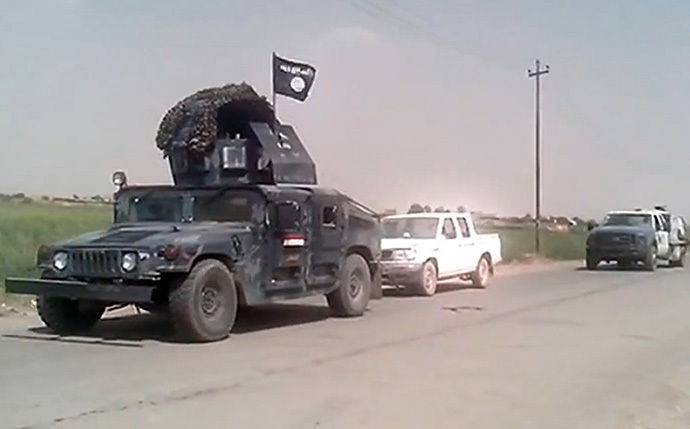
© AFP Photo / Youtube / HarithCaptured Iraqi security forces vehicles mounted with the trademark Jihadists flag as they drive along a road in the northern city of Mosul on June 12, 2014.
"Three to four years ago Al Qaeda in Iraq was a beaten force. The country had massive challenges but had a prospect, at least, of overcoming them. It did not pose a threat to its neighbors. Indeed, since the removal of Saddam, and despite the bloodshed, Iraq had contained its own instability mostly within its own borders," the former PM states."Though the challenge of terrorism was and is very real, the sectarianism of the Maliki government snuffed out what was a genuine opportunity to build a cohesive Iraq. This, combined with the failure to use the oil money to rebuild the country and the inadequacy of the Iraqi forces have led to the alienation of the Sunni community and the inability of the Iraqi army to repulse the attack on Mosul and the earlier loss of Fallujah. And there will be debate about whether the withdrawal of US forces happened too soon."
And of course, the Syrian connection: "The operation in Mosul was planned and organized from Raqqa across the Syria border. The fighters were trained and battle-hardened in the Syrian war. Islamist extremism in all its different manifestations as a group rebuilt, refinanced and rearmed mainly as a result of its ability to grow and gain experience through the war in Syria," Blair explained.
Blair goes on to make a series of recommendations about working with partners in the region, helping Iraq stand up on its feet (despite past reports of billions of aid dollars being squandered or disappearing) and finally, tackling the Syrian conflict by "[putting] aside the differences of the past and [acting] now to save the future."




good old Tony has to have body guards wherever he goes, This elite shill still believes he didn't do anything wrong.
I could go on and on about this fool, but I'll bet someone else has better adjectives to describe this moron.