Storms
S


Windsock

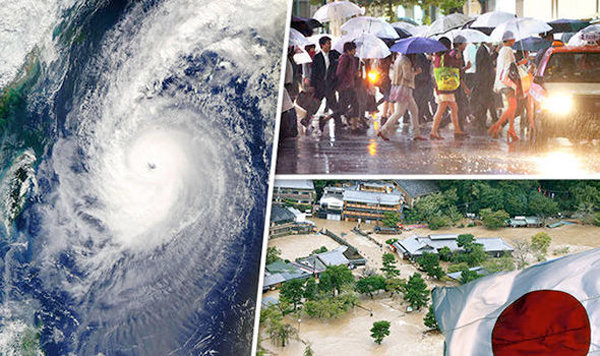
Thousands of lives at risk as Japan prepares for battering from record breaking typhoon Chaba

Typhoon Chaba
© NASA / Getty
Thousands of lives are at risk as a record-breaking typhoon is set to plough through northern Japan.

The potentially catastrophic Typhoon Chaba is set to reach mainland Japan at some point today, with coastal cities particularly at risk.

As the powerful typhoon, which has record breaking winds of up to 375 kilometres-per-hour - the highest on record since monitoring began in 1951 - battered the south coast of South Korea, it is now barrelling towards northern Japan.

Major cities such as Niigata, on the east coast, and Sendai, on the west coast, are particularly vulnerable.

The two cities have a combined population of almost two million people, with a further 300,000 in the mainland city of Fukushima, which the typhoon will also pass over.

Cloud Precipitation

7 dead after Typhoon Chaba drops 11 inches of rainfall in South Korea

Typhoon Chaba
Typhoon Chaba
Typhoon Chaba left a trail of destruction in South Korea on Wednesday, 05 October, after dumping over 280 mm (11 inches) of rain in some areas. Chaba is thought to be the strongest typhoon to hit South Korea since Maemi in 2003.

South Korea's Ministry of Public Safety and Security said that seven people have been killed and four are missing.

The southern cities of Ulsan, Busan and South Gyeongsang province (Yeongnam region), as well as South Jeolla (Honam region), Jeju (Jeju Region) were the worst affected.

Three people died in the city of Busan, three the Ulsan and one victim in Gyeongju. One of the victims is thought to be an emergency worker who was helping with rescue efforts in Ulsan. Most of the victims are believed to have died as a result of flooding.

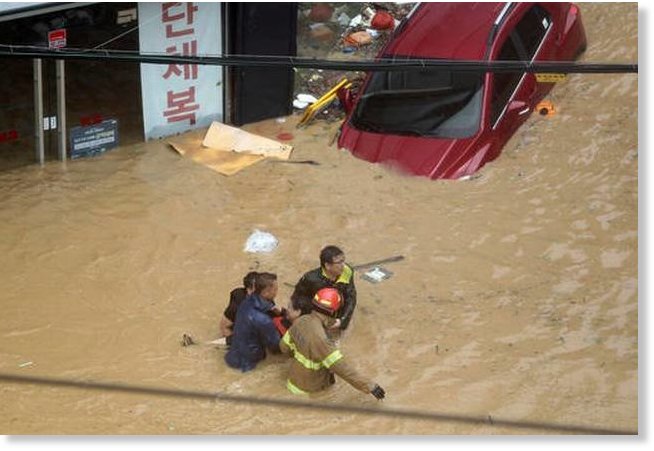
Rescue workers carry a resident through a flooded street caused by Typhoon Chaba in Ulsan
Rescue workers carry a resident through a flooded street caused by Typhoon Chaba in Ulsan, South Korea
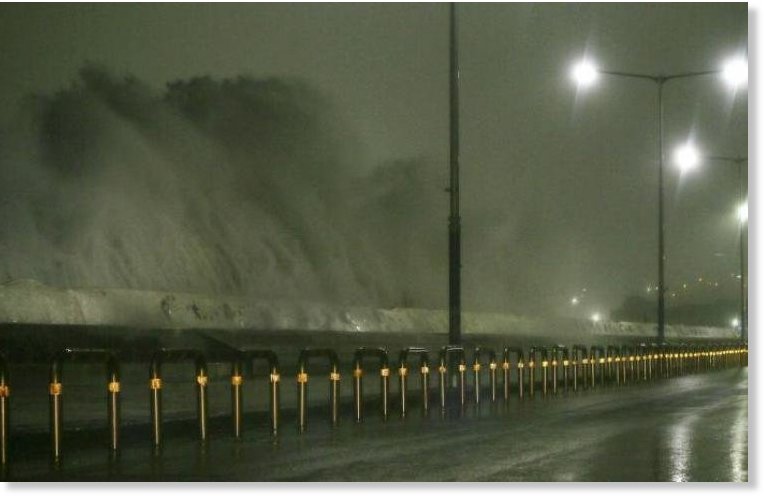
Over 300 hundred homes have been damaged by flooding, with around 14 of them severely damaged or completely destroyed. Shops, businesses and vehicles have also suffered damaged. Power outages were reported across affected areas. Schools and transport, including flights, have been disrupted. The heavy rain has also caused dozens of landslides and major damage to banks along swollen rivers. Huge waves and storm surge has also caused damage along the coastline, including sea walls.

Footage shows vehicles swept away by muddy water racing through city streets. At one point a building was swept away by a swollen river.


Comment: See also: Typhoon Chaba sets new records in South Korea


Cloud Lightning

Lightning bolt kills six cows in Pakistan

lightning
© 123RF
Six cows perished when lightning struck a herd in Raisar village of Tharparkar district on Tuesday night as widespread rains coupled with thunderstorm continued to lash most areas of the district for a third consecutive day, Wednesday.

Intermittent moderate to heavy spells of rain had started on Monday evening lashing Mithi, Kaloi, Naukot, Chelhar, Diplo, Islamkot, Bhalwa, Dahli and many other areas. Many rural areas of Mirpurkhas district also received light rain on Tuesday bringing down the temperatures and providing relief to growers.

A maximum of 62mm rain was reported from Mithi while other areas of Tharparkar district also received several heavy spells during the last three days.

After a long spell of widespread heavy rains lasting more than two weeks and ending in the first week of September, growers of Tharparkar had returned to their lands from other areas and started cultivating their crops. The fresh spell was welcomed by them as, according to them, this would add to the soil fertility.

Attention

Hurricane Matthew sends Florida into panic as 'direct hit' and 'massive destruction' expected

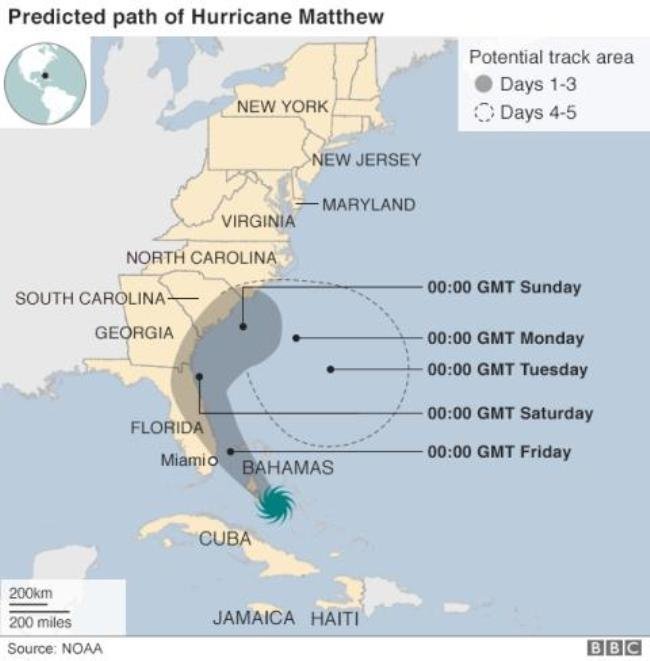
Hurricane Matthew path
© NOAA
Hurricane Matthew is making its way towards the US, sending Floridians into a panic and rushing to finish last minute preparations before it strikes. Staple products have long been claimed by shoppers as officials warn of a "direct hit on Florida."

Matthew, a deadly Category 3 storm, is currently moving northeast through the Caribbean and is expected to make landfall on the Atlantic coast of Florida by Thursday evening or early morning on Friday.

The National Hurricane Center has issued an advisory at 11p.m. Wednesday, saying that Matthew was moving northwest near 10 mph (17 km/h) with maximum sustained winds reaching 115 mph (185 km/h).

"Strengthening is expected during the next 24-36 hours, and Matthew is forecast to be a category 4 hurricane as it approaches Florida," the NHC said.

The Central Florida coast is potentially at highest risk, with Flagler and Volusia counties bracing for a direct hit. Both hurricane and tropical storm warnings have been issued for Florida's coastline, stretching from Miami to the Volusia county line, which includes Fort Lauderdale, West Palm Beach, Cape Canaveral and Daytona Beach.

Comment: After unusually forming very close to the equator, Matthew has already caused severe damage in Haiti and Cuba. Meanwhile in the Pacific, Typhoon Chaba has set new records in South Korea. Just over one week ago an 'unprecedented' storm resulted in the entire state of South Australia (inhabited by more than 1.7 million people) losing power.


Windsock

Typhoon Chaba sets new records in South Korea

typhoon Chaba damage
Cars are submerged in floodwater in an apartment complex in Ulsan on Wednesday.
Typhoon Chaba left a trail of destruction on Jeju Island and the southern mainland.

According to the Korea Meteorological Administration on Wednesday, Chaba brought winds of up to 49 m/s in parts of Jeju Island, second only to typhoon Maemi in 2003 (51.1 m/s).

The Seogwipo area of Jeju saw a record 116.7 mm of rain an hour.

The southeastern port cities of Busan and Ulsan were hit by heavy winds of up to 28.3 m/s and 21.5 m/s.

Ulsan experienced 104.2 mm of rainfall an hour, a record for the city.

Downpours also soaked nearby Gyeongju, North Gyeongsang Province, which was hit hard by a recent earthquakes, with 280 mm of rain.

According to the KMA, Chaba was the most powerful typhoon ever to hit the Korean Peninsula in October.

Typhoons usually hit Korea in the summer but are seen in October only once in a decade.

The last typhoon that caused such extensive damage in October was in 2013, and one in October 1994 did not cause nearly as much damage.

Comment: Asian typhoons are becoming more frequent and intense researchers say


Windsock

Rare, deadly Typhoon Chaba batters South Korea with massive waves and flooding

Typhoon Chaba
© YonhapDamages caused by the Typhoon Chaba
Typhoon Chaba hit the southern parts of South Korea Wednesday, leading to casualties among local population.

At least three people were killed and three others went missing after the typhoon swept over South Korean island of Jeju and the cities of Busan and Ulsan, according to national KBS broadcaster.

The rainfall due to typhoon Chaba reached over 120 millimeters (4 inches) in some areas of the country, according to the Korean Meteorological Administration. About 58,000 houses are left without power in Busan and Jeju Island. The typhoon has reportedly disrupted transport services and air traffic.

Typhoon Chaba hammered parts of Japan's Okinawa prefecture on Monday, bringing more than 200 millimeters of rainfall. Over 590,000 residents of the Japanese Okinawa Prefecture were prepared for evacuation.


Comment: It is rare for a typhoon of this size to hit the Korean Peninsula at this time. According to the Korea Meteorological Administration (KMA), only eight typhoons out of 327 that affected Korea between 1904 and 2010 landed in October. See also: Asian typhoons are becoming more frequent and intense researchers say


Tornado1

Hurricane Matthew hits Cuba hours after slamming Haiti, headed for the Bahamas & US

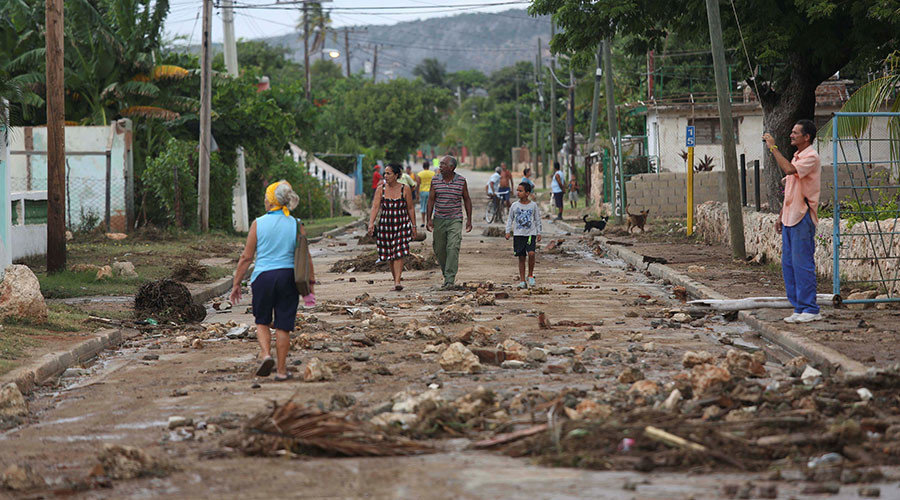
Hurricane Matthew in Cuba
© Alexandre Meneghini / ReutersPeople walk on the street after strong waves hit the coast at Siboney beach ahead of the arrival of Hurricane Matthew in Cuba, October 4, 2016.
Hurricane Matthew has reached Cuba just hours after flattening homes and leaving a trail of destruction in Haiti. The eye of the storm slammed the country with sustained winds of around 140 mph (225kph).

The Category 4 hurricane - the most powerful Atlantic tropical storm in almost a decade - reached Cuba's eastern tip around 8 pm local time Tuesday night.

Three hours later, it was churning around 20 miles (32km) northwest of where it made landfall, moving north at about eight miles per hour (13kph), according to the National Hurricane Center.

Comment: And projections for what Matthew is likely to do in coming days, from Weather.com:
Hurricane Matthew will hammer parts of eastern Florida and other parts of the Southeast coast starting Thursday and continuing into the weekend.

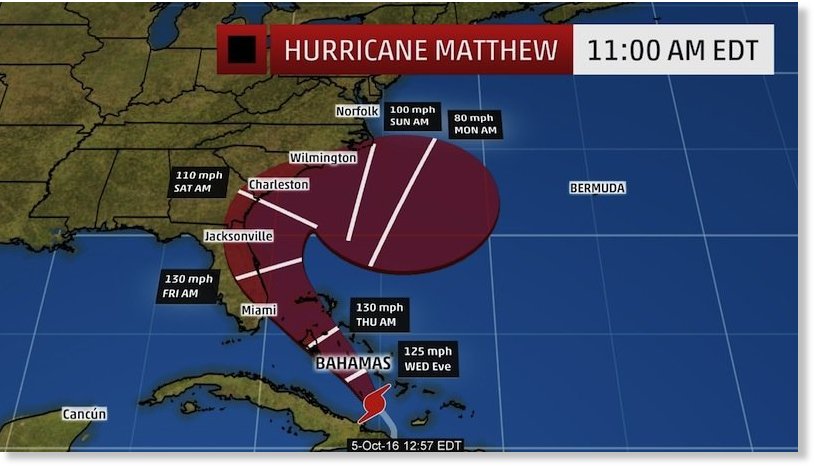
As illustrated by the National Hurricane Center's (NHC) projected path map, and also explained below, the severity of any direct impacts will depend on how close the center of Matthew moves near the coast.

All interests from Florida to coastal Georgia and the Carolinas should continue to monitor the forecast closely and make necessary preparations for a hurricane. Those in eastern Florida should make those preparations as soon as possible.

(MORE: Full Matthew Forecast)

Here is the latest on what we know about Matthew right now in terms of U.S. impacts.

1. Timing For Matthew

hurricane matthew
As far as timing for any impacts along the Southeast coast, here is a general overview. The NHC forecast calls for Matthew to be a strong hurricane during this timeframe.

Florida Peninsula (particularly east): Thursday-Friday, possibly lingering into early Saturday in northeast Florida.
Southeast Georgia: Friday-Saturday.
Eastern Carolinas: Later Friday-Saturday, possibly continuing into Sunday.

2. Battering Waves, Coastal Flooding, Beach Erosion Likely

No matter how close the center of Matthew passes in relation to the Southeast coast, we expect major marine impacts.

Matthew will generate large, battering waves along the entire coastline Thursday into the weekend. Mariners and beachgoers are encouraged to stay out of the water given this danger.

Significant coastal flooding is also likely along the path of Matthew from Florida into the Carolinas. The magnitude of any inundation will be dictated by the exact path Matthew takes.

Furthermore, the threat for major, damaging storm surge flooding is in play should the center of Matthew make landfall along the Southeast coast. Locations from Florida's east coast to the coastal Carolinas are at risk for this possibility, though this is still uncertain.

Here is how high the water could reach during this life-threatening inundation if the peak surge coincides with high tide, according to the National Hurricane Center:
  • North Palm Beach, Florida, to the Flagler/Volusia county line: 3-5 feet above ground level
Of course, beach erosion is a given with all those factors above playing out.

If you live along the immediate coast, stay informed and have a plan to evacuate should you be instructed to do so.

3. Tropical-Storm-Force Winds and Hurricane-Force Winds Likely

The potential for tropical storm-force winds (39 mph+) or hurricane-force winds (74+ mph) is in play along the entire Southeast coast.

How strong those winds are in any one location will depend on where the center of Matthew tracks in relation to the Southeast coast.

The last few days, forecast guidance has trended towards a track closer to the coast, which increases the probability of strong, damaging winds in some areas.

Right now, it appears at least tropical storm-force winds likely from most of Florida's East Coast to coastal North Carolina.

Hurricane-force winds are also highly possible throughout that stretch of the coast. This would particularly be the case if Matthew's eyewall grinds along the Southeast coast or even makes landfall, again anywhere from Florida's east coast to coastal Georgia and the Carolinas.

At this time, the National Hurricane Center has the greatest chance of hurricane-force winds right along Florida's east coast. Those damaging winds are likely to occur no matter whether the center of Matthew makes landfall or stays just offshore. The exact strength of the winds will depend on how close the eyewall passes to the coast.

Structural wind damage will be possible along with downed trees and widespread power outages in areas where hurricane-force winds occur. Matthew is forecast to be a major hurricane (Category 3 or stronger) when it moves near Florida's east coast, so extreme wind damage cannot be ruled out. Once again, that will depend on the exact path of the eyewall.

Even tropical storm-force winds could down trees and knock out power.

4. Rainfall Flooding, Tornadoes

Two other threats we will have to watch for from Matthew is the potential for rainfall flooding and tornadoes.

Once again, Matthews track in relation to the U.S. coast will dictate the magnitude of any heavy rainfall impacts, possibly resulting in flooding. The heaviest rainfall totals, possibly ranging between 5-12 inches, are likely to be confined to the immediate coast, from Florida to the North Carolina.

In areas where coastal flooding occurs, the heavy rainfall could make flooding worse or prevent water from receding.

An isolated tornado threat could also develop on the Southeast coast, particularly if Matthew makes landfall.

5. Matthew May Stall Off Southeast Coast Instead of Impacting Northeast States

In recent days, forecast guidance had suggested Matthew would eventually get pulled northeastward by a jet stream dip and potentially impact the Northeast states along with Atlantic Canada. This no longer appears to be the most likely scenario.

Instead, that jet stream dip may leave Matthew behind. This would result in Matthew pushing southeastward away from the coastal Carolinas on Sunday. It's possible Matthew could then meander off the Southeast coast into early next week, but details on where it may eventually go from there are uncertain at this time.


Cloud Lightning

5 killed by lightning bolt in Uttar Pradesh, India

lightning
© 123RF
Five persons including a boy were killed after they were struck by lightning in Lalganj area in the district, police said today.

The incident took place last night in which Jainarain (40), Lalta (58), Bhola Sharma (65), Shivshankar (30) and Shivam (10) were killed, they said.

Disrict Magistrate Kanchan Verma said a report in this regard has been sought and compensation will be given to the families of the victims.

Source: PTI

Windsock

Eleven dead after hurricane Matthew causes 'catastrophic' damage in Haiti

Hurricane hits Haiti
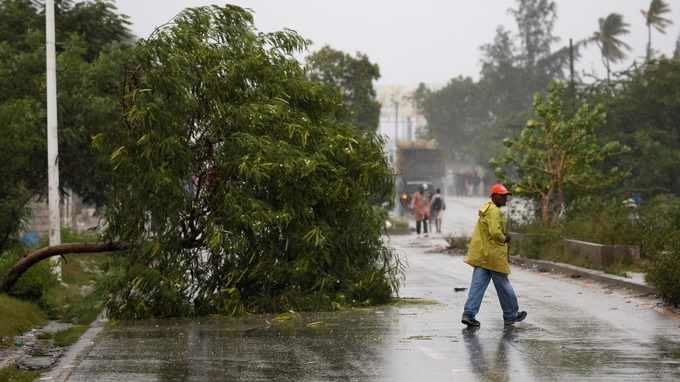
© ReutersA tree blown over by the storm in Port-au-Prince, Haiti.
Hurricane Matthew has slammed into the Haitian and Cuban coast, bringing gusts of up to 175 miles-per-hour as well as dangerous flooding.

At least eleven people have been killed by the Category 4 storm across the Caribbean, including three in Haiti and three children inside a home that collapsed in the Dominican Republican.

The storm was both powerful and slow-moving, a dangerous combination that led to rainfall estimated at 15-25 inches (38-64 cm) in south western Haiti, with more than three feet (0.9 meters) falling in some mountainous areas.

Dennis Feltgen, a meteorologist for the US National Hurricane Centre, said the conditions were extremely dangerous.

"They are getting everything a major hurricane can throw at them," he said.


Comment: Unusual Atlantic storm: Matthew may hit US as Category 5 Hurricane next week


Cloud Lightning

Lightning hits airplane in rare strike over Iceland

Lightning Strikes Airplane In Flight
Lightning strikes airplane in flight
Lightning struck WOW Air's TF-GAY airbus as it took to the skies today, and an alert Icelander captured the moment on video.

As can be seen, a bolt of lightning struck the plane early in its flight. A plane being struck by lightning may be uncommon enough as it is, but in Iceland, the occasion is even more uncommon - lightning is a very rare sight in this country, as the weather seldom creates the conditions that make it happen.

Amazingly, the plane was undamaged, and continued on its merry way from Keflavík to Paris without incident.