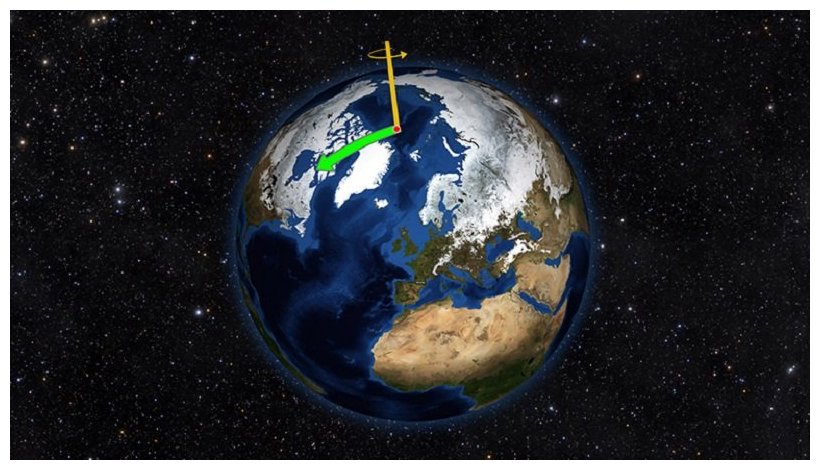
© NASA/JPL-CaltechEarth does not always spin on an axis running through its poles. Instead, it wobbles irregularly over time, drifting toward North America throughout most of the 20th Century (green arrow). That direction has changed drastically due to changes in water mass on Earth.
Although a desktop globe always spins smoothly around the axis running through its north and south poles, a real planet wobbles. Earth's spin axis drifts slowly around the poles; the farthest away it has wobbled since observations began is 37 feet (12 meters). These wobbles don't affect our daily life, but they must be taken into account to get accurate results from GPS, Earth-observing satellites and observatories on the ground.
In a paper published today in Science Advances, Surendra Adhikari and Erik Ivins of NASA's Jet Propulsion Laboratory, Pasadena, California, researched how the movement of water around the world contributes to Earth's rotational wobbles. Earlier studies have pinpointed many connections between processes on Earth's surface or interior and our planet's wandering ways. For example, Earth's mantle is still readjusting to the loss of ice on North America after the last ice age, and the reduced mass beneath that continent pulls the spin axis toward Canada at the rate of a few inches each year. But some motions are still puzzling.