Animals
S


Bug

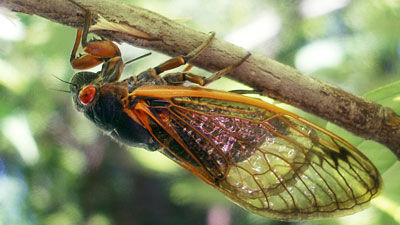
US: Cicadas Invade South After 13-Year Sleep

cicada
© UnknownThe last cicada swarm in the US was in Virginia in 2004
Another natural phenomenon has hit the Southern States as swarms of cicadas return after 13 years hibernating underground.

Every 13 years the inch-long insects emerge from their underground lairs to plague America's Deep South in a feeding and breeding frenzy.

It adds to the natural phenomena the region has battled with after tornadoes last month and floods in Mississippi this week.

Apart from their intense 120-decibel mating racket and the frustration of finding them in hair, clothes and lunch-boxes, they're completely harmless to humans.

X

US: Second Wave of Mystery Pelican Deaths Hits Topsail Beach, North Carolina

Image
© WWAY YV
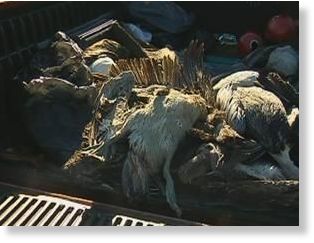
A second wave of mysterious pelican injuries and deaths has occurred in the past several weeks at Topsail Island in North Carolina following earlier incidents about six months ago in which about 250 pelicans died as a result of still undetermined causes.

Necropsies in the fall of 2010 performed at the University of Georgia on the first group of Brown Pelicans were inconclusive as to cause of injury though there was no evidence of toxicological causes such as poisons. The newly found birds have also been sent to the university for analysis.

This recent incident involves about 30 pelicans that washed up on the shores either dead or so badly injured that they had to be euthanized. In an interview with WNCT-TV, Toni O'Neil of the Possumwood Acres Wildlife Sanctuary commented on the injuries to one bird "... [it] looks like a bomb has gone off in the wing. It's that shattered and smashed so completely".

Heart - Black

Dozens of dolphins found dead in Ukraine

Image
© Unknown

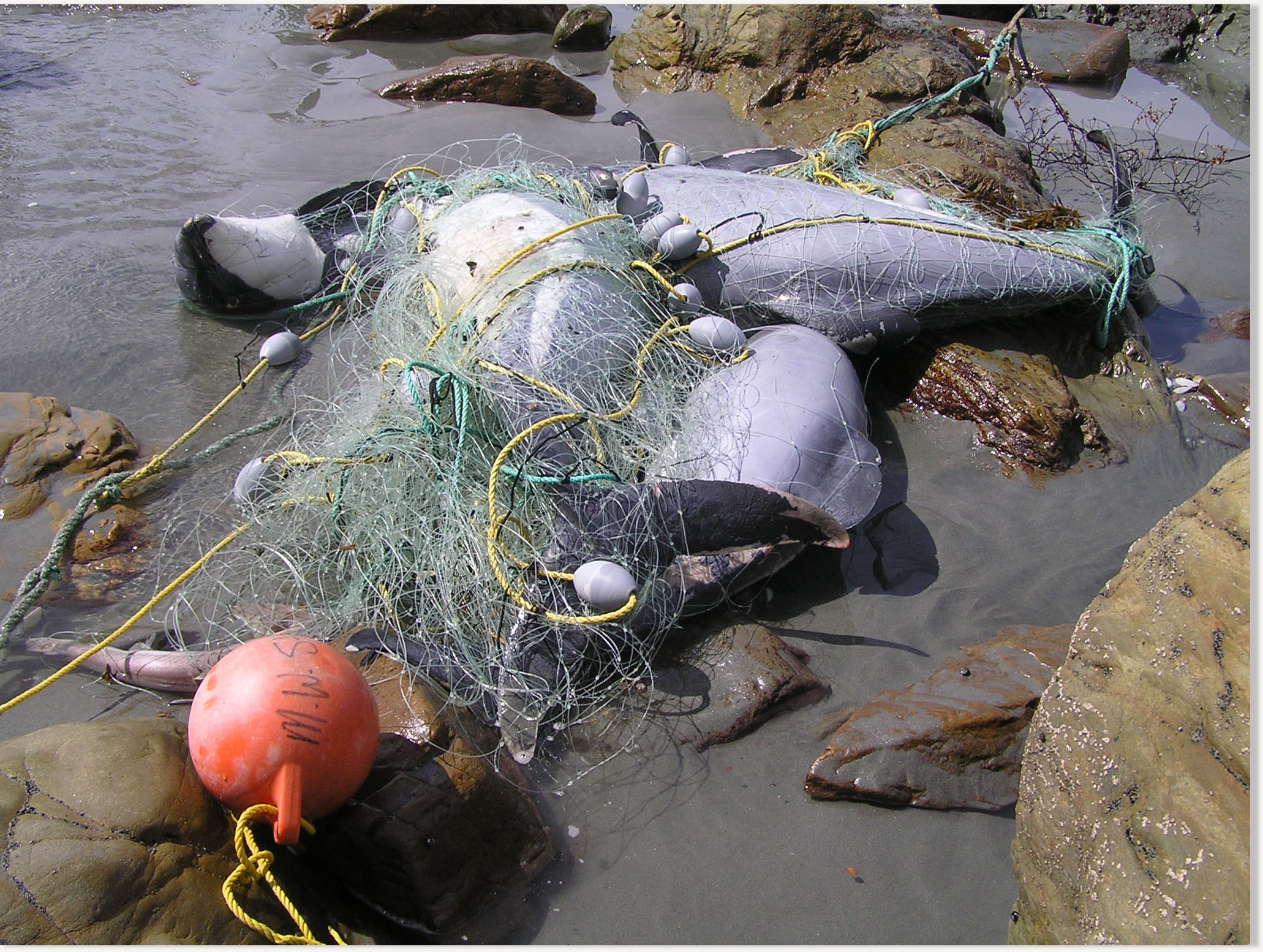
Thirty one dolphins were found dead in the Crimean Peninsula in Southern Ukraine, the press office of the Emergencies Ministry in Crimea reported Tuesday.

According to officials, the dead dolphins were scattered in an area of 2 km along the coastal zone.

Experts said the probable cause of the mammalian deaths is getting into the fishing nets. The majority of the dolphins have visible wounds on their body, some of them have damaged or missing fins.

Bizarro Earth

US: Great white zeroes in on whale off Vineyard

Image
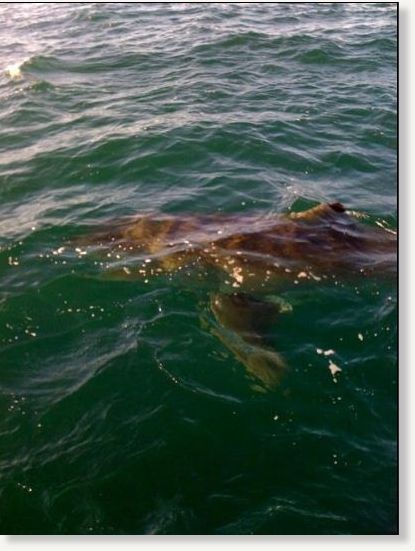
© Jeff Lynch / Boston HeraldPhoto of a great white shark spotted near the carcass of a dead minke whale off Martha’s Vineyard.
Buddies out mackerel fishing today came upon a giant great white shark like they've never seen before "bumping" and "nudging" a dead whale and then circling their boat off Martha's Vineyard.

The line from the seminal shark flick "Jaws" quickly came to mind for the crew -- "We're gonna need a bigger boat."

The monster of the sea was "20 feet" long, said captain Jeff Lynch of Chilmark. "To see something that big was crazy. It was as big as my boat."

The shark had zeroed in on a dead minke whale that was tangled in lobster gear and died. The shark, he said, kept at the whale but never chomped down - possibly sensing it was long dead.

"I was very surprised to see it," Lynch told the Herald.

Fish

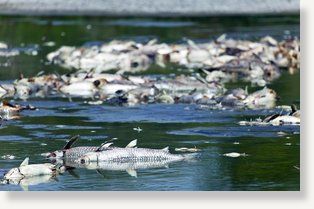
US: Hundreds of fish die in Wichita park's pond

dead fish
© Mike Hutmacher/The Wichita EagleHundreds of fish have died at Buffalo Park pond in west Wichita because of lack of water, and the city expects the toll to climb to about 1,000.
Hundreds of fish have died at Buffalo Park pond in west Wichita because of lack of water, and the city expects the toll to climb to about 1,000.

A combination of three factors have contributed to the kill, said Doug Kupper, the city's parks and recreation director.

The pond, near Central and Maize Road, has been leaking from the bottom and suffering from an invasive plant that has been removing oxygen from the water for a couple of years. Recent hot weather has evaporated more of the water, he said.

Attention

New Zealand: Fears Bee Colony Collapse Has Arrived

honeybee
© 1999, MC Cassine
Beekeepers fear an alarming phenomenon that is wiping out bees and leading to reduced food crops around the world has reached New Zealand.

Colony collapse disorder has caused American beekeepers to report losses of up to 90 per cent in some cases, prompting fears of crop shortages.

Honeybees are the planet's most effective pollinators, and industry leaders in New Zealand are calling for an investigation into the problem.

National Beekeepers Association joint chief executive Daniel Paul said reports coming in to the group were causing concern.

In the past six months, it had received reports of significant bee losses - up to 30 per cent in some places.

"It's significant enough to make us sit up and take notice."

Bizarro Earth

US: Two Stranded Pilot Whales Released Off Cudjoe Key

Stranded Whales
© Associated PressTwo healthy pilot whales are loaded onto a boat in Cudjoe Key to be released at sea.

There was a moment of joy for the tireless marine mammal rescuers working to save a pod of stranded pilot wales Saturday evening in the Keys: two of the seven surviving whales were deemed healthy and released in deep waters nine miles offshore.

Cheers erupted on the barge carrying the whales when the two adult males met in open water, touched each other, and then swam away together.

The whales, each over 12 feet long and more than 1,000 pounds, were first fitted with trackers that should last between 2-3 months.

The pair were part of a pod of 20 pilot whales who inexplicably beached themselves Thursday near Cudjoe Key, about 20 miles east of Key West.

Thirteen of them have died, and the surviving seven have been cared for in a makeshift waist-deep pen, where volunteers continue to cover the whales' exposed bodies in zinc and sheets to protect their sensitive skin from the sun.

Fish

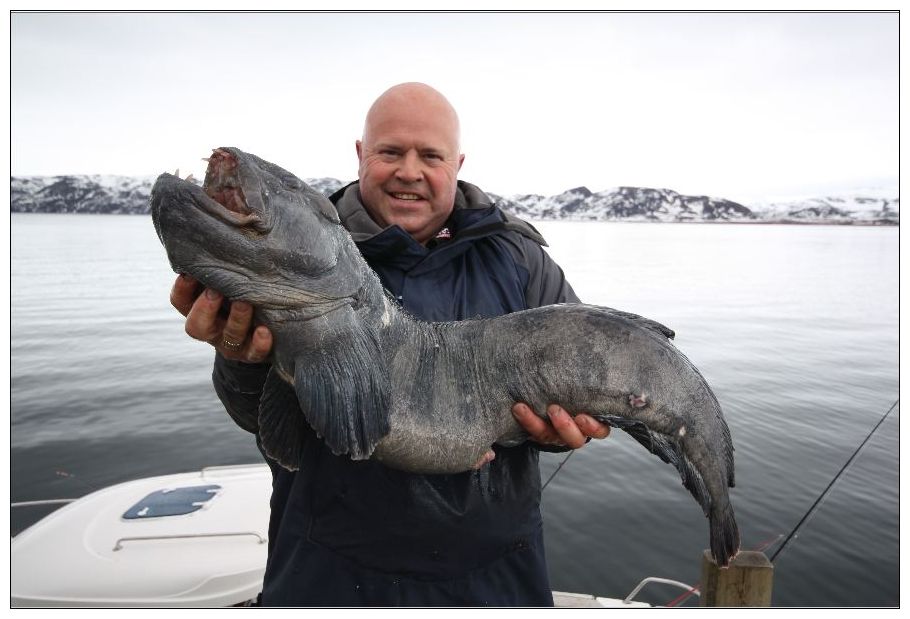
Horrific prehistoric fish landed off the Norway coast

This unusual specimen might look like something out of a horror movie, but it proved to be one of the highlights of Peter Bailey's most recent trip to the prolific waters off the north of Norway.
wolf fish
Peter Bailey with the ugly, prehistoric wolf fish

The prehistoric-looking wolf fish, which pulled the scales around to 16lb 15oz, is one of the biggest landed on rod and line so far this year.

It was caught on a baited pirk when Peter braved strong winds and snow in an area around Kokelv - which is perhaps better known for producing monster cod to well over 70lb in recent months.

Fish

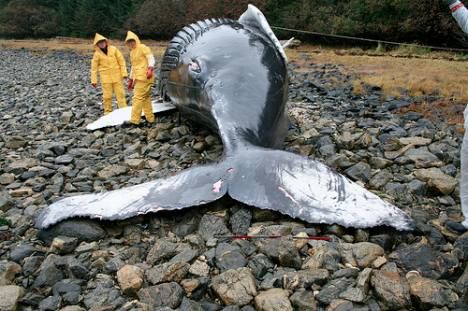
More Frequent Whale Strandings Has Experts on Edge

Image
© NOAA via Flickr CC
In the last few years, there has been an unexplained spike in the number of whales washing ashore. While the National Marine Fisheries Service has declared an Unusual Mortality Event (UME) in the Northern Gulf of Mexico, it's more than just oil spills that are causing increased strandings worldwide. And experts are worried.

The numbers of beached whales have been gradually rising, peaking in 2009 with 46 whales coming ashore, and The Department of Environment and Conservation is conducting an investigation into what could be causing the rise, reports ABC news.

It could be anything from nutrition issues to sonar that drives whales off course, disorients them, or can even cause internal damage. While there has been a rash of strandings in Florida, including at least 15 pilot whales that washed ashore this week in the Florida keys, experts are quick to point out that the BP gulf oil spill is a possible cause, but not the only factor. Earth Times points out that, "A number of recent strandings in other regions happened well before the Deepwater spill occurred. In March 2009, 194 whales and a small dolphin pod became stranded on the coast of Tasmania, and most did not survive. The previous November, 150 pilot whales died in another mass stranding in Tasmania... In February 2011, 107 whales died on the coast of New Zealand."

Comment: It's astonishing that this - ahem - "journalist" doesn't go the distance and draw the obvious conclusion that whales, other sea life, and humans on the shores, are sickening and dying from the BP oil spill.


Bizarro Earth

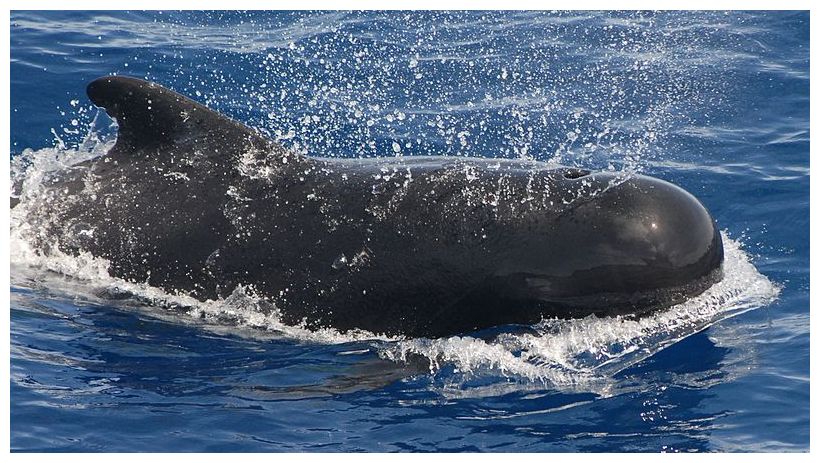
US: 16 Whales Mysteriously Stranded in Florida Keys

Pilot Whale
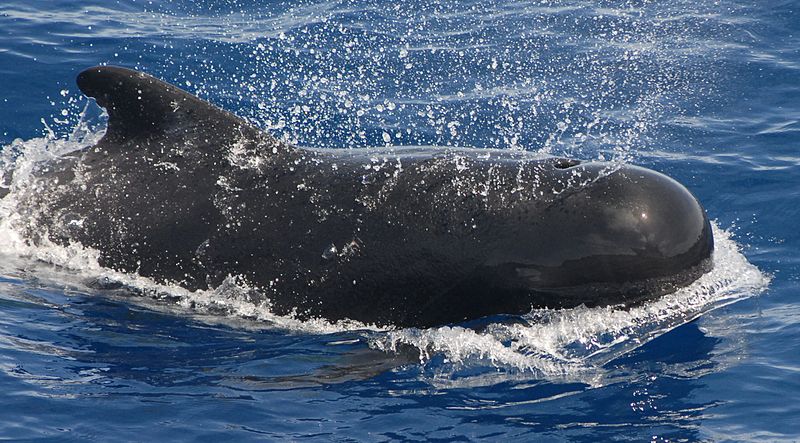
© Adam Li / NOAA Photo LibraryPilot whale.

It's not yet clear why more than 16 pilot whales became stranded in the lower Florida Keys on Thursday, but the list of possible reasons is long -- and includes the whales' social nature.

Pilot whales live in groups called pods that consist of between 15 and 50 animals, and mass strandings like this one have happened before. Most recently, in 2003, about 25 pilot whales became stranded in the Keys, according to Anne Biddle, media relations director for the Marine Mammal Institute, which is responding to the stranding.

"They tend to strand in pods, they stick together, if one is sick, the whole pod is going to strand," Biddle told LiveScience. The whales are stranded in shallow water, and veterinarians are assessing them to determine if all or a couple are sick, she said.

Pilot whales are toothed whales that can grow to be between 14 and 17 feet (4.3 to 5.2 meters). They live in warm, tropical waters, according to Biddle.

There are many potential causes -- including diseases, parasites, loud noise, toxins or simple confusion -- so figuring out what is responsible for the mass stranding can be challenging, according to Chris Parsons, a professor at George Mason University who has tracked mass whale strandings around the world.