
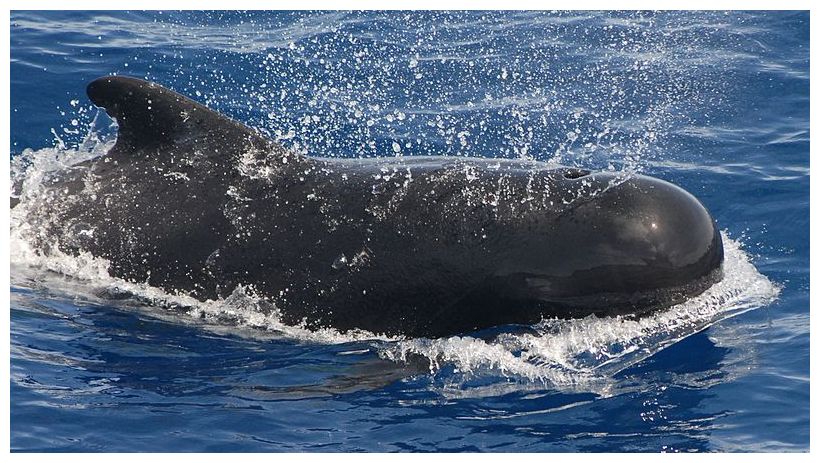
© Adam Li / NOAA Photo LibraryPilot whale.
It's not yet clear why more than 16 pilot whales became stranded in the lower Florida Keys on Thursday, but the list of possible reasons is long -- and includes the whales' social nature.
Pilot whales live in groups called pods that consist of between 15 and 50 animals, and mass strandings like this one have happened before. Most recently, in 2003, about 25 pilot whales became stranded in the Keys, according to Anne Biddle, media relations director for the Marine Mammal Institute, which is responding to the stranding.
"They tend to strand in pods, they stick together, if one is sick, the whole pod is going to strand," Biddle told LiveScience. The whales are stranded in shallow water, and veterinarians are assessing them to determine if all or a couple are sick, she said.
Pilot whales are toothed whales that can grow to be between 14 and 17 feet (4.3 to 5.2 meters). They live in warm, tropical waters, according to Biddle.
There are many potential causes -- including diseases, parasites, loud noise, toxins or simple confusion -- so figuring out what is responsible for the mass stranding can be challenging, according to Chris Parsons, a professor at George Mason University who has tracked mass whale strandings around the world.
"It would be like someone walking in front of a car: Why did they do that? Were they sick? Were they distracted? Or could they not hear or see the car coming?" Parsons said.
In recent years, loud noise -- caused by oil and gas exploration, Navy sonar or even natural events like earthquakes -- has received attention as a cause of whale strandings. Pilot whales, like other toothed whales, have their own sonar system called echolocation (also used by bats) that they use to map out their environment.
But loud noise can be disorienting to a whale. "It would be like shining a flashlight into our eyes in terms of trying to see," Parsons said. If loud enough, noise can even cause injuries to whales.
Whales can also become confused by underwater topography, as has happened in fjords in New Zealand, or become disoriented by a toxin produced by algae during a red tide, he said.
Parasites or disease, including meningitis, could cause one or two whales to strand themselves, with the rest of the pod following, he said.
Two whales have already died, and rescuers have cordoned off six in a safety net where they will be given blood tests and evaluations, according to WSVN, a local news channel.




even MENTION the corexit/oil still in the waters?? It's not gone. But of course, the govt doesn't want to hear about is as they prepare to allow more deep water drilling permits in the GOM.