Animals
S


Bizarro Earth

New Zealand: Mass Whale Stranding at Golden Bay

Stranded Whales
© New Zealand HeraldHalf of the pod of pilots whales stranded at Golden Bay have died, according to DoC.

Half of a pod of sixty-five pilot whales stranded on Farewell Spit in Golden Bay have died.

The surviving 34 are stuck in shallow water, between two and three kilometres offshore.

Department of Conservation (DOC) Golden Bay area manager John Mason said there was nothing that could be done for them, other than to hope they manage to swim away on the next high tide.

"They're in a very remote location and they're in a very dangerous location to try and rescue them because to rescue a whale you have to stay with it until it can swim and to do that the water level is usually between your waste and your chest.

Once you've let the whale go you then have to head back to the beach yourself, which in this case would be two to three kilometres away, so we don't rescue them in those situations.

"All we can do is monitor them. I'm not optimistic that they're going to get back to sea but we certainly wish them well and hope that they make it.''

Fish

Whales and Salmon: When Enemies Need Each Other

Killer Whale
© CorbisSouthern resident killer whales, which live off the coast of Washington State and British Columbia, are one of the most critically endangered groups of marine mammals in American waters.

Both killer whales and Chinook salmon are endangered in the Pacific Northwest. And one of the biggest problems facing both animals is that one eats the other.

According to a new study, a single small and vulnerable group of whales may eat close to a quarter of the salmon run in British Columbia's Fraser River -- and that's just in the summertime.

The findings emphasize the importance, when trying to save one creature, of looking out for everything that hunts and is hunted by it. In this case, whales can't rebound unless the fish bounces back, also. But saving both of them is not that simple.

"This is a case where one endangered species is eating another endangered species," said Rob Williams, a marine conservation biologist now at the University of St. Andrews in the United Kingdom. "We're not going to get anywhere if we have single-species management that doesn't recognize that what is good for one species may be bad for another."

Southern resident killer whales, which live off the coast of Washington State and British Columbia, are one of the most critically endangered groups of marine mammals living in American waters. At last count, the population consisted of just 87 whales.

Fish

22 Sperm Whales Die in Australia

Image
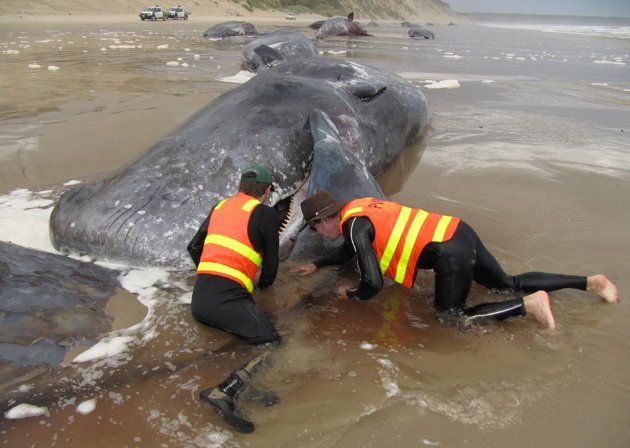
© Tasmania Parks And WildlifeSteve Mansfield (L) and James Grey from the Parks and Wildlife Service tag deceased sperm whales on Ocean Beach near Strahan on Tasmania's west coast on November 1. Wildlife staff are battling wet and windy conditions as they try to save four sperm whales stranded in shallow water after 22 others die.
Rescuers were racing against the clock Monday to save two huge sperm whales stranded on a Tasmanian sandbank after 22 others died, the Parks and Wildlife Service said.

Marine mammal specialists were on site in Macquarie Harbour at Strahan on Tasmania's northwest coast, but the rescue bid was hampered by rough weather.

Twenty-two of the whales -- each weighing two tonnes and up to 12 metres (40 feet) long -- washed ashore on Saturday at Ocean Beach near Strahan, and all of them died.

Four others came into the harbour and became stranded on a sandbank. Two of these were successfully refloated and swam back out to sea, but the other two remain stuck.

Rescuers said two minke whales also got into trouble nearby and died.

Tasmanian Parks and Wildlife incident controller Chris Arthur said the sperm whales were so big that they could not simply be pulled into deeper water by volunteers, instead requiring a more complicated rescue operation.

Bizarro Earth

Australia: Whales Stranded on Tasmanian Beach

Stranded Whales
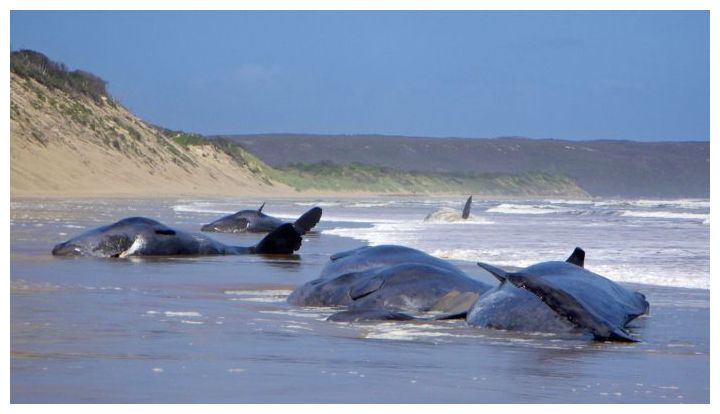
© Audience Submitted22 sperm whales are stranded on Ocean Beach on Tasmania's west coast.

There has been a mass stranding of 20 sperm whales on Tasmania's west coast, with only four whales stuck in shallow water believed to still be alive.

The pod was discovered on Ocean Beach near Strahan early Saturday morning, but authorities say conditions in the water are too dangerous for rescuers to intervene.

Nearby, rescuers were making progress in freeing another eight sperm whales stranded on a sand bar in Macquarie Harbour, about four kilometres south of the beach.

Chris Arthur from the Parks and Wildlife Service says four of them were swimming freely, with a fifth joining them later in the afternoon.

Authorities are urging people to stay clear of the channel between Hells Gate and Table Head.

Blackbox

Queensland: Mysterious disease killing marine life in Gladstone Harbour?

An unprecedented number of fish with red spots, lesions and parasites, as well as dead dugongs and turtles, have been found this year.

Fishermen and conservationists blame the state of the marine life on dredging to widen Gladstone Harbour to accommodate carrier ships servicing the booming liquefied natural gas and coal seam gas industries.
Image
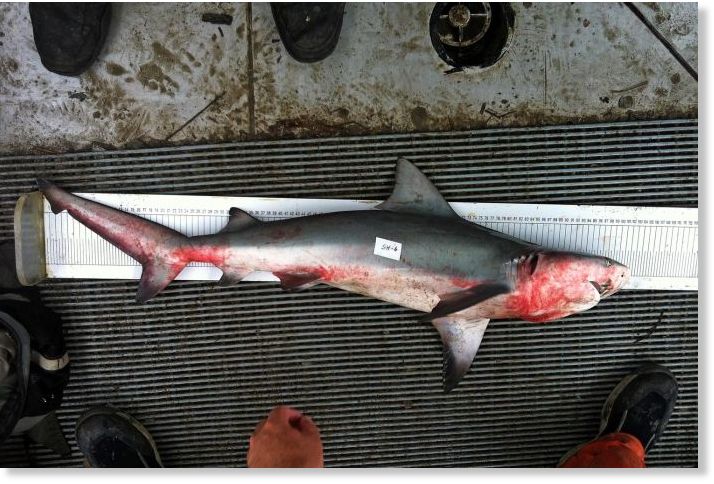
© Trevor FalzonA bull shark with red marks on it caught in the Calliope River, Gladstone in October.
But the Gladstone Port Corporation does not believe the dredging is causing the disease in fish, and authorities say last year's wet summer may be a factor in the poor health of the harbour.

Water testing shows a number of sites within the harbour exceeded national guidelines for aluminium, copper and chromium. Experts say the levels pose a minimal risk to marine life; however, the Queensland Government has appointed an independent scientific panel to conduct more research.

View a gallery of photos of diseased marine life found in Gladstone waters, interspersed with quotes from local fishermen and stakeholders.

Bizarro Earth

Researcher Links Fungus To Dropping Bat Population

Bats
© redOrbit
A University of Tennessee researcher helped confirm the link between the fungus Geomyces destructans and the dropping bat population.

Over a million bats were killed in North American in 2006, and little has been done to try and save them due to lack of evidence for the alleged killer.

However, a new study has discovered that the fungus Geomyces destructans is the agent of White-noise Syndrome (WNS), which is the fungal disease decimating the bat population.

The fungus has been thought to be the likely culprit because the skin lesions found on the bats are associated with colonization of the fungus.

"Many assumed that fungal infections in mammals only occur if some other pathogen has already weakened the immune system," Justin Boyles, a post-doctoral research associate in ecology and evolutionary biology at the University of Tennessee, Knoxville, said in a statement. "Additionally, the recent discovery that G. destructans commonly colonizes the skin of bats in Europe with no major die-offs generated speculation that other unidentified factors are the primary cause of WNS."

Info

Canada: A Mysterious Virus Threatens Salmon in the West

Image
© Getty Images
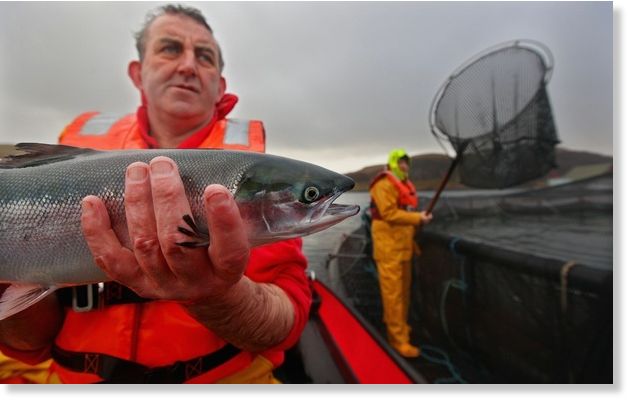
A virus that devastated farm-raised salmon populations in the Atlantic may be appearing among wild fish in the Pacific, a potentially devastating threat to fisheries there.

Scientists reported on Friday that the virus, infectious salmon anemia, had been found for the second time among wild salmon in British Columbia. That could suggest that the disease, now found among farmed salmon in Atlantic waters, has made the jump to wild fish populations, The New York Times reports.

There is no cure.

Wolf

Wolves Likely to Spread Across Germany

Image
© Deutsche Presse-Agentur
Wolves are doing so well in Germany, and adapting to so many different habitats, that they are likely to spread from their current strongholds in the eastern parts of the country to become part of the natural landscape nationwide.

It was 11 years ago that a pack was discovered in Germany again, after the species had been effectively exterminated in the middle of the 19th century. Their protected status in Poland and Germany means their return is "unstoppable" according to Beate Jessel, president of the Federal Agency for Nature Conservation (BfN).

And having been restricted to the eastern and southern parts of the country, the wolves are starting to spread out, adapting to the way people have shaped the world.

A two-year study by the BfN involved fitting six wolves from the Lausitz area in Saxony, with GPS tracking devices to see how far and where the young animals went after leaving their packs.

Bizarro Earth

Report: Lions, Tigers, Cheetahs Could Be Extinct In 10 Years

Big Cats
© redOrbit

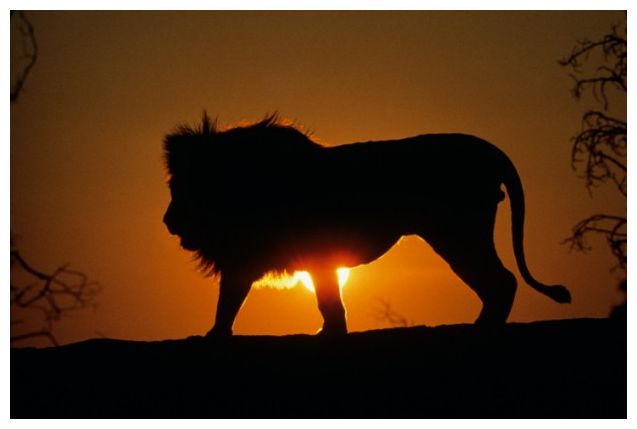
Big cats such as lions, tigers, leopards, and cheetahs could be facing extinction within the next two decades, leading conservation groups to call for increased efforts to save them, USA Today's Dan Vergano reported in a Friday articles.

"The populations of lions, leopards, cheetahs and especially tigers have been decimated in the past half-century," Vergano said, adding that leading scientists report that tigers "have become so rare that lions have become their soup-bone substitutes, sought for Asian medicines and 'tiger bone' wine."

"Do we want to live in a world without lions in the wild?" Luke Dollar, a biologist with Duke University and a member of the National Geographic-sponsored Big Cats Initiative (BCI), told USA Today. "That is the choice we are facing."

According to estimated statistics from the International Union for Conservation of Nature (IUCN), over the past 50 years lions living in the African wild have decreased from 450,000 to 25,000.

During that same period, leopards have decreased from 750,000 to 50,000, cheetahs from 45,000 to 12,000, and tigers from 50,000 to 3,000 (of which only 1,200 are breeding-age females).

Bizarro Earth

Canada - Hundreds of Dead Birds Wash Up on Ontario Shore

Dead Birds
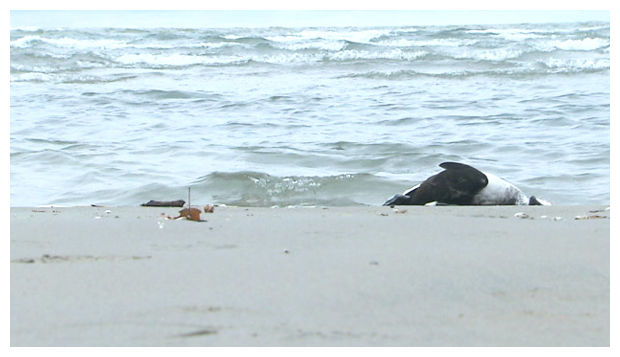
© CTV News, CanadaA dead bird is shown after it washed up on the shores of Wasaga Beach, Ont. in this undated photo.

The Ministry of Natural Resources is investigating after hundreds of birds and fish washed up on the shores of Georgian Bay near Wasaga Beach.

Police say that the wildlife is scattered along a nearly three-kilometre stretch north of Wasaga Beach.

"You just want to cry," resident Faye Ego told CTV Toronto.

Locals said they noticed some dead fish on the beach a few weeks ago and a few dead birds earlier in September.

"But now this is just multiplied," Ego said, adding that the situation is "absolutely devastating."

Ontario Provincial Police Const. Peter Leon said that the number of dead birds is estimated to be between 5,000 and 6,000.