Animals
S


Bizarro Earth

US: Thousands of Blackbirds Fall to Their Death in Arkansas Town for Second New Year's Eve In a Row

Ancient Mayan legend says that 2012 will bring the end of the world.

A small Arkansas town might have shown the first example of that as approximately 5,000 blackbirds dropped dead from the sky last night in the early hours of the new year.

As if the incident was not strange enough, it is the second time in two years that the birds have fallen as the calendar year change

Image
© ABC newsOn the streets: Estimates put the dead bird count well into the thousands.

Bizarro Earth

Unusual Amount Of Gray Whales Spotted Off California Coast

Whales
© redOrbit

Whale watchers are saying that migrating gray whales are swimming through Southern California waters in record numbers this winter.

The Los Angeles Times said on Wednesday that whale watchers at Point Vicente in Rancho Palos Verdes have recorded a record 163 sightings in December so far, which is the most that have been logged at this location in 28 years.

At this time last year, observers logged 26 gray whales. The previous record saw 133 of the mammals in 1996.

"I've seen some pretty good years but never anything like this," Joyce Daniels, a volunteer in the whale census, told the LA Times.

"We had whales everywhere. So many I was having trouble figuring out which whale was which," she said. "It's a real adrenaline rush to have so many whales."

Over 20,000 gray whales migrate each year from the arctic to Baja California, where females give birth. The mammals then migrate back north for the spring weather. California's coast is not just accustomed to only gray whales. Last spring, hundreds of blue whales were spotted in the area. Humpback whales have also been seen off the Californian coast.

Researchers say they hope this means things in the whaling world are going good and the populations are becoming more robust.

Bizarro Earth

Giant Shrimp Raises Big Concern as it Invades the Gulf of Mexico

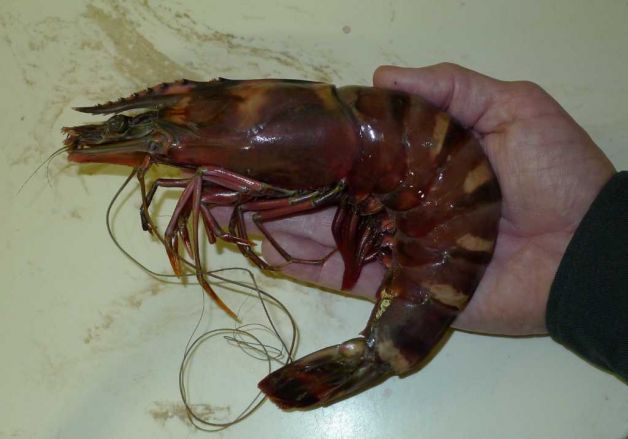
A tiger prawn
© Houston ChronicleA tiger prawn is displayed by shrimp trawler Capt. Tony Perez. The foot-long female was caught about 60 miles south of the Louisiana coast near Morgan City in October.
A truly jumbo shrimp is causing big worries about the future of the Gulf of Mexico's ecosystem.

The Asian tiger prawn, a foot-long crustacean with a voracious appetite and a proclivity for disease, has invaded the northern Gulf, threatening prized native species, from crabs and oysters to smaller brown and white shrimp.

Though no one is sure what the ecological impact will be, scientists fear a tiger prawn takeover could knock nature's balance out of whack and turn a healthy, diverse marine habitat into one dominated by a single invasive species.

"It has the potential to be real ugly," said Leslie Hartman, Matagorda Bay ecoystem leader for the Texas Parks and Wildlife Department. "But we just do not know."

The tiger prawns from the western Pacific - which can grow up to 13 inches long - have been spreading along the Gulf Coast since 2006, but their numbers took off this year. Shrimpers pulled one from Texas waters for the first time in June.

Nuke

Best of the Web: Seals with Damaged Flippers and Hair Loss 'Are Being Killed by Radiation from Fukushima Plant', Biologists Warn

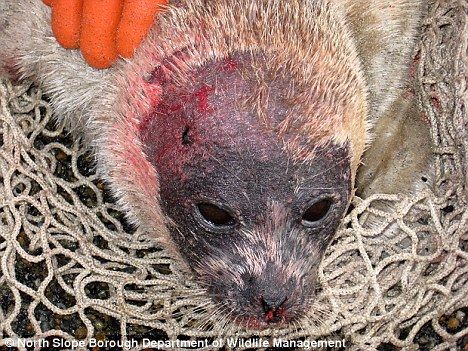
injured seal
© North Slope Borough Dept of Wildlife ManagementHarmed: Seals like this one in Barrow, Alaska, have been found with bleeding lesions, damaged fur and flippers thought to have been caused by radiation from Fukushima, Japan.
  • Seals washed up with hair loss and bleeding lesions
  • 9.0-magnitude quake caused meltdown at Japanese plant in March

Scientists in Alaska are investigating whether seals are being killed by radiation from Japan's crippled Fukushima nuclear plant.

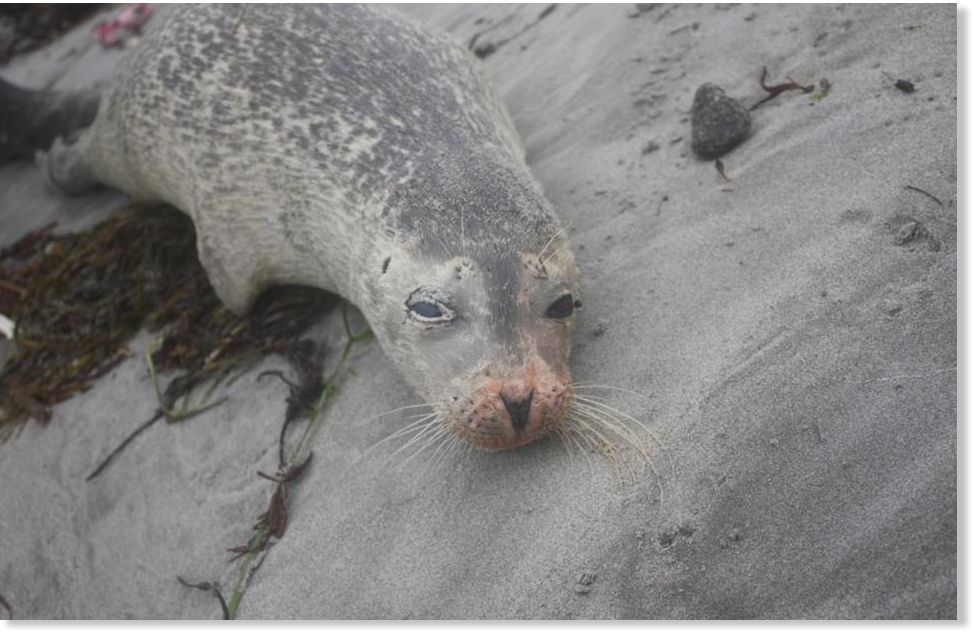
Scores of ring seals have washed up on Alaska's arctic coastline since July either injured or killed by a mysterious disease which biologists first thought was a virus.

But the bleeding lesions on the hind flippers, irritated skin around the nose and eyes and patchy hair loss on the seals' fur coats may have been caused by radiation from the stricken nuclear plant.

X

New England, US: Flu is blamed for mysterious seal deaths

Image
© New England AquariumDead harbor seals were seen on New Hampshire beaches earlier this year.
A flu virus similar to one found in birds but not previously detected in harbor seals was the cause of five of 162 recent deaths of the marine animals off the New England coast, federal and state officials said yesterday.

The influenza virus, known as H3N8, appears to have a low risk for transmission to humans, they said. But officials are urging the public to be cautious about approaching stranded seals to reduce the potential risk of spreading the infection to people or their unleashed dogs.

"Influenza that poses a risk to people are human strains of influenza. . . . but there have been documented cases in people of transmission from other species,'' said Dr. Catherine M. Brown, public health veterinarian for the Massachusetts Department of Public Health.

Other viruses that caused global disease outbreaks in years past, such as avian and swine flu, jumped from birds and pigs to humans, usually through the animals' caretakers, Brown said. She said there has been an increasing number of instances in the past decade of flu viruses jumping from one species to another.

Fish

Beluga Whales Trapped By Ice in Russia

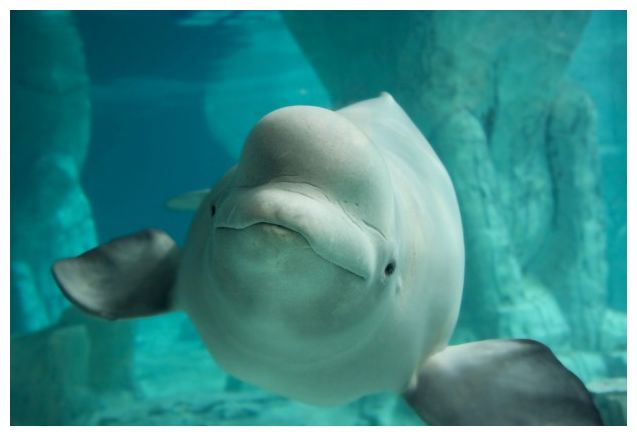
Beluga Whale
© redOrbit

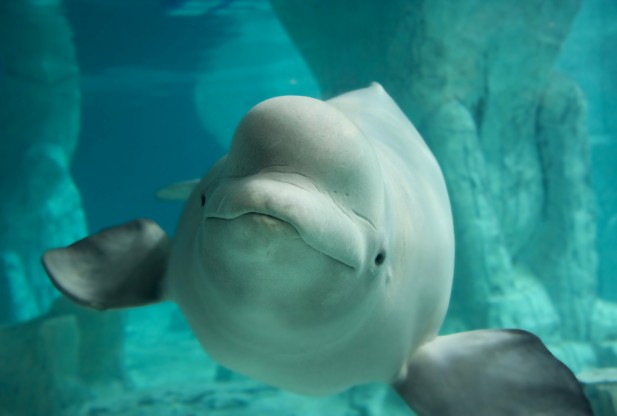
More than a hundred Beluga whales are trapped in frigid water surrounded by ice floes in the Chukotka region of Russia's Far East, and risk death unless they are rescued soon, local authorities said.

The flock of gentle whales was trapped in the Sinyavinsky Strait off the Bering Sea near the village of Yanrakynnot, a statement from the Chukotka Autonomous Region said, with local governor Roman Kopin calling for the government to send an icebreaker to the region to try and free them from their soon-to-be icy graveyard.

Local fishermen reported that the whales were concentrated in two relatively small ice holes, where they can at least breathe freely for the time being. But the odds of them being able to swim back out to open water are slim due to the vast fields of ice over the strait.

The statement said the whales risk becoming starved if they cannot be rescued soon. And with the advancement of the ice floes, the space where they are concentrated is growing smaller and smaller.

"Given the lack of food and the speed at which the water is freezing, all the animals are threatened with exhaustion and death," it added.

A Russian icebreaker was just two days sail away from the area, the Chukotka government noted. It could easily make the trip in time to save the whales, it added.

Magic Wand

US: Cable guy finds sleeping bear in New Jersey basement

A cable TV repairman got quite a surprise when he walked into the basement of a New Jersey home.

There was a 500-pound bear sound asleep on the floor.

The bear had been spotted wandering in the neighborhood in Hopatcong earlier Wednesday. It's not clear how it got into the home.

The bear ambled out of the house before state Fish and Game officials arrived.

Blackbox

India - Bird deaths: 250 crows die in Hazaribagh; samples sent to diagnose disease

Altogether 250 crows have died in Hazaribagh district in the last 48 hours following an undiagnosed disease.

District animal husbandry officer Yamuna Prasad said the birds died at Bishnugarh and Katkumsandi blocks, and their faeces would be sent to Indian Veterinary Research Institute, Bhopal and Indian Institute of Virology, Pune for tests.

"After getting the reports we have deputed a team to create awareness among the villagers at every 5 km with necessary instructions like not to handle the dead crows without gloves and bury the birds immediately and using masks," he said.

According to Satya Prakash, the state coordinator of the Indian Bird Conservation Network, said tests on crow deaths in Jamshedpur and Bokaro have been found to be H5N-1.

Blackbox

US - More bird death: Dozens of dead birds found in northwest New Mexico

A strange sight in Bloomfield where 40 to 50 dead birds were found along U.S. 64.

Some of the black and speckled birds were lying on their backs with their small feet sticking up in the air, and at least one was missing its head.

The Daily-Times reports about 30 dead birds were north of the highway and about 20 additional piles of flattened feathers were on the highway.

Wildlife biologist John Kendall with the Bureau of Land Management investigated the cluster.

He thinks they likely roosted in shrubs north of the highway Wednesday night and died when they flew into the side of a large truck driving the highway late Wednesday or early Thursday.

It's also unlikely the birds died from environmental causes because they were so close together when they died.

Bizarro Earth

US: Thousands of birds make crash landing in Utah

Image
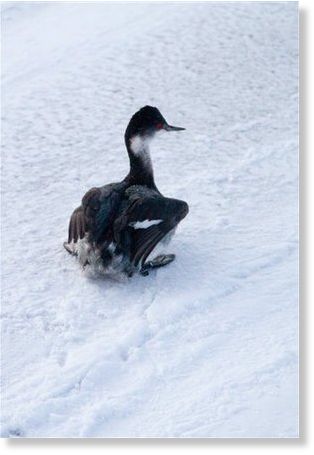
© Utah Division of Wildlife Services, Lynn Chamberlain | AP PhotoIn this photo provided by Utah Division of Wildlife Services, a surviving grebe waddles across the snow Tuesday, Dec. 13, 2011 after thousands of the birds crash landed throughout Southern Utah on Monday night.
St. George - Thousands of migratory birds died on impact after apparently mistaking a Wal-Mart parking lot and other areas of southern Utah for bodies of water and plummeting to the ground in what one wildlife expert called the worst downing she's ever seen.

Crews went to work cleaning up the dead birds and rescuing the survivors after the creatures crash-landed in the St. George area Monday night. By Tuesday evening, volunteers had rescued more than 2,000 birds, releasing them into nearby bodies of water.

"They're just everywhere," said Teresa Griffin, wildlife program manager for the Utah Division of Wildlife Resource's southern region. "It's been nonstop. All our employees are driving around picking them up, and we've got so many people coming to our office and dropping them off."

Officials say stormy conditions probably confused the flock of grebes, a duck-like aquatic bird likely making its way to Mexico for the winter. The birds tried to land in a Cedar City Wal-Mart parking lot and elsewhere.