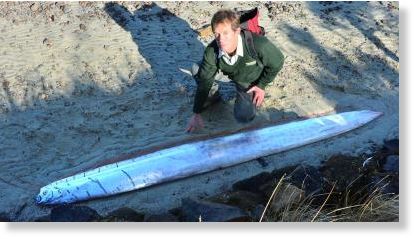
A 3m, self-amputating, vertically swimming, serpent-like ''bizarre'' marine specimen has washed up on the salt marsh at Aramoana.
Department of Conservation service manager David Agnew said he got a call from Aramoana resident Don Gibbs, who discovered the fish on the salt marsh side of the spit.
He went to have a look and said he had never seen anything like it before in his eight years in Dunedin and 20 years with Doc, during which he has mostly been stationed along the coastline in New Zealand.
''It's very unusual looking.''
University of Otago NZ Marine Studies Centre manager Tessa Mills confirmed the fish was an oarfish, which have been known to grow to 11m long.
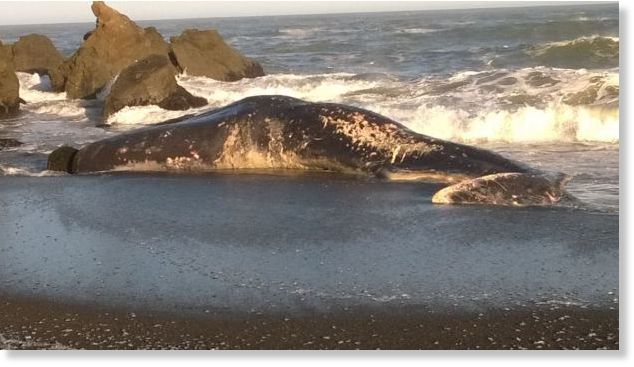
Biologists are heading to the San Mateo coast Wednesday morning to try and determine what killed an endangered sperm whale.
The 50-feet sperm whale was found bleeding from its head and into the water along at Mori Point on the south end of Sharp Park State Beach in Pacifica Tuesday.
On Wednesday, scientists from the Marine Mammal Center and the Academy of Sciences will perform a necropsy. They'll have their work cut out for them since adult sperm whales can get up to 50 tons in size.
It's unknown at this point if they will then leave the decomposing whale ashore or tow it out to sea.
Whale strandings are fairly rare. The Center said they do not see many stranded animals of this species, dead or alive, on shore.
Priscila Korb patch.com Wed, 15 Apr 2015 17:18 UTC
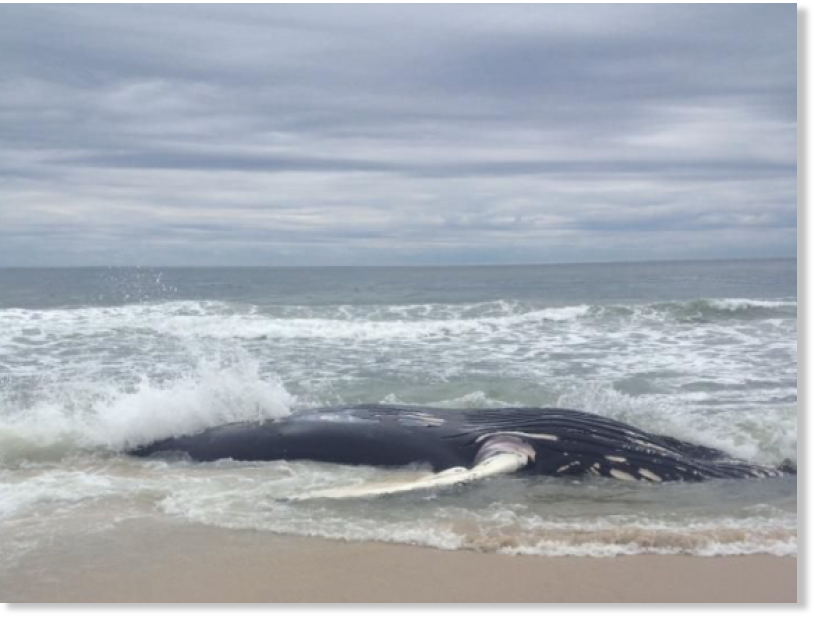
The dead whale on a Southampton beach
The whale was seen floating in the water on Monday and found on the beach on Tuesday.
A dead whale that was seen floating in the water on Monday, has washed up on a Southampton beach on Tuesday, according to the Riverhead Foundation for Marine Research and Preservation.
The foundation is working with National Oceanic and Atmospheric Administration (NOAA) to assess the situation and will provide more details as they become available.
They also remind residents to report all sightings to their 24-hour hotline at 631-369-9829.
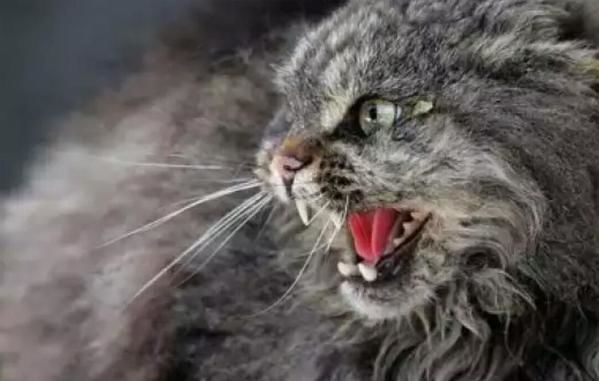
Australia wants its cats dead. But not because it's a nation of fanatical dog people — rather, the country's enormous feral cat population now constitutes a major threat to its biodiversity. To save the country's native wildlife, the cats need to go.
Due to hotter days, longer dry periods, and increasingly intense bush fires caused by climate change, Australia's biodiversity is diminishing. Despite being one of the world's 17 "megadiverse" countries, Australia has not done a bang-up job of protecting its wildlife. As mammalian extinction rates go, Australia's is pretty dang high: Twenty-one percent of Australian native land mammals are threatened.
Comment: Brush fires leave threatened species more exposed to feral cats.
But, shockingly, climate change is actually not the No. 1 enemy of koalas and kangaroos: Feral cats are the "single biggest threat" to protecting Australia's wildlife, according to a new piece from VICE News. There are about 20 million of these little cutthroat barbarians pawing, nuzzling, and murdering (in equal measure) their way across the continent, eating three to 20 animals each day — which adds up to a loss of 80 million native animals per week.
Comment: While the feral cat crisis is a CATaclysmic scenario for Aussie wildlife running out of control, this article doesn't mention the public health consequences of feral cat colonies, whose populations are rapidly increasing. Rabies, toxoplasmosis, cat scratch fever and other potentially serious infectious diseases can affect humans and other wildlife. Another solution is TNR (trap, neuter and release) however, this method is less reliable and discouraged by health and wildlife organizations.
The $2M pledged to slow biodiversity loss is not allocated to killing feral cats, per se, but to boost the recovery of threatened species in Australia's national parks via 10 projects targeting key species' habitats and threats, both flora and fauna. Specifically they will benefit Norfolk Island green parrot, Cocos buff-banded rail, long-nosed potoroo, southern brown bandicoot, northern quoll, partridge pigeon, brush-tailed rabit-rat, the plants of the Arnhem Plateau and the Kakadu Threatened Species Strategy. The feral cat massacre is the idea of Federal Environment Minister Greg Hunt. According to the mammal action plan assessments, it will take decades. They are now working on an engineered virus. (Oh! Oh!... call David Lynch!!!)
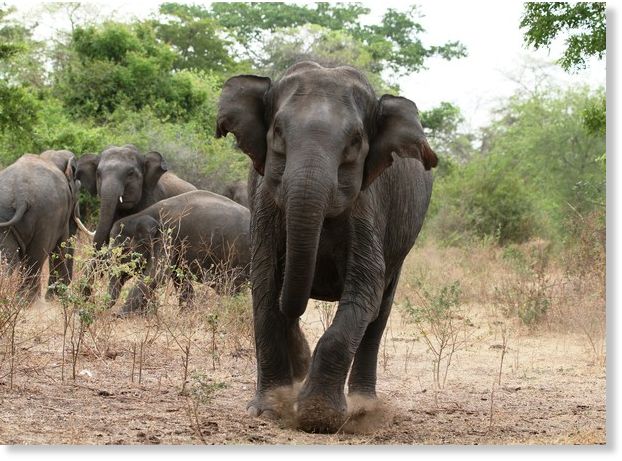
A villager was trampled to death by an elephant in Bankura district when he was returning home after attending 'Gajan' festivities last night.
50-year-old Swapan Bauri was cycling back home in Baguli village after attending 'Gajan' or 'Charak Puja' festivities in Kandashole village when he was chased by two male elephants.
One of the pachyderms lifted him by his trunk and then trampled him to death at Kadashole, Borjora Forest Ranger, Mohan Chandra Shit said today.
The villagers sat on a protest today demanding adequate compensation to the victim's family following which the Forest Ranger was asked to be present at a meeting between the residents and the police at the local police station, he said.
The Ranger said as per official norms, Rs 1.25 lakh was paid as compensation to Bauri's family and another Rs 1.25 lakh would be paid to them after his postmortem.
Man-elephant conflict is a problem in Purulia, Bankura and West Midnapur districts of the state as elephant herds from Dalma Wildlife Sanctuary of neighbouring Jharkhand migrate to the areas resulting in degradation of crops and property as well as injury and loss of human lives.
Sarah Griffiths Daily Mail, UK Fri, 10 Apr 2015 13:11 UTC
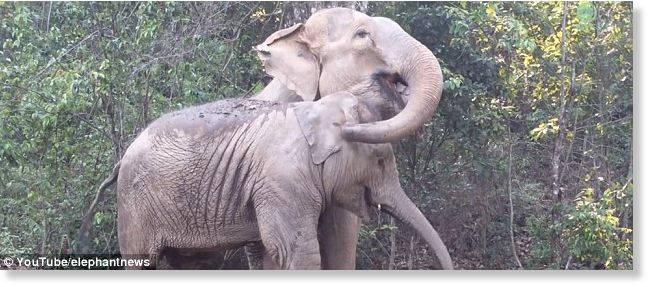
After a 62-mile (100km) trek through the Thai jungle, Me-Bai, the small calf can be seen nuzzling her mother, Mae Yui, and joyfully flapping her ears in the Elephant Nature Park sanctuary in the north of the country
The old adage that an elephant never forgets appears to be true, based on a touching video showing an Asian elephant returning to her mother after years apart.
After a 62-mile (100km) trek through the Thai jungle, Me-Bai, the small elephant can be seen nuzzling her mother, Mae Yui, while the pair joyfully flap their ears and caress each other with their trunks in the Elephant Nature Park sanctuary, in the north of the country.
Me-Bai was sold to provide rides for tourists in Thailand when she was three-and-a-half years old, and didn't see her mother, who also worked in the trade, for three years.
It is particularly sad because females tend to stick together in herds until they die, sharing incredibly strong bonds. They are very rarely separated before the calf is five years of age.
The small elephant left the tourism trade 'because she [Me-Bai] was too young [and] began to lose weight and could not carry the tourists any longer,' according to Elephant News' YouTube page.
Me-Bai was recently rescued and brought to the sanctuary after a tiring 62 mile (100km) trek in the hot sun that lasted four days.
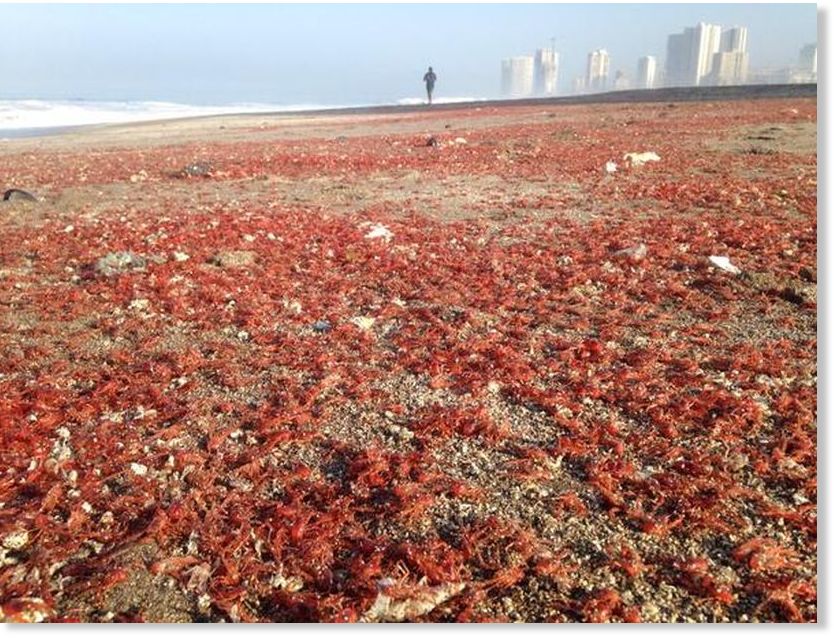
Playa Brava in Iquique has now turned red... Prawn red! A sign of the next big one?
Scientists are baffled by this apocalyptic mass die-off and will conduct various tests - water and shellfish - to determine the cause of this kill!
Yesterday morning the entire coast of Playa Brava in Iquique was blanketed by millions of dead or dying prawns.
The reason for this mass die-off is still unknown.
The apocalyptic event started at around 07:00. Rescue was launched directly after. But rough sea hampered the work of the rescuers, whose efforts were unsuccessful.
The victim Marco Antonio Sanchez, was allegedly intoxicated when he entered the water.
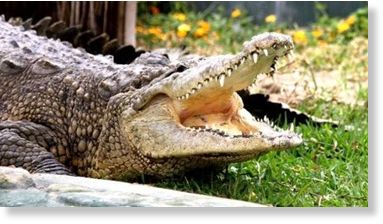
A 31-year old tourist, native of the state of Tlaxcala in central Mexico, died last Saturday drowned after being dragged by a 7 feet long crocodile in the Bojorquez Lagoon near Cancun hotel zone.
Eyewitnesses declared that the now deceased Marco Antonio Sánchez Fernández went swimming after heavily drinking. A few meters away from the sidewalk that is relatively close to the shore, bathers spotted a crocodile measuring over two meters (7 feet).
After the animal perceived movement, it entered the water. Realizing this, many people who were at the scene and police elements patrolling the area, warned the unnoticed swimmers to come out, but only one of them listened and when the other tried to react, the crocodile pulled him to deeper waters.







Comment: See also: Something amiss in the ocean depths? Rare Oarfish washes up on beach in Japan
Deep sea oarfish caught by Vietnamese fishermen: Consequences of earthquakes?
Waiting for the big one: giant oarfish start shock waves in LA
Giant deepwater oarfish washing up on California shores: Harbingers of death!
18-foot oarfish caught by Catalina marine science instructor in California
Second rare oarfish washes up in Southern California
Something amiss deep down? Bizarre-looking oarfish washes ashore on Cabo San Lucas beach
Appearance of "Earthquake fish" spook Japanese