Comets


Fireball

NASA spots comet and a body that's 'either a comet or an asteroid'

On Thursday, NASA's Near-Earth Object Wide-field Survey Explorer (Neowise) mission announced the discovery of two objects — one of which is a comet while the other is a mysterious object that seems to straddle the line between a comet and an asteroid.

The comet, C/2016 U1 NEOWISE, made its closest approach to Earth on Dec. 12, when it flew by at a distance of 0.71 AUs (1 AU, or the mean distance between Earth and the Sun, is roughly 93 million miles). As it nears the sun, there is "a good chance" that it might be seen with a pair of binoculars next week, although it's hard to be certain, given the unpredictable nature of a comet's brightness.

"As seen from the northern hemisphere during the first week of 2017, comet C/2016 U1 NEOWISE will be in the southeastern sky shortly before dawn," NASA said in a statement. "It is moving farther south each day and it will reach its closest point to the sun, inside the orbit of Mercury, on Jan. 14, before heading back out to the outer reaches of the solar system for an orbit lasting thousands of years. While it will be visible to skywatchers at Earth, it is not considered a threat to our planet."

The nature of the other object, named 2016 WF9, is less clear. Scientists at NASA believe that given its 4.9-year-orbit — which, at its closest approach on Feb. 25, will bring it to a distance of roughly 32 million miles from Earth — it can have multiple possible origins. It may once have been a comet, or it may be a dark asteroid that has strayed from the asteroid belt.


Comment: Ahem, 'comets' ARE 'asteroids', just 'lit up' as they discharge the solar capacitor while passing through our electric solar system.


Fireball 2

Comet 45P to make New Year's Eve Northern Hemisphere appearance

Even if you're not a fan of New Year's Eve fireworks, you'll have another reason to look to the skies Saturday. NASA says that as we ring in the new year, a comet will near the moon and be visible to those looking west.

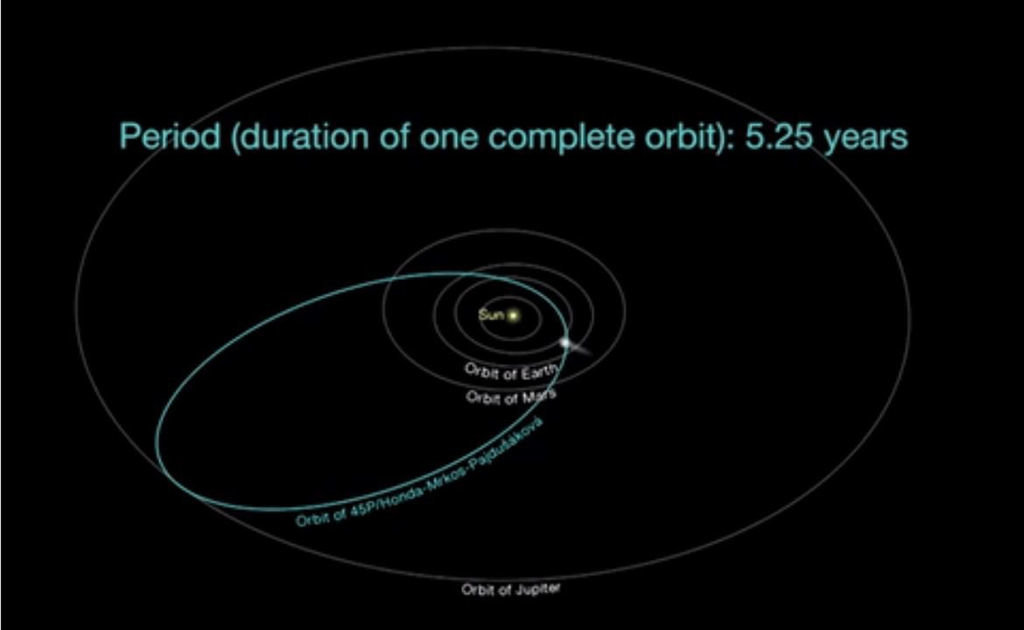
But here's the catch — you'll need a pair of binoculars to see it. NASA says comet 45P/Honda-Mrkos-Pajdušáková, named for the astronomers who discovered it in 1948, takes 5.25 years to complete its orbit.This year, it was first visible on the low western horizon on Dec. 15. On New Year's Eve, it will appear in the sky right near the moon.
comet 45p
© NASA
The comet will be observable from the Northern Hemisphere of the planet, and here's an easy way to check if it will be visible in your location on New Year's — go to TheSkyLive.com. It will reach its perihelion — the point of orbit when an object is closest to the sun — on New Year's Day, making its orbit around the sun and disappearing from visibility from Earth. It will be viewable, and reach its maximum brightness, once it swings back around the sun in 2017.

Comet

Comets & Asteroids - Summary for November 2016

During the months of November 2016, 1 new comet has been discovered. "Current comet magnitudes" & "Daily updated asteroid flybys" pages are available at the top of this blog (or just click on the underline text here).

The dates below refer to the date of issuance of CBET (Central Bureau Electronic Telegram) which reported the official news & designations.

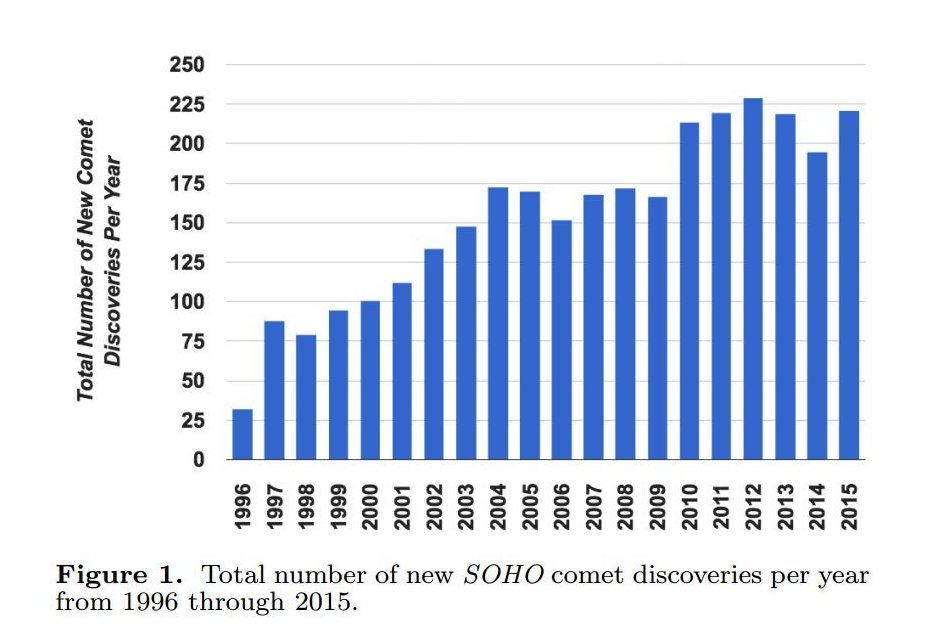
SOHO Comet Discoveries
© K. Battams & M. Knight
Comet Discoveries

Nov 03 Discovery of C/2016 U1 (NEOWISE)

Other news

Nov 02 Newly discovered asteroid 2016 VA came to about 90.000 km from the Earth's surface on the second day of November, reaching magnitude 12. It crossed the Earth shadow for a few minutes (between 23:24-23:35 UT on Nov 01, just 0.3 LD from Earth), challenging astronomers to observe a peculiar "asteroidal eclipse".

Below you can see an animation showing this spectacular event as observed by G. Masi (Virtual Telescope Project). According to Masi: "Each frame comes from a 5-seconds integration. At the eclipse time, the asteroid was moving with an apparent motion of 1500"/minutes".

Comet 2

Incoming star Gliese 710 could spawn swarms of comets when it passes our Sun

Gliese 710
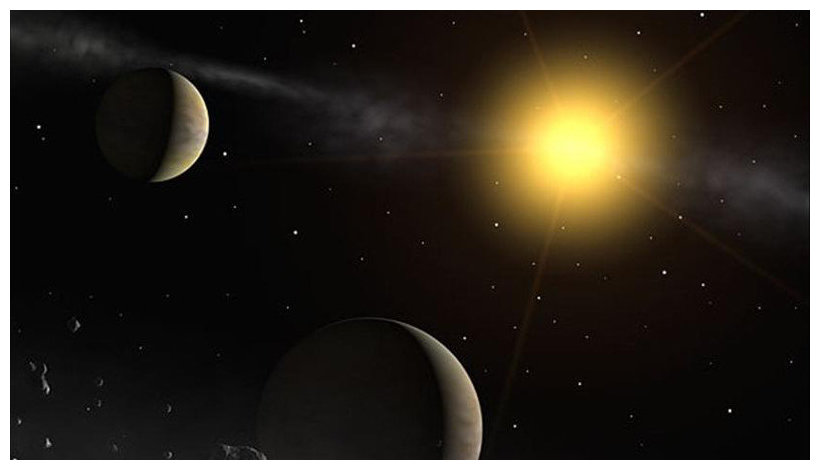
© ESOArtist’s impression of Gliese 710, a sun-like star that will travel through our Solar System’s Oort Cloud in about 1.3 million years.
For years, scientists have known that Gliese 710 will come excruciatingly close to our Solar System in about a million years. An updated analysis suggests this star will come considerably closer than we thought, during which time it's expected to spawn dangerous cometary swarms.

Gliese 710 is currently 64 light-years from Earth, but for all intents and purposes, it's heading straight for us. A new study published in the journal Astronomy and Physics projects the close encounter will happen about 1.35 million years from now, and that the star will come within 13,365 AU of our sun (where 1 AU is equal to the average distance of the Earth to the sun), or 1.2 trillion miles. At that distance, it would take light 77 days to reach the Earth.

That's obviously far, but not in cosmological terms. That distance is well within the Solar System's Oort Cloud—a large bubble of ice and rock that surrounds the sun to a distance as far as 50,000 to 200,000 AU. So while Gliese 710 is sure to avoid a direct hit with any object in the inner Solar System, it'll likely travel through the Oort Cloud. And with its tremendous gravitational influence (it's about 60 percent the size of our sun), it'll perturb the many large rocks currently sitting idle way out there in the outer reaches. This star is poised to send a shower of comets into the inner Solar System, possibly causing a serious impact event with Earth.

Fireball

House in Indonesia hit by meteorite

A house hit by an alleged meteor
© Tempo.coA house hit by an alleged meteor.
Residents of Sungai Serut District, Bengkulu City, were surprised by a rock that is alleged to be a meteor that ripped through a house owned by Wahab (56), on Wednesday, November 24, 2016.

At the time of the incident, according to Wahab, he was having a casual conversation with his friend. Suddenly, they heard a loud thump from the inside of his house. The noise originated from his kitchen.

After a quick search, Wahab found a rounded smoky object that is as big as a basketball that had made it through his kitchen roof. "Not only did it hit the roof, the rock also destroyed the water dispenser and a water gallon, as well as a table," he said.

Wahab and a number of his friends flushed the rock with water and placed it outside the house. The locals broke the white-colored rock to pieces and gave it to a number of people as they believe that the meteorite has a certain effect.

The rest of the rock has been handed over to the police.

Fireball 3

Japanese teenager films meteor shortly after Fukushima earthquake

Meteor over Japan
© Asuka/Twitter
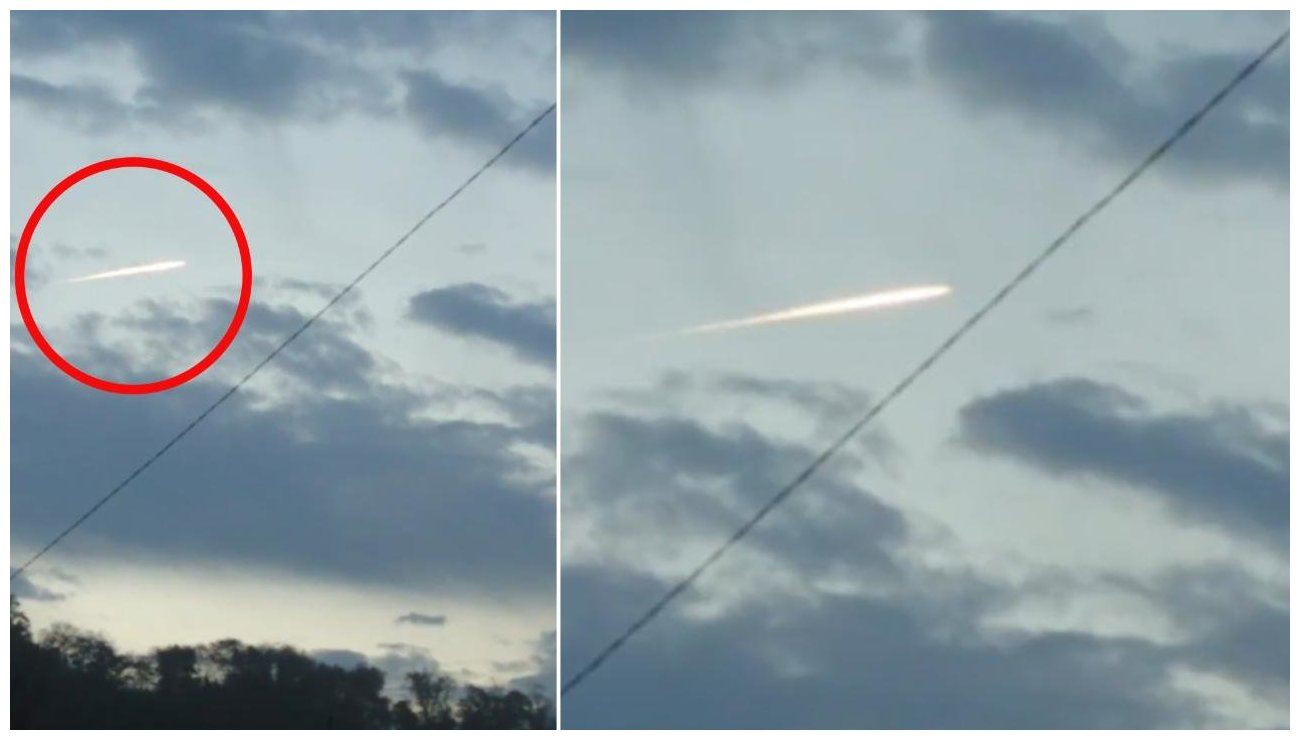
A teenager has filmed a ' meteorite ' burning across the sky shortly after the Japanese earthquake struck.

The teen, known as Asuka, 16, from Japan, filmed the extraordinary sight trailing across the evening sky this evening.

A rough translation of her Tweet accompanying the video says: "A movie I took while preparing to die.

"Thought that it was a meteorite because there was an earthquake earlier. It is not a meteorite."

The video emerged as the country absorbed the 7.3 magnitude earthquake that has shaken Tokyo after striking off the coast of Japan.

Chalkboard

Mathematician claims one in 500 chance of extinction next year

Earth
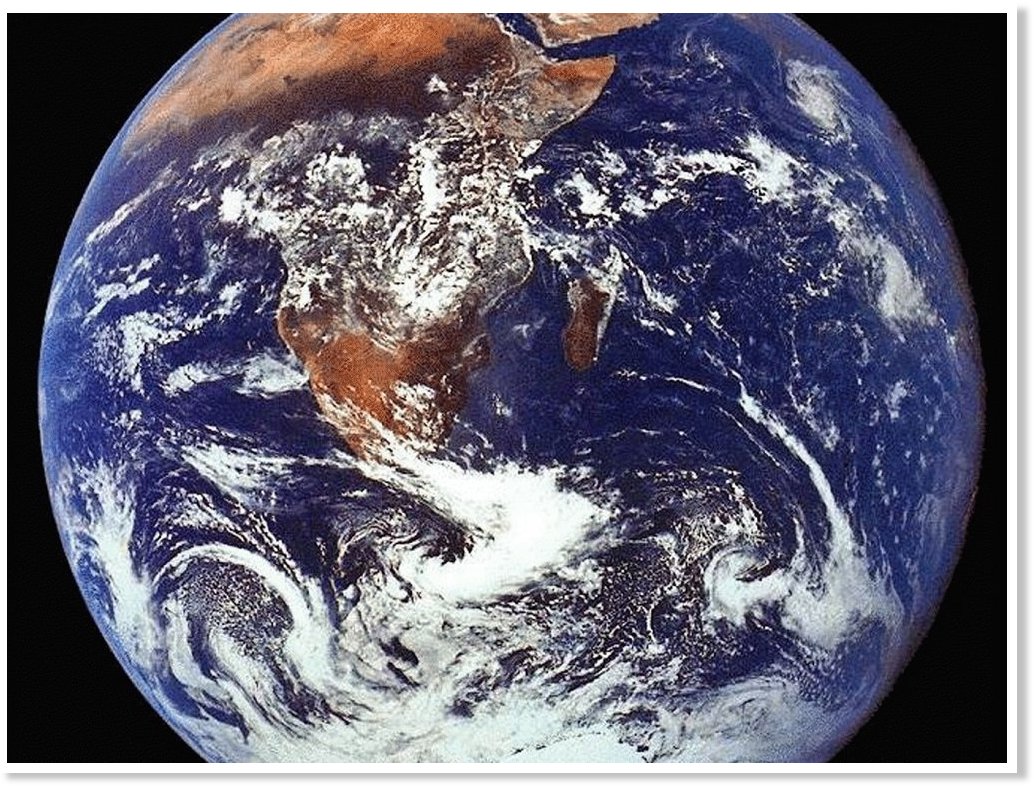
© NASAThe calculation is based on the Doomsday Argument.
The human race faces a one in 500 chance of extinction in the next year, an expert mathematician has claimed.

Dr Fergus Simpson, a mathematician at the University of Barcelona's Institute of Cosmos Sciences, said there was a 0.2 per cent chance of a "global catastrophe" occurring in any given year over the course of the 21st Century.

The calculation is based on the Doomsday Argument, which it is claimed can predict the number of future members of the human species given an estimate of the total number of humans born so far.

"Our key conclusion is that the annual risk of global catastrophe currently exceeds 0.2 per cent," Dr Simpson wrote in an academic paper called Apocalypse Now? Reviving the Doomsday Argument, accessed through Cornell University's online library.

"In a year when Leicester City FC were crowned Premier League champions, we are reminded that events of this rarity can prove challenging to anticipate, yet they should not be ignored," he added.

According to Dr Simpson's calculations, around 100 billion people have already been born and a similar number will be born in the future before the human race expires.

He estimated there was a 13 per cent chance humanity would fail to see out the 21st Century.

This is a more optimistic conclusion than previous studies, with British Astronomer Royal Sir Martin Rees suggesting there was a 50 per cent probability of human extinction by the year 2100 in his 2003 book Our Final Hour.

Red Flag

Your brain on aspartame

aspartame
© Underground Health
Controversy continues to rage over the artificial sweetener aspartame. Since it was first approved by the Food and Drug Administration (FDA) in 1981, aspartame has made its way into more than 6,000 food items.

The FDA claims aspartame is safe but has set an acceptable daily intake of no more than 50 mg per kilogram of body weight. In other words, an adult weighing 165 pounds should consume no more than 3,750 mg of aspartame a day. A can of diet soda typically contains about 180 mg of the chemical. That means the FDA's "safe" limit equates to about 21 cans of diet soda per day.

But is any level of aspartame really safe?

For decades researchers have claimed aspartame is responsible for headache, memory loss, mood changes, and depression. Consumer complaints back them up. Over 75% of adverse reactions to food additives reported to the FDA concern aspartame. Reported problems include headaches, migraines, vision problems, tinnitus, depression, joint pain, insomnia, heart palpitations, and muscle spasms.

Recently researchers from the University of North Dakota wanted to test the safe limits of aspartame over a short period of time. They found that at just one half of the FDA's "safe" acceptable daily intake, aspartame caused serious neurobehavioral changes including cognitive impairment, irritable moods, and depression.[i]

Comment: More information about how toxic aspartame is to human health:


Seismograph

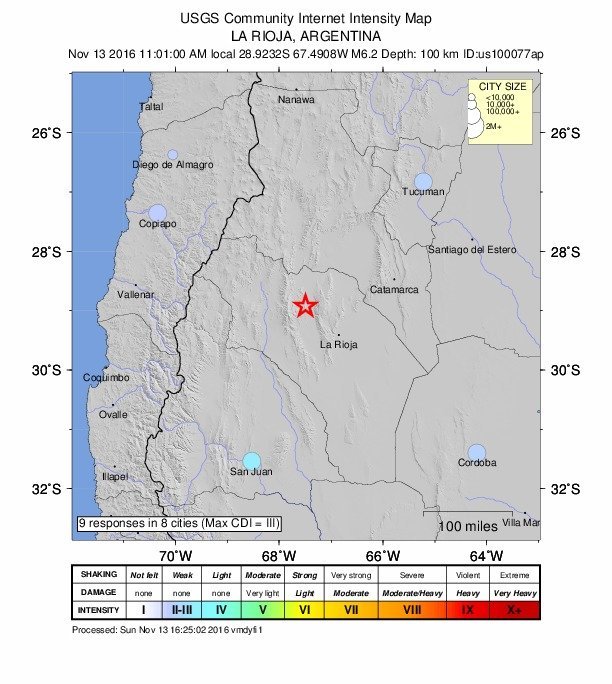
USGS: second magnitude 5.7 quake strikes Argentina

Magnitude 5.7 earthquake La rioja, Argentina
© USGSLa Rioja, Argentina

Comment: Other interesting events of note in the last 24 hours:


Question

Sonic boom over South Dakota remains a mystery

Leonid Meteor
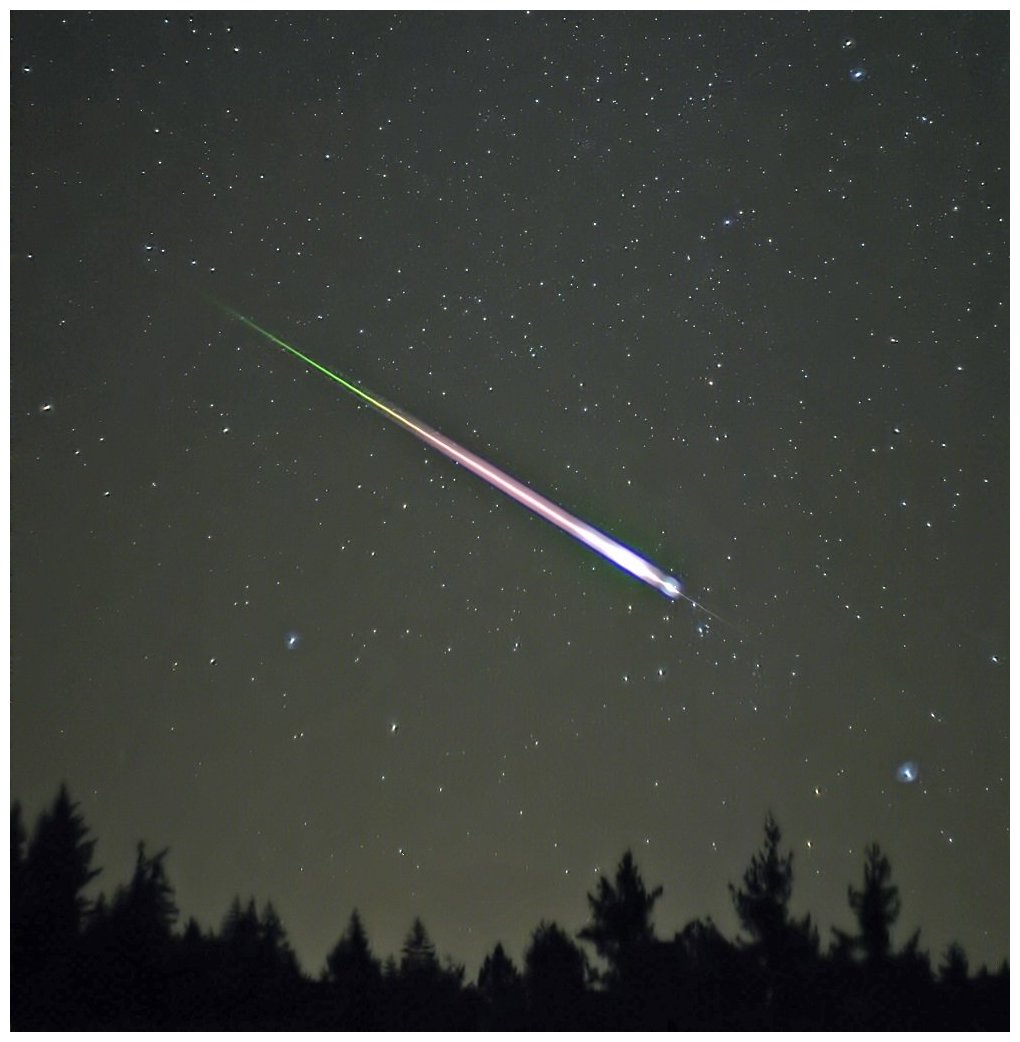
© Wikimedia CommonsA meteor during the peak of the 2009 Leonid Meteor Shower. The photograph shows the meteor, afterglow, and wake as distinct components.
Spearfish — The mystery of what caused Monday's loud boom remains.

Some theories have been refuted, while more mysterious references have appeared.

Shortly before 2 p.m., the boom was heard throughout the Black Hills. Some people said it shook their homes or businesses, rattling windows, and scaring them in several instances.

But the noise was heard in a much larger area than the Black Hills. Responses to Tuesday's Black Hills Pioneer story reported hearing the noise from Western Nebraska to Southeast Montana.

Kathy Griesse reported hearing the noise near the Agate Fossil Beds National Monument south of Harrison, Neb. She said it sounded like the noise came from the north and west of her. Additionally, she talked to people in Crawford, Neb., where people told her windows rattled at the sound of the boom; people in Whitney, Neb., also heard the noise.

On the northern end of reports, Lane Pilster said he heard the boom at his ranch, 14 miles west of Alzada, Mont.

This is about a 200-mile straight-line distance between the two reported locations.

Pilster reported that he and his dad both heard the noise to the south of them.

"The beginning of it was intense, but then faded off with a dull rumbling like a jet was flying by. The sound probably lasted about 8-10 seconds," Pilster said.

He also said he felt a moderate vibration around 5:30 a.m. Monday, and that it lasted 15-20 seconds.

He wasn't the only one to hear a strange noise apart from the 2 p.m. event.

Brad Scott, of Spearfish, heard a loud boom in downtown Spearfish around 7:30 a.m. Sunday

He described it as the "sound of about 8 shotguns going off at once."

So what was the noise?