Comets


Fireball 2

Asteroid attack? Yet another asteroid to give Earth a close shave

Another close shave
© ESASpace rock block party!
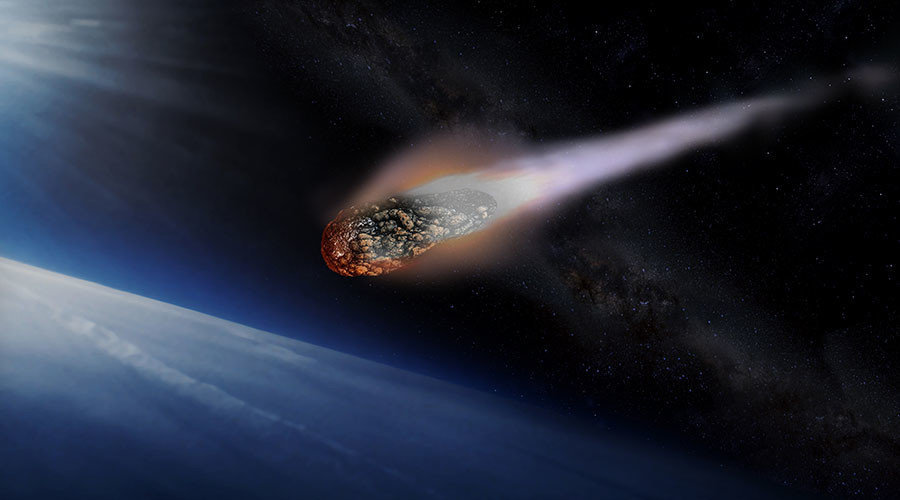
For the fourth time since the start of 2017, a small celestial body will pass closer to Earth than the distance between us and the moon. Recently discovered asteroid 2017 BS32 zips by around midday Thursday.

This latest narrow shave comes just a few days after the closest such flyby in months, prompting observers and some astronomers to wonder if the apparent blitz of tiny planetoids could be more than mere coincidence.

According to astronomer Paul Cox at the Slooh observatory, the apparent bursts of small, close-approaching asteroids were first spotted just before buzzing us initially sparked discussion in 2016.

"One possibility sprang to mind -- that these clusters of smaller asteroids making close approaches to Earth over relatively short periods of time were in fact the fragments from larger asteroids that had broken up," Cox said via email. "However, when we reviewed the orbits of each of the asteroids, we found no correlation between them -- showing clearly they weren't associated in any way."

Cox said the scientists also looked for a connection to seasonal changes or to weather at observatories that might reduce discoveries of nearby asteroids, but there was no conclusive data to be found.


Comet

Anything to worry about with 'death asteroid' WF9?

comet to earth
© shutterstock
By now you've probably heard of 2016 WF9. Everybody is freaking out about this 'death asteroid' and, if the predictions hold up, it really is something to worry about. Except, as you might have guessed, the predictions do not actually hold up.

There's really only one person saying WF9 is the Sweet Meteor of Death some people were rooting for in the 2016 election: Dyomin Damir Zakharovich, a Russian astronomer who claims that the asteroid is actually a piece of Nibiru. What, you might ask, is Nibiru? Why, it's a planet we were told about by Nancy Lieder, a woman who claims to be in telepathic contact with aliens from Zeta Reticuli. This would be a good point to bring up that the "Nibiru cataclysm" was supposed to have happened in 2003.

In rather sharp contrast to the doomsaying, here's what NASA had to say about 2016 WF9:
2016 WF9 will approach Earth's orbit on Feb. 25, 2017. At a distance of nearly 32 million miles (51 million kilometers) from Earth, this pass will not bring it particularly close. The trajectory of 2016 WF9 is well understood, and the object is not a threat to Earth for the foreseeable future.

Comment: An asteroid is about to slip between Earth and the moon — the second near miss in 3 weeks


Fireball

Meteor fireball spotted over Leeds, UK

Meteor over Leeds
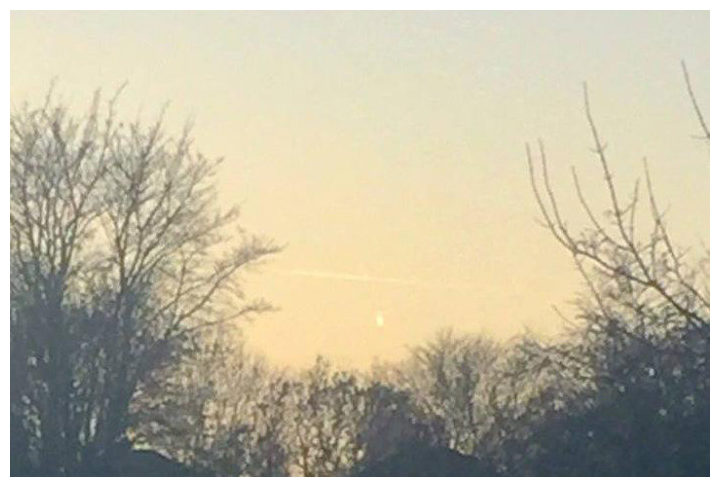
© Yorkshire Evening PostThe meteor over Allerton Bywater.
Is this a meteor in the skies over Leeds?

Kelly Moss snapped the burning light hovering over Brigshaw High School in Allerton Bywater at around 4.30pm on Wednesday, as dusk was falling.

A meteor, often called a shooting star, is the visible passage of a glowing meteoroid, micrometeoroid, comet or asteroid through Earth's atmosphere, after being heated to incandescence by collisions with air molecules in the upper atmosphere, creating a streak of light via its rapid motion and sometimes also by shedding glowing material in its wake.

Fireball

Mysterious boom rattles San Diego residents

San Diego
© 7 San Diego
Several people across San Diego County reported hearing a loud, mysterious boom Tuesday afternoon.

An NBC 7 viewer told us, around 3:18 p.m., she heard two loud booms that shook the windows in her home in Santee.

There were multiple posts on social media of people reporting their homes rattled from the boom. The posts were from residents across the county, including Clairemont, Santee, and San Diego.

Some wrote that they suspected the sounds were caused by a sonic boom, but NBC 7 has not confirmed that.

Comment: Fox News San Diego reports two large "bangs" were heard. Residents also reported a car moving back and forth and a "large glowing ball in the western sky".


Fireball 4

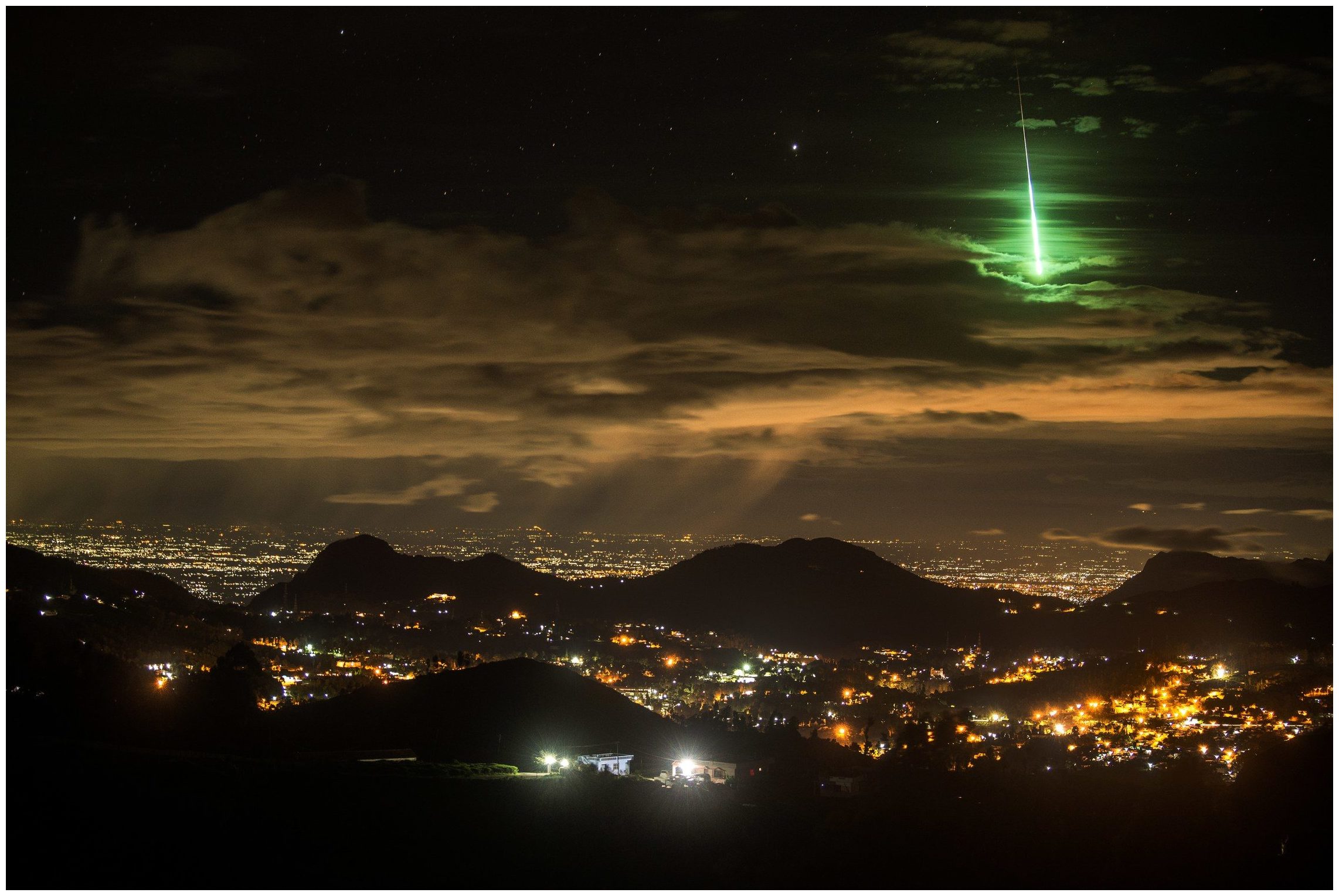
Brilliant green meteor fireball photographed over Southern India

Green Meteor over South India
© Prasenjeet Yadav
While exploring the sky islands of the Western Ghats in 2015, molecular ecologist turned photographer Prasenjeet Yadav shot a rather rare photograph with a green meteor up in the sky and the twinkling lights of the town below. It earned him a plethora of awards, including National Geographic Nature Photographer of the year, 2016, and also an Honourable Mention in the Landscape Category by National Geographic. The photograph was shot on October 9, 2015, and Yadav was at the Nilgiri's near Ooty when he shot the green meteor. The town he is overlooking is Mettupalayam.

"This is probably the only composed photo of a green meteor. No photographer can plan this shot. This can happen for a fraction of second anywhere in the universe, and the fun part is, I was sleeping when my camera captured it. Everything else was hard work but for those 15 seconds, I was the luckiest photographer on the planet," says Yadav, who was working on a story on sky islands of Western Ghats when he shot this. Along with bird ecologist Dr Robin Vijayan, Yadav was working on a project to understand the role these mountains play in the formation of new species.

Born in Nagpur, Yadav went to Bangalore to pursue research at the National Center for Biological Science. In 2013, he moved to photography and began concentrating on environment and conservation stories. He is reportedly the only Indian to be represented by the National Geographic Creative. Although he has stepped away from the academic realm, Yadav considers himself a non-traditional scientist and often collaborates with researchers, policy makers and conservationists for his projects in the world of nature photography. Currently, he is working on a story on the sky islands of southern India for National Geographic and is documenting the unseen species of amphibians, reptiles, birds and mammals found only in the south Western Ghats.

Fireball 2

Meteor fireball blazes across Siberian city of Omsk

Meteor over Omsk
© CENMotorists were given an extraordinary experience as the meteor blazed across the sky.
Motorists in the city of Omsk in Siberia were treated to the rare phenomenon as the falling space rock crashed to earth. The meteor, which appeared in the Omsk Oblast, appeared to be a massive fireball and was visible for miles. However experts say the flaring object was actually probably small enough to fit in your pocket.

Vladimir Krupko, head of the local planetarium, said: "Most likely it was a small meteorite, the size of a walnut.

"Since it was flying up high in the air, it was visible from other cities as well.

"When it entered the atmosphere it caught fire at about 120 kilometres (74.5 miles) above the ground, and by the time it was 40-60 kilometres (25-37 miles) above the ground the fire had gone out."

Despite there being plenty of larger objects whizzing around our solar system, no large meteorites, which are debris from a comet, asteroid, or meteoroid, are expected for at least 100 years, Mr Krupko said.

Comment: A few weeks ago two large meteor fireballs were caught on camera in northwestern Russia.


Sherlock

Lost 'Dark Age' Kingdom of Rheged uncovered in Scotland

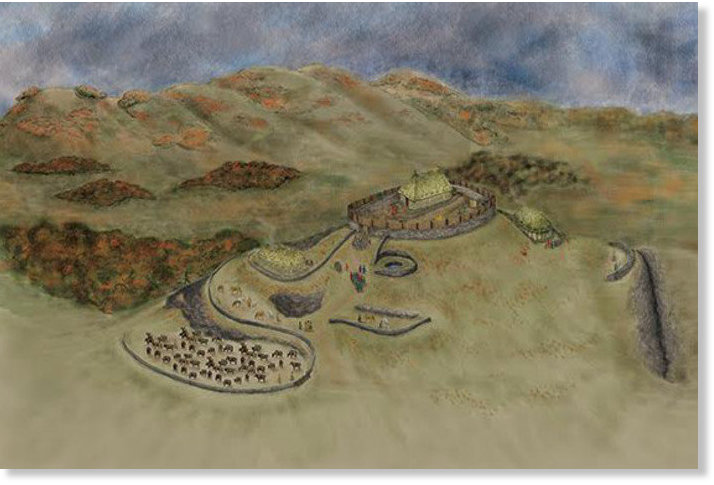
A "lost" dark age kingdom has been discovered in Dumfries and Galloway after archaeologists finally solved the mystery surrounding the location of the elusive stronghold. The kingdom of Rheged has been found following excavation work by Gatehouse of Fleet in Dumfries and Galloway.

Rheged
© GUARD ArchaeologyA recreation of the royal stronghold of Rheged which has been discovered in Dumfries and Galloway.
Previously, it was thought the kingdom was headquartered in Cumbria although no evidence of it was ever found. Archaeologists were first drawn to the site by Pictish carvings in stones at Trusty's Hill given the unusual southerly location of the markings. But the team from GUARD Archaeology now believe the carvings belong to the stronghold of King Urien's where inauguration ceremonies for the Britons of Galloway were held around 600AD.

Ronan Toolis, who led the excavation, said: "The new archaeological evidence suggests that Galloway may have been the heart of the lost Dark Age kingdom of Rheged, a kingdom that was in the late sixth century pre-eminent amongst the kingdoms of the north." Excavations have revealed the summit of the hill was fortified with a timber-laced stone rampart.

Fireball 2

Are we next? Researchers reconstruct the dark and frozen conditions on Earth after asteroid megastrike

The apocalyptic time that many believe wiped out the dinosaurs has been reconstructed by scientists in unprecedented detail. They found tiny droplets of sulfuric acid formed high up in the air after the well-known impact of a large asteroid 66 million years ago, blocking the sunlight for several years.

They say this 'big chill' had far more catastrophic effects that first thought, causing global temperatures to plummet for three years, even mixing oceans and killing off sea life.
ice age
'The big chill following the impact of the asteroid that formed the Chicxulub crater in Mexico is a turning point in Earth history,' says Julia Brugger from the Potsdam Institute for Climate Impact Research (PIK), lead author of the study to be published today in the Geophysical Research Letters.

'We can now contribute new insights for understanding the much debated ultimate cause for the demise of the dinosaurs at the end of the Cretaceous era.'

Comet 2

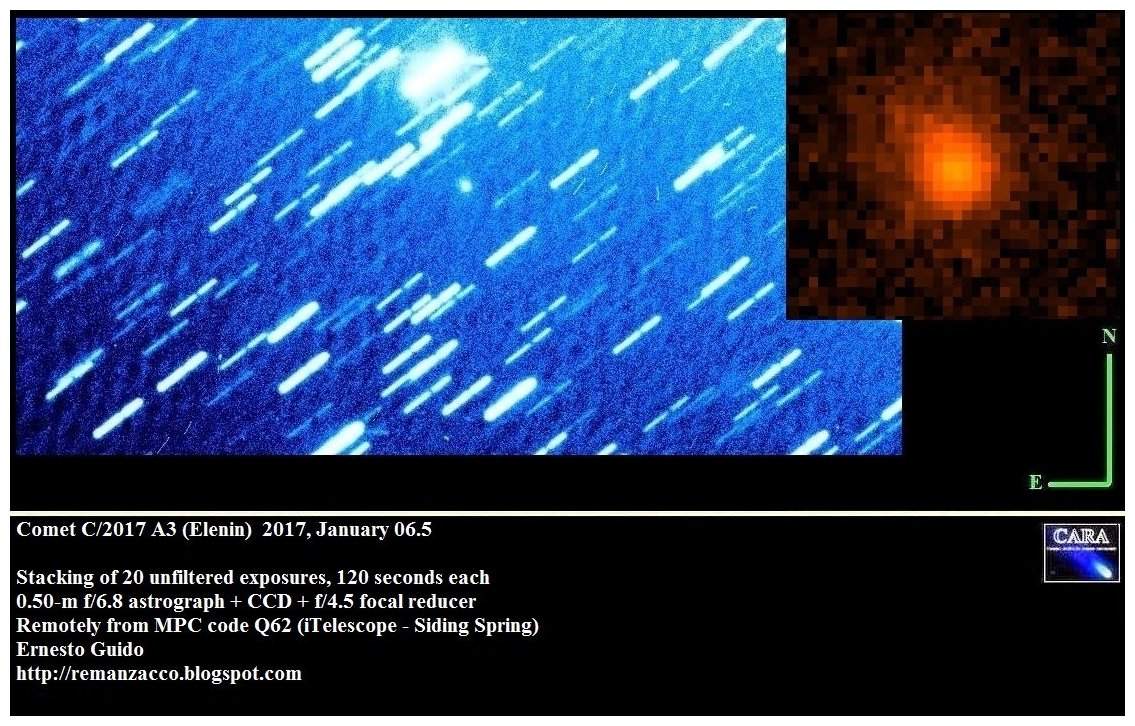
New Comet: C/2017 A3 (Elenin)

MPEC nr. 2017-A75, issued on 2017, January 11, announces the discovery of a comet (magnitude ~18.2) by L. Elenin on CCD images obtained with 0.4-m f/2.4 reflector + CCD at the ISON-SSO Observatory, Siding Spring on Jan. 5.4 UT. The new comet has been designated C/2017 A3 (Elenin).

I performed follow-up measurements of this object, while it was still on the neocp. Stacking of 20 unfiltered exposures, 120 seconds each, obtained remotely on 2017, Jan 06.5 from Q62 (iTelescope network) through a 0.50-m f/6.8 astrograph + CCD + f/4.5 focal reducer, shows that this object is a comet with a compact coma nearly 10 arcsec in diameter elongated toward PA 40.

My confirmation image (click on it for a bigger version)
Comet C/2017 Elenin
© Remanzacco Blogspot
M.P.E.C. 2017-A75 assigns the following preliminary parabolic orbital elements to comet C/2017 A3: T 2017 Jan. 20.6; e= 1.0; Peri. = 301.87; q = 3.91; Incl.= 99.12

Comet 2

Another close shave: Asteroid discovered 4 days ago whizzes past Earth

Near Earth asteroid
© Erik Simonsen / Getty Images
An asteroid between 11 to 34 meters across (36 to 111ft), roughly the size of 10 jumbo African elephants, made a remarkably close approach to Earth on Monday morning, passing by at a distance only half that of the Moon.

According to the Slooh Observatory, the space rock, dubbed 2017 AG13, was moving at about 10 miles per second, making it hard to spot with a telescope.

"This is moving very quickly, very nearby to us," Eric Edelman, an astronomer with Slooh, said during a live broadcast of the surprise flyby at 7:47am ET on January 9.