Comets


Fireball

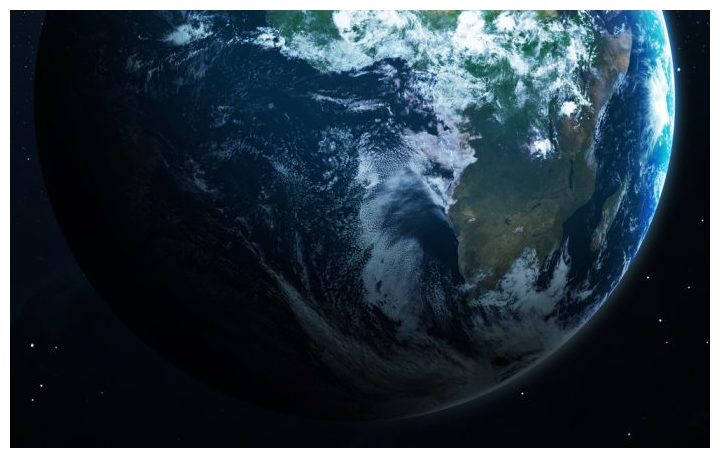
Earth wishing for just one passing meteor to hit!

Earth
© Waterford Whispers News
An increasingly depressed Earth has looked towards passing meteors with a wistful desire, hoping one of them could slightly change course and hurtle towards its surface, obliterating its life-sustaining self.

Growing more world weary with each passing day, Earth, home to over 7 billion people has become more listless as its chief tenants continue to treat it with disrespect.

"Aw man, that one was really close, and it looked big enough to put me out of my misery too," Earth confirmed as it stared at a meteor the size of Gilbraltar as it whizzed past.

Becoming unhappy as the level of pollution humans create which is causing irreparable damage to it, the Earth has confessed in recent times it would love nothing more than to alter its orbit for the worse and admitted to being jealous of lifeless planets.

"And hey, I'd given self-harming some consideration, but why bother when North Korea are running missile nuclear tests".

"You know, when that last big one hit I was relieved to still be standing after it all. But the more time passes, the more I think the dinosaurs were the lucky ones, not me," Earth added, unable to rouse itself from its melancholic mood.

Info

Early history and impact events in India

1st Millenium India
© Malaga Bay
Getting acquainted with 1st millennium Indian History is a daunting task.

However, Wikipedia provides a helpful Outline of South Asian History that lists the various Kingdoms and Empires that emerged during the 1st millennium.
History of South Asia - South Asia includes the contemporary political entities of the Indian subcontinent and associated islands, therefore, its history includes the histories of India, Pakistan, Bangladesh, Nepal, Afghanistan, Bhutan, and the island nations of Sri Lanka and the Maldives.
The level of detail associated with each Kingdom or Empire is fairly variable.

Some histories are short and vague. Others are long and detailed.

Fireball 4

Bright light seen shooting across Wellington's night sky

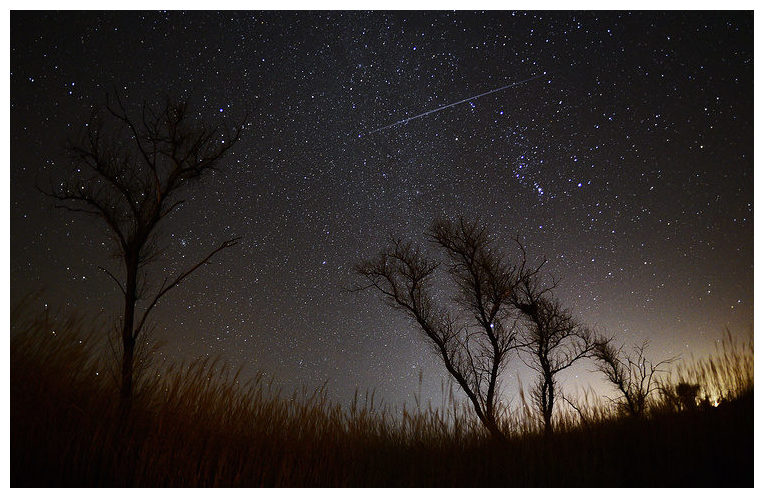
When Stephen Moore installed a dashcam in his vehicle, it wasn't to capture footage of UFOs.

But that's exactly what happened when his son witnessed a bright light shoot across the Wellington sky shortly before 8pm on Tuesday.
Meteor
© Stephen MooreThe dashcam captured the bright light on Wellington's Featherston St.
The pair eagerly returned to their home in Hataitai and downloaded the footage from the camera.

"It records in real time, so after we saw it we thought it was too fast to be a plane," said Moore.

Brett Jennings saw something similar in Nelson, and said the light was bright green in colour.

Info

Indigenous peoples around the world tell myths which contain warning signs for natural disasters - Scientists are now listening

A Moken woman stares out to sea.
© Photo by Taylor Weidman/LightRocket/GettyNative knowledge - A Moken woman stares out to sea.
Shortly before 8am on 26 December 2004, the cicadas fell silent and the ground shook in dismay. The Moken, an isolated tribe on the Andaman Islands in the Indian Ocean, knew that the Laboon, the 'wave that eats people', had stirred from his ocean lair. The Moken also knew what was next: a towering wall of water washing over their island, cleansing it of all that was evil and impure. To heed the Laboon's warning signs, elders told their children, run to high ground.

The tiny Andaman and Nicobar Islands were directly in the path of the tsunami generated by the magnitude 9.1 earthquake off the coast of Sumatra. Final totals put the islands' death toll at 1,879, with another 5,600 people missing. When relief workers finally came ashore, however, they realised that the death toll was skewed. The islanders who had heard the stories about the Laboon or similar mythological figures survived the tsunami essentially unscathed. Most of the casualties occurred in the southern Nicobar Islands. Part of the reason was the area's geography, which generated a higher wave. But also at the root was the lack of a legacy; many residents in the city of Port Blair were outsiders, leaving them with no indigenous tsunami warning system to guide them to higher ground.

Humanity has always courted disaster. We have lived, died and even thrived alongside vengeful volcanoes and merciless waves. Some disasters arrive without warning, leaving survival to luck. Often, however, there is a small window of time giving people a chance to escape. Learning how to crack open this window can be difficult when a given catastrophe strikes once every few generations. So humans passed down stories through the ages that helped cultures to cope when disaster inevitably struck. These stories were fodder for anthropologists and social scientists, but in the past decade, geologists have begun to pay more attention to how indigenous peoples understood, and prepared for, disaster. These stories, which couched myth in metaphor, could ultimately help scientists prepare for cataclysms to come.

Anyone who has spent time around small children gets used to the question 'why?' Why is the sky blue? Why do birds fly? Why does thunder make such a loud noise? A friend's mother told us that thunder was God going bowling in the sky. Nature need not be scary and unpredictable, even if it was controlled by forces we could neither see nor understand.

The human penchant for stories and meaning is nothing new. Myths and legends provide entertainment, but they also transmit knowledge of how to behave and how the world works. Breaking the code of these stories, however, takes skill. Tales of gods gone bowling during summer downpours seems nonsensical on the surface, but know a little about the sudden thunderclaps and the clatter of bowling pins as they're struck by a ball, and the story makes sense.

Comet 2

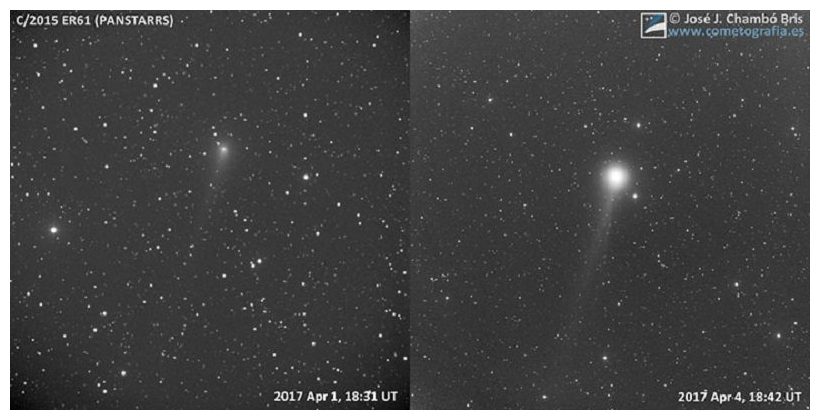
April 2017: The month of 4 visible comets - Comet PanSTARRS (C/2015 ER61) brightens overnight

C/2015 ER61
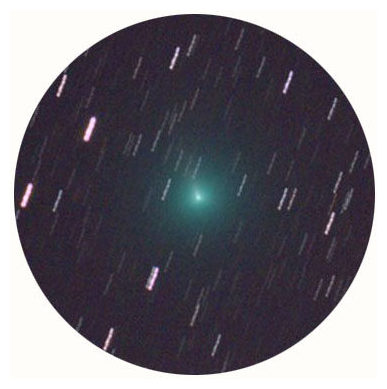
© José J. ChambóLook at the difference in appearance of comet PanSTARRS (C/2015 ER61) pre-outburst (left) on April 1st and in outburst on April 4th.
2017 may well go down as the year of the binocular comet. Three have been easy catches, and it's only the start of April: 45P/Honda-Mrkos-Pajdusakova, 41P/Tuttle-Giacobini-Kresak and Lovejoy (C/2017 E4). Now there's a fourth. Overnight, PanSTARRS (C/2015 ER61) joined the club.

Discovered two years ago on March 15th by the Pan-STARRS 1 telescope on the summit of Haleakalā, it was a faint 21st-magnitude midge. But how it's bloomed! By late March and the start of April, the comet had brightened to around magnitude +8.5 while puttering across Sagittarius and Capricornus low in the southern sky before dawn.
PanSTARRS (C/2015 ER61)
© Gerald RhemannThis April 5th photo catches the comet in the full glory of its outburst.
Then it happened. On April 4th, comet observer Juan José González Suárez reported a possible outburst to magnitude +7.4. This was confirmed, both visually and photographically, by several observers including myself early this morning. It's now as bright as magnitude +6.5, a leap of two magnitudes practically overnight! Although the specific cause of the outburst isn't known, it's likely that some sort of outgassing or disruption on the comet's surface exposed fresh ice to sunlight, initiating a new wave of vaporization.

Comment:

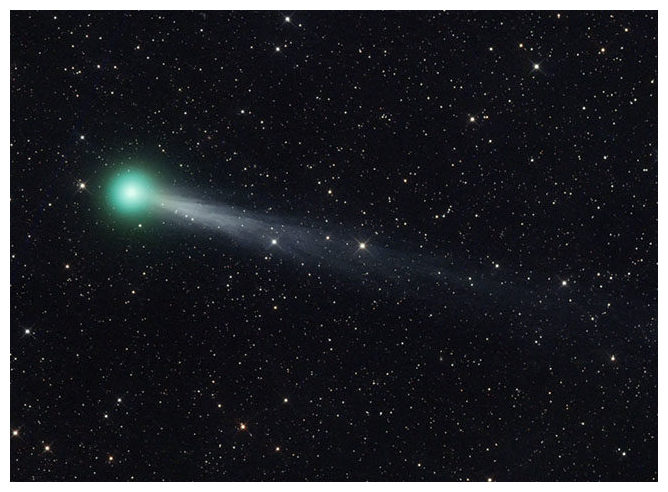
Green comet flyby on April 1st

Another comet brightens and now visible in the Northern hemisphere


Info

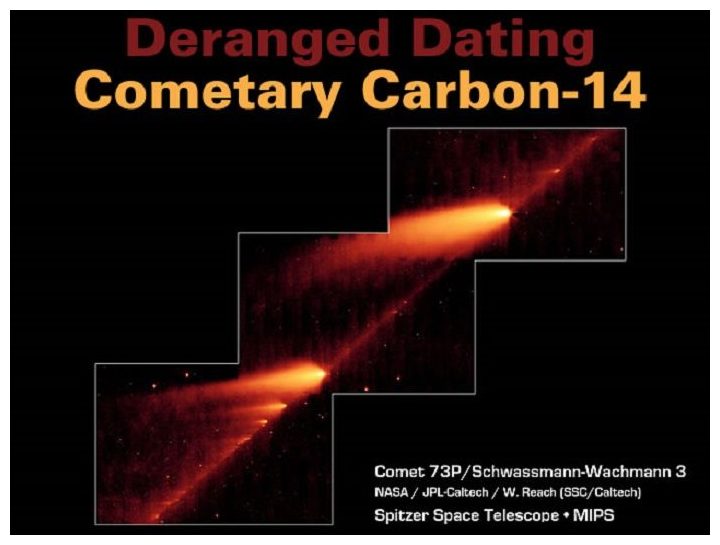
Deranged Dating: Cometary Carbon-14

Cometary Carbon-14
© NASA/JPL-Caltech/W. Reach (SSC/Caltech)
Earth Scientists apparently accept radiocarbon dating as the gospel truth.

However, if the Settled Science that supports radiocarbon dating is really just one huge homogenised hodgepodge then acquiescent Earth Scientists are simply being misdirected and left to flounder in the dark.
This would go some way towards explaining why so many Earth Scientists are gainfully employed chasing their tails.

Thus, the mainstream gained the scientific kudos associated with Radiocarbon Dating whilst [simultaneously] wrestling control of the Settled Science away from Willard Libby by imposing a calibration curve that was approved by the mainstream.

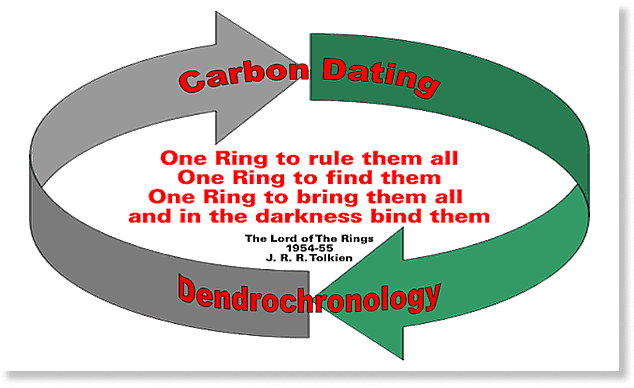
Sadly, this hybrid, high jacked and half-baked Settled Science has now degenerated into a recursive [incestuous] feedback loop where dendrochronology calibrates Radiocarbon Dating which, in its turn, is used to calibrate dendrochronology.

See: Carbon 14 - Libby's Ring
Carbon Dating
© Malaga Bay
Amongst the many issues associated with the Settled Science of radiocarbon dating there is the curious case of Catastrophic Cometary Carbon-14.

Arguably, the burning up of a cometary debris train in the Earth's atmosphere would significantly enhance the level of atmospheric Carbon-14.

Comet 2

Another comet brightens and now visible in the Northern hemisphere


Terry Lovejoy's new comet has gone from faint to bright in just three weeks and is now a tempting binocular target at dawn.


Comet C/2017 E4 Lovejoy
© Terry LovejoyComet C/2017 E4 Lovejoy was discovered on March 9th by Australian amateur Terry Lovejoy. It's his 6th discovery and seen here on March 25th.
Who doesn't love a comet that exceeds expectations? That's exactly what's happening with Terry Lovejoy's latest discovery, C/2017 E4 Lovejoy.

Discovered on March 10th at magnitude +12, early observations suggested a peak magnitude of +9 in mid-April, assuming it didn't crumble apart en route to an April 23rd perihelion.

Forget that. This fuzzball's already at magnitude +7 - 7.5 and a snap to see in 50-mm binoculars.

I know because I got up Wednesday morning (March 29th) shortly before the start of dawn, pointed my 10×50 glass just below the figure of Equuleus, the Little Horse, and saw a small, dense ball of glowing fuzz without even trying.

Comet 41P/Tuttle-Giacobini-Kresak — now circumpolar in Ursa Major — shines at a similar brightness, but it's larger and less condensed and therefore not as easy to see as Lovejoy.
Comet Lovejoy
© Bob KingComet Lovejoy captured with a 135-mm telephoto lens (f/2.8, ISO 2500, 10-second exposure) on Wednesday morning March 29th, when it entered the small constellation Equuleus. Though small at this focal length, the comet's blue-green color is a dead giveaway.
A little more than a week ago, Comet Lovejoy glowed at magnitude +10 - 11; a few days ago it was at +9. Given its meteoric rise in brightness, observers are anticipating the comet to crest to magnitude +6 around perihelion as it describes a roller coaster arc across Pegasus and Andromeda. Twice it passes bright deep-sky objects: the bright globular cluster M15 on April 1st and the Andromeda Galaxy on April 20 - 22. Another easy time to spot it will be on April 8 - 9 alongside β Pegasi in the northwest corner of the Great Square.

Comet 2

Green comet flyby on April 1st

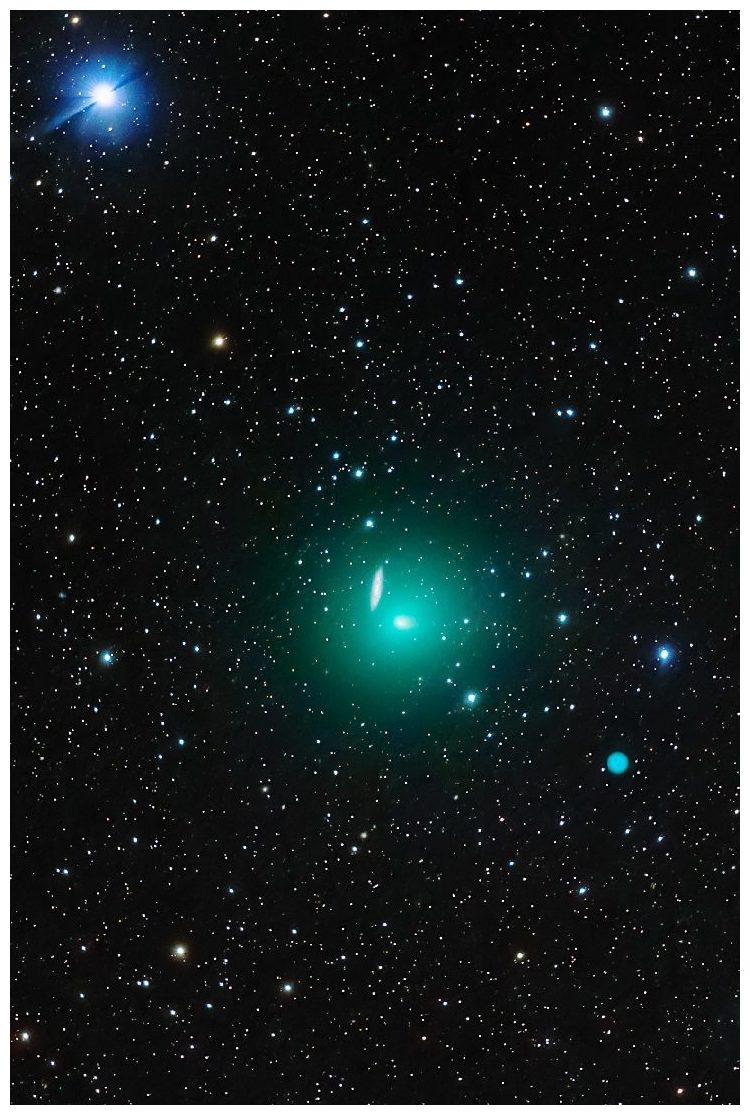
Green comet 41P/Tuttle-Giacobini-Kresak is flying over Earth's North Pole this week where sky watchers can find it all night long not far from the bowl of the Big Dipper. At closest approach on April 1st it will be just 21 million km from Earth--an easy target for backyard telescopes and almost visible to the naked eye. Amateur astronomer Yasushi Aoshima sends this picture of the approaching comet from Fukushima, Japan:
Comet 41P/Tuttle-Giacobini-Kresak
© Yasushi AoshimaTaken by Yasushi Aoshima on March 22, 2017 @ Fukushima, Japan.
"On March 22nd I caught 41P 'eating' M108, the Surfboard Galaxy," says Aoshima. "The comet's green atmosphere appeared to swallow the distant spiral galaxy as it exited Ursa Major."

Fireball 4

Eyewitnesses wanted: did you see bright green meteor fireball in Irkutsk, Siberia?

Fireball
© Yuri Smityuk/TASS
Scientists in the Russian city of Irkutsk (Siberia) are searching for people who could have witnessed the fall of a celestial body glowing bright green, Executive Director of the Irkutsk Planetarium Pavel Nikoforov told TASS.

"At 14:39 local time (11:39 GMT), while we were riding in a car along the bridge across the Irkut River towards the Leninsky district, we spotted an unusual glowing object in the daytime sky. It was speeding at a 45 degree angle, but its light went out in just a couple of seconds. We very much hope that Irkutsk's residents may have recorded this phenomenon using their car DVRs. We could collect these recordings and hand them over to scientists," he stated.

The fact that the celestial body was seen in the daytime, speaks volumes for its enormous weight, a source in the Astronomical Observatory of Irkutsk State University told TASS. "We assume that a celestial body weighing several kilograms could be glowing so brightly in the daytime. If we are provided with video recordings showing the bolide, then we could calculate its weight and trajectory," the source added.

In the autumn of 2016, residents of the Irkutsk region and the Republic of Buryatia witnessed a bright green meteor soaring above Lake Baikal. It was later dubbed the Baikal Bolide. Scientists believe that its weight was about 80 kilograms but because of its high speed it burnt up in the atmosphere.

Fireball

Lunar impact event sighted

Lunar Impact event
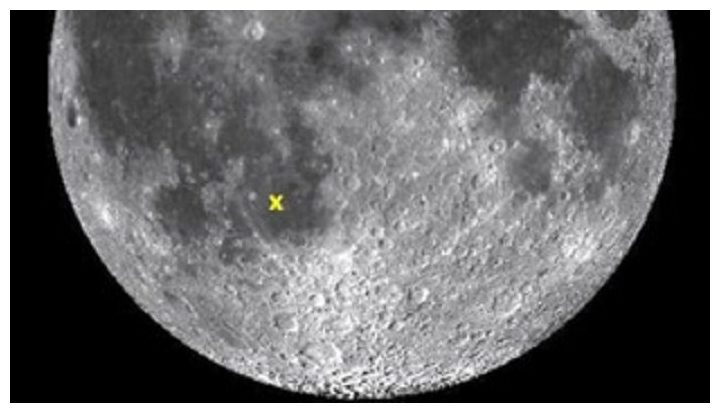
© Aberystwyth UniversityX marks the spot where the meteorite hit the moon.
Space scientists at Aberystwyth University have reported what they believe to be the first confirmed sighting in the British Isles of a meteorite hitting the Moon.

A Lunar Impact Flash - a flash of light when something hits the Moon's surface - was recorded on the southern hemisphere of the Moon and probably caused by a small meteorite the size of a golf ball.

Lasting less that one tenth of a second, the image was caught on New Year's Day 2017 on a remotely operated telescope at Aberystwyth University.
Lunar Impact Flashes are notoriously difficult to record. The meteorite would be travelling at anywhere between 10 to 70 km per second as it hit the surface of the Moon. That is the equivalent of travelling from Aberystwyth to Cardiff in just a few seconds, and the resulting impact would be over in a fraction of a second.

A similar meteorite hitting the Earth's atmosphere would produce a beautiful shooting star, but as the Moon has no atmosphere it slams into the surface, causing a crater the size of very large pot hole. Just under 1% of the meteorite's energy is converted into a flash of light, which we were able to record here in Aberystwyth.

- Dr Tony Cook, Aberystwyth University
Scientists estimate the Moon is hit by similar sized meteorites as often as once every 10 to 20 hours.