Volcanoes
S


Attention

Philippines: 7 quakes recorded at Taal Volcano

Image
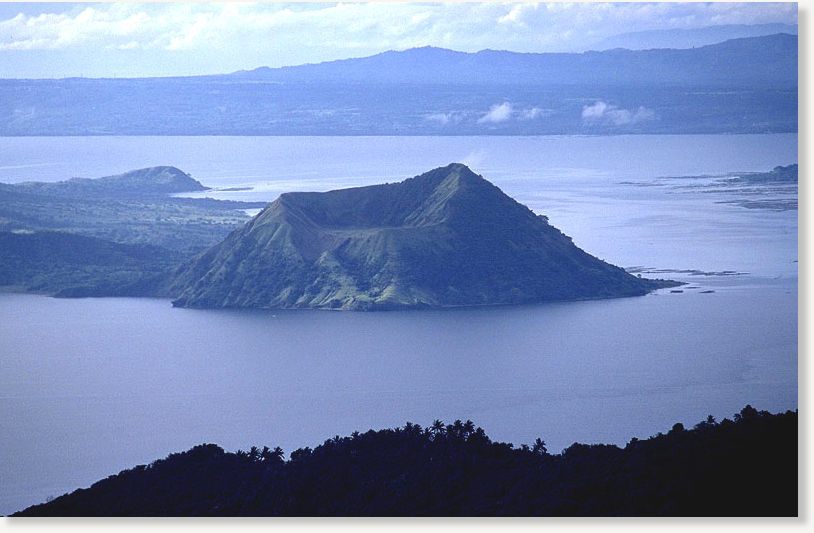
Taal Volcano
At least seven volcanic quakes were recorded around restive Taal Volcano in Batangas in the last 24 hours, state volcanologists said Friday.

The Philippine Institute of Volcanology and Seismology also noted weak steaming activity even as it said Alert Level 1 stays.

"Alert Level 1 is still enforced over Taal Volcano. This means that a hazardous eruption is not imminent. However, the public is reminded that the Main Crater should be strictly off-limits due to sudden occurrence of steam explosions and accumulation of toxic gases," it said in its Taal update.

Bizarro Earth

Indonesian mud volcano flow 'to last 26 years'

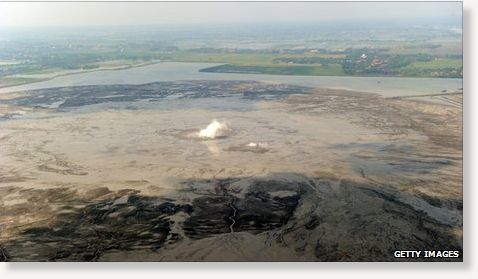
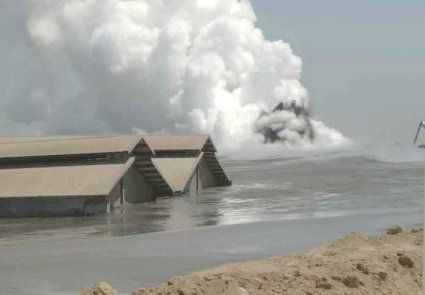
The world's largest mud volcano, which left 13,000 families homeless, is likely to continue erupting for another 26 years, researchers have estimated.

mud volcano
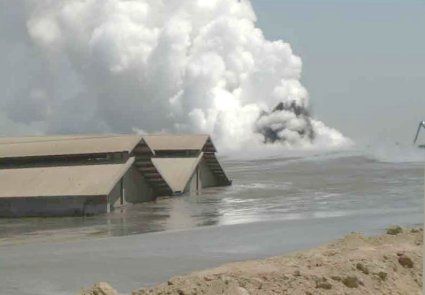
The mud buried homes, schools and farmland, and has displaced thousands of families
It first erupted back in May 2006, and - at its peak - was spewing 180,000 cubic metres of mud a day, equivalent to 50 Olympic-sized swimming pools.

The volcano, in East Java, Indonesia, has buried homes, schools and farmlands over seven square kilometres.

The findings have been published in the Journal of the Geological Society.

Bizarro Earth

Indonesia's Infamous Mud Volcano Could Outlive All of Us

Lusi mud volcano
© n/a
Since it roared to life in May 2006, a mud volcano near Indonesia's coastal city of Sidoarjo has swallowed homes, rice paddies, factories, and roads, killing 15 people, displacing 40,000, and harming the livelihoods of many more. As the ongoing eruption nears its 5th anniversary, observers wonder whether it will ever stop. The answer: Not anytime soon. A new study predicts the volcano will continue spewing significant amounts of mud for another 2 decades. A second study forecasts that it could grind on as long as 87 years.

The mud volcano has inflicted a punishing blow to the region of Java island 700 kilometers east of the capital, Jakarta. Nicknamed Lusi, a contraction of lumpur (Indonesian for mud) and Sidoarjo, the volcano has so far disgorged 144 million cubic meters of mud, some of which now covers an area roughly twice the size of New York City's Central Park. Much of the mud has been diverted to a nearby river, where it has formed a new 83 hectare island and extended a natural delta. Compensation and mitigation have cost at least $767 million, according to Humanitas, a nongovernmental organization in Melbourne, Australia, that is studying the disaster's social impact. That is a fraction of the real economic toll, which is still being tallied.

Lusi may be a harbinger of disasters to come. "Like a volcanic eruption, a mud eruption is just the effect of geological activity, and I'm sure in the future another mud volcano must erupt in this region," says Soffian Hadi Djojopranoto, a geologist with the Sidoarjo Mudflow Mitigation Agency. "We need very serious research to understand this phenomenon."

Phoenix

Two US volcanoes making news: Kilauea and St. Helens

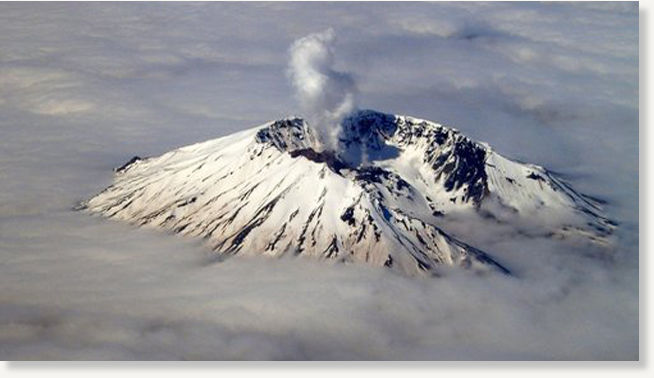
Mount St Helens
© Big ThinkAn undated aerial image of Mount St. Helens, Washington.
We've talked a lot about volcanoes in other parts of the world, but now we have two UF volcanoes making some news (although neither because they're having a large eruption):

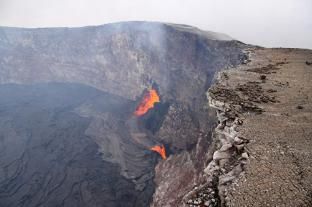
Hawai'i: The lava lake at the Halema'uma'u Crater in Kilauea has reached new heights - in fact, the lava lake had gotten high enough (~77 meters below the crater floor) in the pit crater that there was some thoughts that it might spill out onto the floor of the crater. However, that fate is unclear now as the pit crater itself is collapsing into the lava lake, with large chunks of the rim falling in on Monday. These chunks, some as large as 120 meters x 5 meters, fell into the lake and produced small plumes of ash and gases along with very obvious popping sounds heard as far as half a mile away. You can hear some of the noises and watch some quicktime movies of the activity at the Halema'uma'u Crater over on the Hawaii Volcano Observatory website. Collapses in the pit crater in 2009 blocked off the lava lake from view, but quickly the lava was able to retake the crater. Seismicity related to the upper east rift zone of lava seemed to peak late last week, which might suggest that the influx of new basaltic magma might be waning. Be sure to check out the great time lapse videos (this one from Pu'u O'o) from Eruptions readers along with all the Kilauea the webcams as well. UPDATE: Speaking of Pu'u O'o time lapse video, here is a new one from the USGS as well.

Phoenix

Thousands Flee as Philippine Volcano Erupts

Mount Bulusan
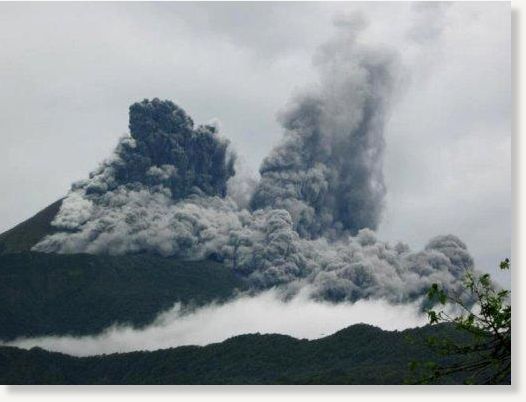
© Agence France-PresseMount Bulusan spews ash in the Philippine town of Casiguran in Sorsogon province. The volcano has erupted showering an entire town with ash, although there were no immediate reports of damage or casualties, officials said
Thousands of people in the Philippines fled their homes as a volcano erupted on Monday, sending a spectacular column of ash high into the sky, residents said.

The eruption of Bulusan, a 1,559-metre (5,115-foot) volcano, turned mid-morning into night for about 20 minutes across largely farming areas around its slopes, regional army spokesman Major Harold Cabunoc told AFP.

"There was a major ashfall. There was zero visibility," Cabunoc said.

State volcanologist Ramil Vaquilar told AFP that rumbling sounds accompanied the ash column that rose between two and 2.5 kilometres (1.2-1.6 miles) above the crater.

About 2,000 residents were evacuated from three farming villages in the area as the government banned people from within four kilometres of the crater, said Lieutenant-Colonel Santiago Enginco, the local army commander.

Thirty-eight high school students were treated for ashfall inhalation, Enginco said.

Bizarro Earth

Iceland: Small earthquake swarm in Krísuvík volcano

Krísuvík
© Unknown
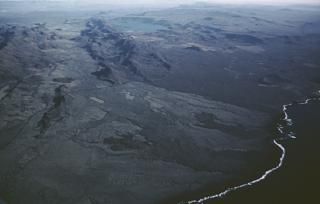
The Krísuvík volcanic system (also spelled Krysuvik) consists of a group of NE-SW-trending basaltic crater rows and small shield volcanoes cutting the central Reykjanes Peninsula west of Kleifarvatn lake. Several eruptions have taken place since the settlement of Iceland, including the eruption of a large lava flow from the Ogmundargigar crater row around the 12th century. The latest eruption at Krísuvík took place during the 14th century.
Currently there is a small earthquake swarm in Krísuvík volcano. This earthquake swarm is small and is only about 20 or so earthquakes at current time. It is impossible to know if this earthquake swarm is going to continue or grow at present time. But it is not uncommon in this area for a small earthquake swam to be a warm up for a larger one. But as always there is just a wait and see what happens in the area.

Bizarro Earth

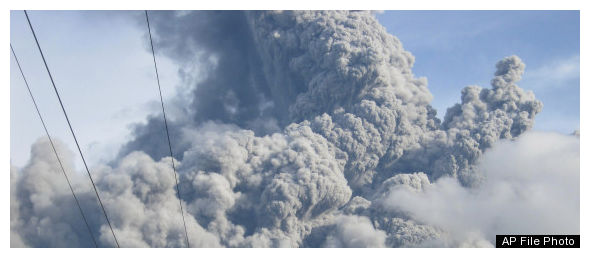
Mt. Bulusan Erupts: Major Volcano Eruption In Philippines

Mt. Bulusan
© AP File Photo
Philippines volcano Mount Bulusan erupted on Monday morning at 9:15 a.m. local time, per the ABS-CBN News Channel.

Ash and steam from the explosion reached as high as 2 kilometers, according to the report.

The Philippine Daily Inquirer posted this photo of the Mount Bulusan eruption to Posterous.

Journalist Harold Geronimo of Manila, Philippines, was the first to report the eruption on Twitter, sending this tweet from his Blackberry minutes after the eruption.

Mount Bulusan had increased volcanic activity in November 2010, spewing ash and steam over several days (the photo above is from Nov. 2010). Families were evacuated at the time.

Radar

US: Pele shows 'a lot more' Big Island activity

Image
© Hawaiian Volcano ObservatoryLava continued erupting Thursday morning from a vent in the east wall of Puu Oo crater.
Increased volcanic activity continues at the summit of Kilauea and at the Puu Oo vent.

Lava is flowing from another east cone and a vent on the east wall of Puu Oo into the crater. Hawaii Volcano Observatory released a video Wednesday of the activity in the crater. The flow continued, off and on, Thursday and yesterday.

A lava lake in Halemaumau is also active.

A section of rock above the summit vent collapsed into the lake Monday, sending gas and ash into the air and creating loud popping that could be heard by visitors at the Jaggar Museum overlook in Hawaii Volcanoes National Park. Lava ash and "Pele's hair" - fine strands of cooled lava - dusted cars in the parking lot.

Megaphone

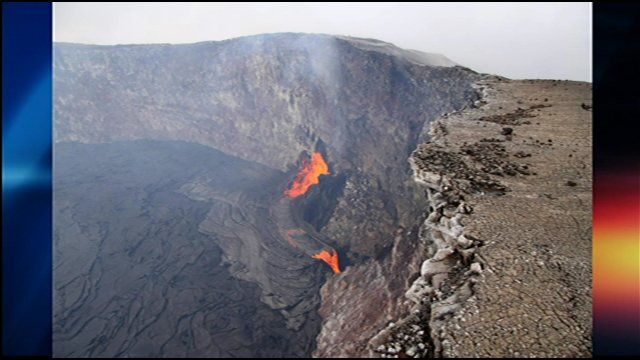
Lava Lake at Kilauea has Reached One of its Highest Levels Ever

lava lake @ Kilauea
© Hawaii News Now
Scientists on the Big Island say it's been an especially active week at Kilauea volcano - as it continues to erupt in two locations: on the east rift zone and at the summit.

The volcanic activity along the summit has died down a little since Monday - when the lava lake at Halemaumau crater reached one of the highest levels ever observed. But it's still fascinating for both geologists and tourists alike.

Kilauea's fiery summit cauldron ripped open this week, and its beauty is matched only by the roar of its fury. Summit activity isn't as intense as it was earlier in the week, but the changes have delighted scientists.

"It is an exciting time for volcanologists," says Janet Babb of the U.S. Geological Survey's Hawaiian Volcano Observatory. "This is the job that we're trained to do and the kind of research that we're involved in, so it has been exciting."

On Monday, they watched as a number of rocks fell into Kilauea's summit vent. Sulfur dioxide emissions remain elevated. Babb explains, "Large sections of the rim of the vent fell into the lava lake below. It caused a lot of degassing, and in a few instances, some explosive events that caused a lot of dusty, ashy plumes to rise skyward."

Bizarro Earth

Philippines: 7 volcanic quakes recorded at Taal

Image
© UnknownTaal
Taal Volcano in Batangas province showed renewed activity on Wednesday, with state volcanologists recording at least seven quakes in the last 24 hours.

In its Thursday report, the Philippine Institute of Volcanology and Seismology reiterated Taal's main crater remains off limits to the public.

"Alert Level 1 is still enforced over Taal Volcano. This means that a hazardous eruption is not imminent. However, the public is reminded that the main crater should be strictly off-limits due to sudden occurrence of steam explosions and accumulation of toxic gases," Phivolcs said on its website.

It added that the northern portion of the main crater rim, in the vicinity of Daang Kastila trail, may also be dangerous when increased steam emission is reactivated along existing fissures.

Phivolcs also reminded the public that the entire Volcano Island is a Permanent Danger Zone (PDZ), and permanent settlement in the island is strictly not recommended.

See the complete table on the Phivolcs website.