Volcanoes
S


Alarm Clock

New volcano images by USGS, earthquakes "a concern"

Image
© USGS
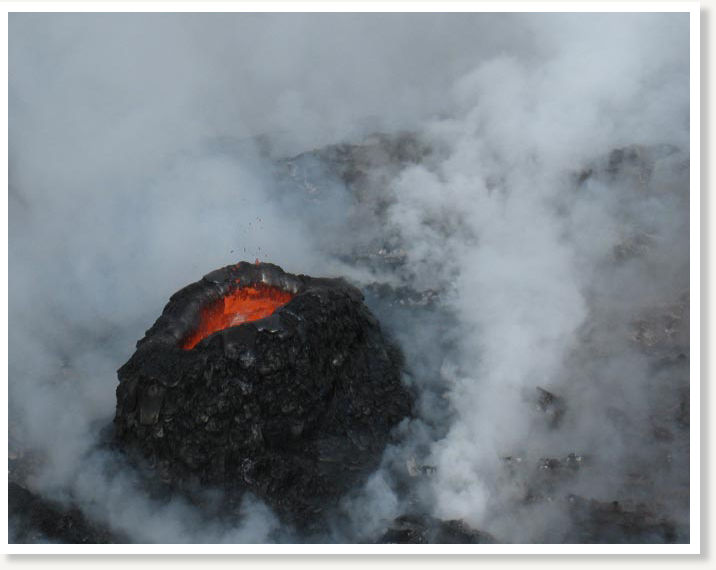
A new spattering vent has formed on the south side of the Thanksgiving Eve Breakout shield, and the Hawaiian Volcano Observatory caught a glimpse of the activity just before daybreak on February 4.

The active Pu'u O'o crater floor is slowly filling the east side of the vent with lava.

Meanwhile, at Kilauea's summit, the circulating lava lake in the collapse pit deep within the floor of Halema'uma'u Crater has been visible via Webcam throughout the past week. Volcanic gas emissions remain elevated, resulting in high concentrations of sulfur dioxide downwind.

Bizarro Earth

Icelandic Volcano 'Set to Erupt'

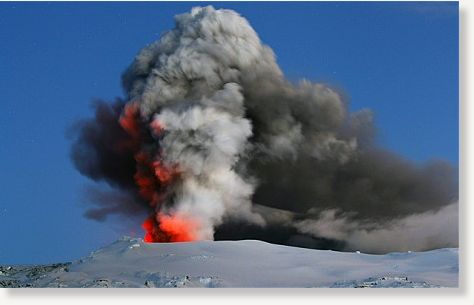
Scientists in Iceland are warning that another volcano looks set to erupt and threatening to spew-out a pall of dust that would dwarf last year's event.

iceland,eyjafjallajokull,volcano
© ReutersLava and ash explode out of the caldera of Iceland's Eyjafjallajokull volcano
Geologists detected the high risk of a new eruption after evaluating an increased swarm of earthquakes around the island's second largest volcano.

Pall Einarsson, a professor of geophysics at the University of Iceland, says the area around Bárdarbunga is showing signs of increased activity, which provides "good reason to worry".

Bizarro Earth

Growing Fears in Japan As Two Volcanoes Erupt Again

Two volcanoes on Japan's southern island of Kyushu erupted on Tuesday.

A volcano at Sakurajima, the Minamidake crater, erupted early Tuesday followed by an eruption at Shinmoedake in the afternoon.

Shinmoedake erupted for the first time in 52 years last month and has erupted more than ten times since.

Bizarro Earth

Huge Yellowstone Volcano Rising

Image
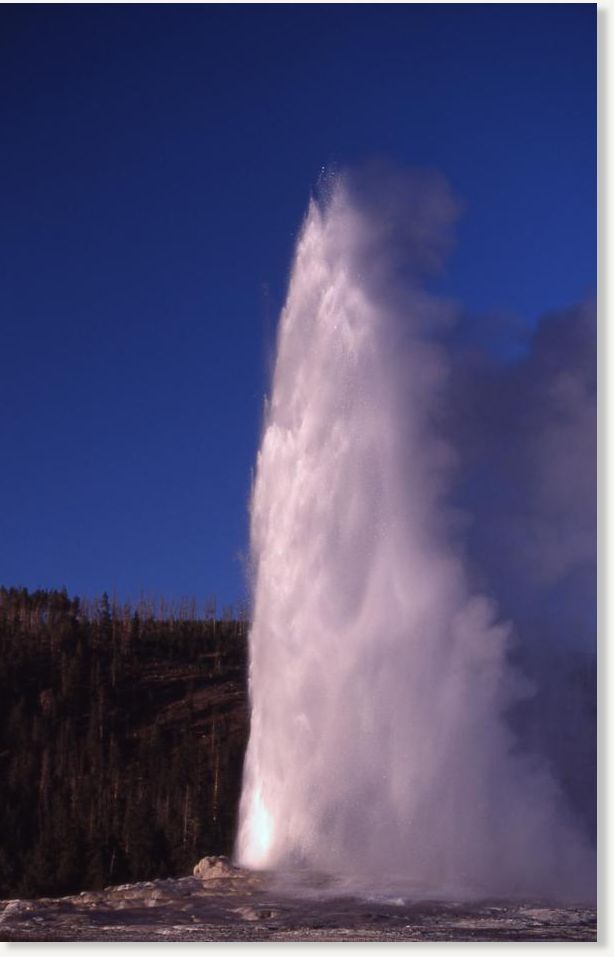
© NPSHydrothermal fluids, just like the ones shooting from Old Faithful, could be pushing up the Yellowstone supervolcano.
The huge volcano under Yellowstone National Park has been rising at an unprecedented rate during the past several years, according to a new study.

In the ancient past, the Yellowstone volcano produced some of the biggest-known continental eruptions, but the recent rising doesn't mean another doomsday eruption is looming, scientists say.

The recent rising is unprecedented for Yellowstone's caldera - the cauldron-shaped part of the volcano - but it's not uncommon for other volcanoes around the world. The new study has simply revealed a more active caldera at Yellowstone than scientists realized.

"It's pretty exciting when you see something that's five times larger than what you've seen in the past," said Charles Meertens, director of the nonprofit UNAVCO facility in Boulder, Colo., which aids geoscience research. Meertens is a former postdoctoral fellow under one of the study's authors, Robert Smith of the University of Utah in Salt Lake City.

Bizarro Earth

Another Japanese Volcano Erupts

Image
© Yomiuri Online
And another volcano has erupted in Japan.

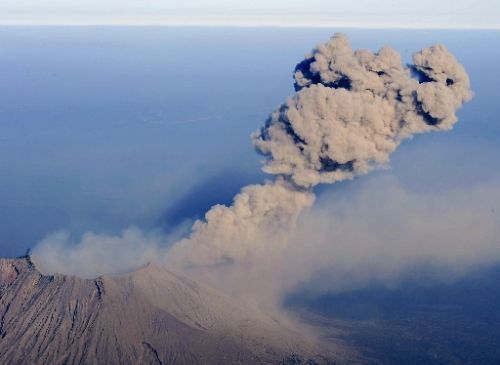
Minami-dake crater at Sakurajima, a volcano on Japan's southern island of Kyushu, erupted Tuesday, following volcanic explosions at Mt. Kirishima in the same region.

The volcano spewed plumes of smoke and ash up to 2,000 meters into the air.

Local authorities temporarily banned citizens from driving near the area due to the sheer amount of ash raining down from the volcano.

Bizarro Earth

Russia's Kizimen Volcano Erupts Sending Ash Four Kilometres High

The Kizimen Volcano located on Russia's Kamchatka Peninsula is spewing ash into the skies and creating potential problems for aircraft.


Phoenix

Japan: A Neighbour With a Volcanic Temper

Image
© Kazuhiro Nogi/AFPResidents clearing volcanic ash released by the erupting Shinmoedake volcano from the roof of their house in Miyakonojo, Miyazaki prefecture, yesterday. Shinmoedake, the 1,421-metre-high volcano on the border of Miyazaki and Kagoshima prefectures in southwestern Japan, was still active after its first major eruption in 52 years in late January.
It shot to fame in 1967 thanks to the James Bond film You Only Live Twice but now it seems to be vying for the limelight again as it shoots lava into the sky in a diabolical vein.

Japan's Mount Shinmoe was an "extinct" peak way back in the 60s, serving as the perfect observation point for the 007 agent to scrutinise archvillain Ernst Stavro Blofeld in his secret base.

However, in reality the volcano is neither a secret rocket base, nor extinct.

Image
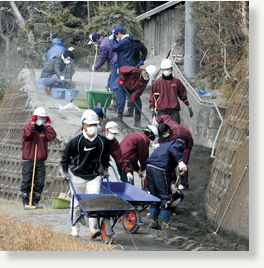
© unknownVolunteers carrying volcanic ash from an entrance of a residence in Miyakonojo, Miyazaki prefecture, yesterday.
In fact Mount Shinmoe jumped back into action only a few days ago, after 52 years in comatose mode, disturbing air and land traffic as it goes through one of its biggest eruptions as it spews and rocks on Kyushu, the southernmost of Japan's four main islands.

The revamped volcano got back into action on January 27 and in its biggest explosion it managed to break windows eight kilometres away. Officials cannot determine how long the eruptions will continue but some are insisting the cycle could go on for weeks and even intensify.

Cloud Lightning

SOTT Focus: Cyclones, Earthquakes, Volcanoes And Other Electrical Phenomena

Tornado and Lightning
© Unknown
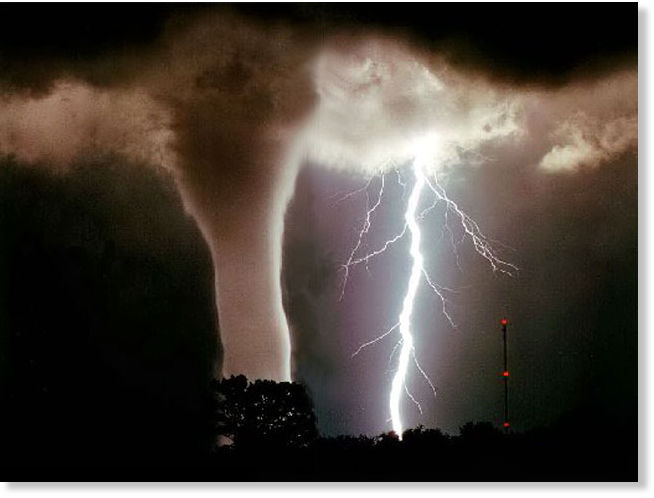
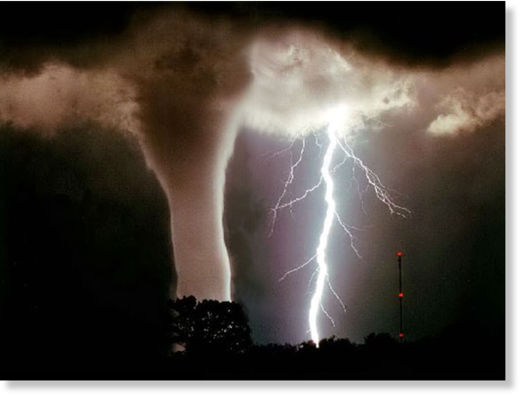
Recent events provide us with a great case study of the cosmic forces that may lie behind large storms such as cyclones, hurricanes, blizzards and much more. The recent events I speak of include the major blizzard that swept across the Midwestern and Eastern US as well as the punishment Cyclone Yasi inflicted on eastern Australia earlier last week. Both of these storms grew to enormous sizes during a time period that coincided with the Earth being lashed by a solar storm just following a New Moon. As strange as this may sound, this isn't the first time that celestial alignments along side of solar activity have spurred such events. If a correlation between these factors exists, as we suspect, then this overturns much of what is commonly believed about Earth weather and, as we'll see, even geology.

To understand how this all works, let's start with the sun. On January 31st a massive coronal hole opened up on the sun, hurling another sledgehammer of charged particles in the direction of Earth. This was due to impact us sometime between February 2nd and February 4th. Not only this, but we recently passed through a new Moon on February 2nd. But why is the Moon of any significance here, one might ask?

As James McCanney explains in an interview he did for Spectrum Magazine in 2003:
The [New] Moon moves in front of Earth, breaks that electrical flow [between the sun and Earth], and then moves out of the way. It gives us tremendous bombardment after that Moon moves out of the way, the first and second day after the New Moon. That's the condition that has been identified as being one of the leading causes of kicking-off major hurricanes and storms. What it does is: The Moon is interacting with the solar electric field. It's that CHANGE which causes the storms, and causes the environment around Earth to change, and thus affects Earth weather.
So the picture we're painting is this: The sun blasts a massive front of solar wind in the direction of the Earth. As the New Moon moves out of the way of the sun and Earth, this, by itself, creates a significant increase in charged particles hitting the Earth. With the excess of charged particles from this solar storm hitting us near simultaneously, all of this excess charge ends up in the radiation belts surrounding the Earth. The Earth then finds ways to discharge this imbalance such as these two major storms we've seen. One storm takes the form of a massive blizzard covering about half of the US. The other takes the form of a cyclone storm, Yasi, that pounds the already flooded east coast of Australia. Increased volcanic and earthquake activity was also noted during this time as well.

Bizarro Earth

Kyushu Volcano to Continue Eruptions Over Next Two Weeks: Experts

Coordinating Committee for Prediction of Volcanic Eruption
© MainichiToshitsugu Fujii, center, chairman of the Coordinating Committee for Prediction of Volcanic Eruption, is flanked by other officials in Tokyo's Chiyoda Ward on Feb. 3.
Mount Shinmoedake straddling Miyazaki and Kagoshima prefectures will continue its explosive eruptions over the next couple of weeks, according to a report by the government's Coordinating Committee for Prediction of Volcanic Eruption.

As the 1,421-meter volcano keeps threatening the lives of local residents, the committee met for an emergency executive meeting at the Meteorological Agency in Tokyo on Feb. 3.

"Over the next one to two weeks, the volcano is expected to repeat its explosive eruptions, emitting as much lava as it is at the moment," the committee concluded.

The committee, however, did not make any long-term predictions about what the volcano will do. The panel of volcanologists and other experts will intensify observations and analyses of subterranean magma activities using seismometers and angle meters.

Bizarro Earth

Envisat captures volcanic eruptions in Japan

Image
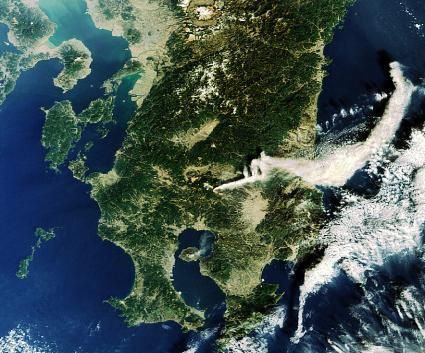
© ESAAcquired today by ESA's Envisat satellite, this image shows smoke pouring from Mount Shinmoedake, a volcano in the Kirishima mountain range on Japan's southern island of Kyushu.
Shinmoedake, which featured in the 1967 James Bond film You Only Live Twice, started erupting on 27 January after being quiet for 52 years. Eruptions spewed ash and smoke as high as 3000 m.

The Sakurajima volcano, further south, is also visible in the image. Sukurajima has been erupting almost constantly since 1955, producing thousands of small explosions every year.

The image was acquired on 4 February at 01:25 GMT by the MERIS instrument in full resolution mode.