Volcanoes
S


Bizarro Earth

Massive volcanic eruption on the cards for Japan

Mt. Fuji
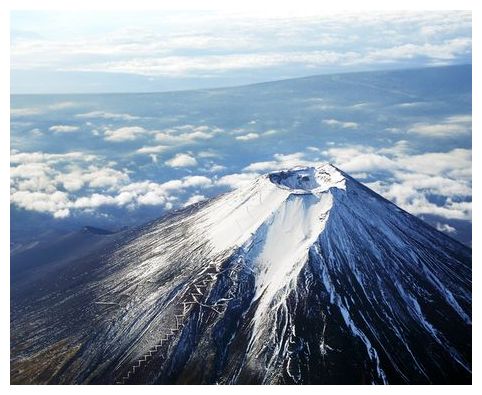
© Asahi Shimbun file photoMount Fuji, Japan's most famous volcano.
Japan should brace for a catastrophic volcanic eruption at some point, say experts, citing a massive buildup of magma at many of the nation's 110 active volcanoes. The last particularly serious eruption in Japan occurred in 1914, when Mount Sakurajima in southern Kagoshima Prefecture blew its top. According to study by volcanologists, Japan, which lies on the Pacific Rim of Fire, has been shaken by more than 1,000 volcanic eruptions over the past 2,000 years.

"The possibility of a major eruption in the future is real," said Yoichi Nakamura, a professor of volcanology at Utsunomiya University who has been analyzing volcanic eruptions with a team of researchers.

To be classified as active, a volcano must have erupted within the past 10,000 years or still be spewing gases, according to the Japan Meteorological Agency.

The active volcanoes include sites in the disputed Northern Territories off northeastern Hokkaido as well as undersea volcanoes.

Of the 110 active volcanoes, the agency monitors activity of the 47 around the clock to detect signs of an imminent eruption.

Arrow Up

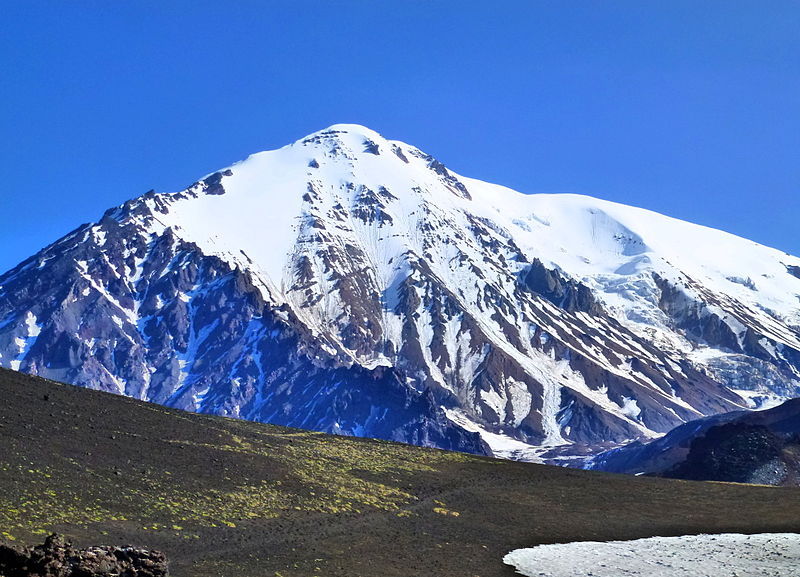
Tolbachik Volcano in Kamchatka erupts for first time in 36 Years

Image
© Leo PalkovicsTolbachik Volcano, Kamchatka
The 3,085-meter Plosky Tolbachik volcano in Russia's Far Eastern Kamchatka Peninsula is erupting for the first time in 36 years, according to reports of KVERT, the he volcano monitoring body for Kamchatka.

The volcano is located on the peninsula's eastern coast, 343 km from the region's capital of Petropavlovsk-Kamchatsky.

A bulletin released Tuesday by the Kamchatka Volcanic Eruption Response Team (KVERT), as cited by The Voice of Russia, described a significant explosive eruption with the potential for ash explosions up to 10 km.

The eruption at Plosky Tolbachik was given code orange (number three on the four-tiered USGS Volcano Alert Level), meaning it "poses limited hazards."

Blue Planet

Lava flow from Hawaii's Kilauea volcano reaches ocean for first time since December

Image
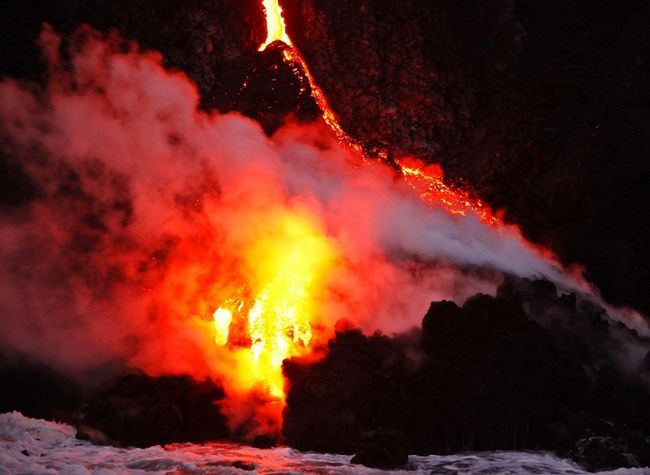
© REUTERS/Hugh GentryWaves crash over lava as it flows into the ocean near Volcanoes National Park in Kalapana, Hawaii on November 27, 2012.
A volcano on Hawaii's largest island is spilling lava into the ocean, creating a rare and spectacular fusion of steam and waves that officials said on Tuesday could attract thrill-seeking visitors if it continues.

Lava from a vent in Kilauea Volcano on the Big Island of Hawaii began flowing into the ocean 7 miles (11 km) away on Saturday. The volcano has been erupting continuously from its Pu'u O'o vent since 1983.

The flow was the first from the volcano to reach the ocean since December, said Janet Babb, spokeswoman for the U.S. Geological Survey's Hawaiian Volcano Observatory.

Even as Hawaii tourism officials awaited an increase in visitors drawn by the explosive natural show, officials warned of potentially deadly risks and urged visitors to stay a safe distance away and respect barriers placed around the lava flow.

Arrow Up

Indonesia's Mount Lokon volcano erupts

Image
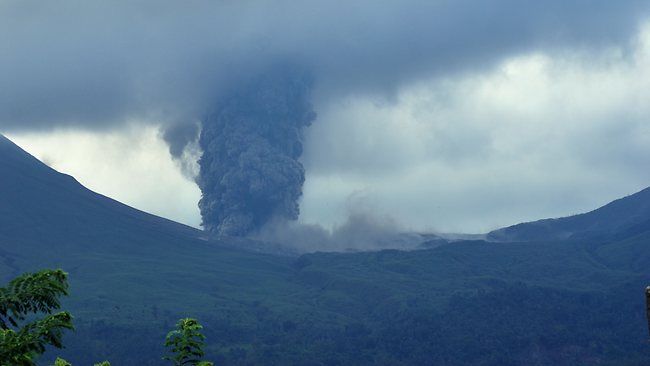
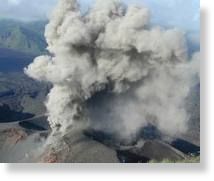
Mount Lokon volcano spews a giant column of volcanic ash during an eruption seen from Tomohon town on Sulawesi Island, Indonesia.
Mount Lokon volcano in North Sulawesi erupted on Wednesday, spewing ash up to 3.5 kilometers to the sky, without report of fatality and evacuation, officials said.

Head of National Volcanology Surono said that the eruption took place at 10:05 local time (0205 GMT).

He said that the agency had asked people living near the crater to be alert.

"We issued warning to the people living 2.5 kilometers from the crater," Surono told Xinhua by phone.

Spokesman of National Disaster Management and Mitigation Agency (BNPB) Sutopo Purwo Nugroho confirmed that there was no evacuation after the eruption.

"There is still no need for evacuation," he told Xinhua by phone.

Indonesia, an archipelago country, is home to 129 active volcanoes.

Arrow Up

Mordor erupts! New Zealand's Mount Tongariro volcano that stars as 'Mordor' in Lord of the Rings erupts on video


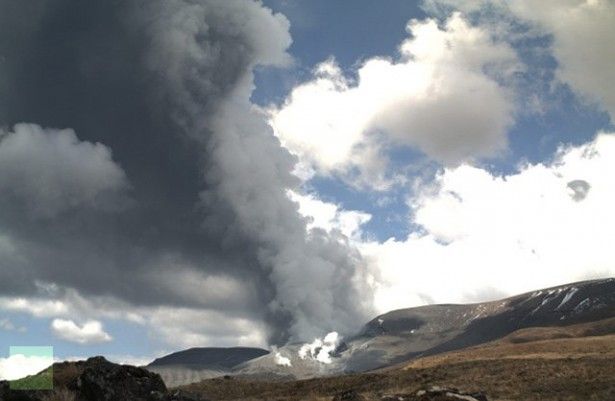
New Zealand's Mount Tongariro volcano sprang suddenly to life on November 21, spewing ash nearly 20,000 feet into the air, canceling regional flights and coating everything in its vicinity in a layer of fine gray silt.

The volcano had erupted in August after being dormant for more than a century, according to news accounts. But since then it had been quiet.

"The eruption itself gave us no warning whatsoever, it just snuck up on us," said an unnamed observer to BBC News in the video below, which showed pictures of people hosing down their front porches and leaving footprints as they walked.

One resident described it as a mushroom-looking cloud not unlike that of a nuclear bomb. No one was reported hurt, though numerous flights were canceled as the ash cut visibility. About 50 hikers in Tongariro National Park, including numerous schoolchildren on a class trip, had to scurry to safety during the five-minute eruption, reported the website Live Mint. The mountain is closed to hikers for at least three days.
Image
© AFP Photo/GNS ScienceTe Maari Crater on Mount Tongariro situated in the central area of New Zealand's North Island.

Bizarro Earth

Volcano erupts on New Zealand's North Island

Volcanic Eruption
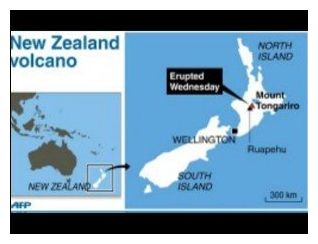
© Agence France-PresseGraphic showing Mount Tongariro in New Zealand’s North Island, which erupted Wednesday sending a plume of ash into the atmosphere.
Wellington - New Zealand's Mount Tongariro volcano erupted on Wednesday, sending a column of ash high into the atmosphere of the country's North Island, scientists said.

The official GNS Science monitoring service issued a potential threat alert after the 1:25 p.m. (0025 GMT) eruption at the volcano which became active in August this year after lying dormant for more than a century.

Civil Defense authorities described the eruption as minor but said conditions could be hazardous in the vicinity of the mountain and nearby areas could experience ashfall.

The August eruption, the first since 1897, hit domestic flights and closed highways but Air New Zealand said it did not expect the latest activity to disrupt services, although it was closely monitoring the situation.

Local resident Clint Green witnessed the eruption and said it sent ash spewing about two kilometres (more than a mile) into the air.

"It was pretty spectacular. All of a sudden a towering black plume just began erupting very quickly, skyrocketing up," he told Radio New Zealand.

"At first I didn't believe what I was seeing."

There were no immediate reports of injuries.

Bizarro Earth

Mt. Rokatenda spews ash, hundreds evacuated

Image
Mount Rokatenda in Sikka regency, East Nusa Tenggara (NTT), continues to spout volcanic ash. Residents living around the volcano have reportedly been evacuated to the shelter at Hewuli village administrative office in Alok Barat district. The Sikka Disaster Management Agency (BPBD) reports that 196 residents living around Mount Rokatenda had fled to Maumere city.

The ash cloud from Mount Rokatenda has affected water kept in tanks on the roofs of houses around the volcano. Residents have collected rain water to offset the impact of an eruption. As many as six of 109 Awa village residents in the shelters have been taken to Maumere regency hospital suffering from various illnesses, such as respiratory, eye and skin irritation.

Bizarro Earth

New Zealand volcanologists warn central North Island mountain of Ruapehu showing signs of an imminent eruption

Image
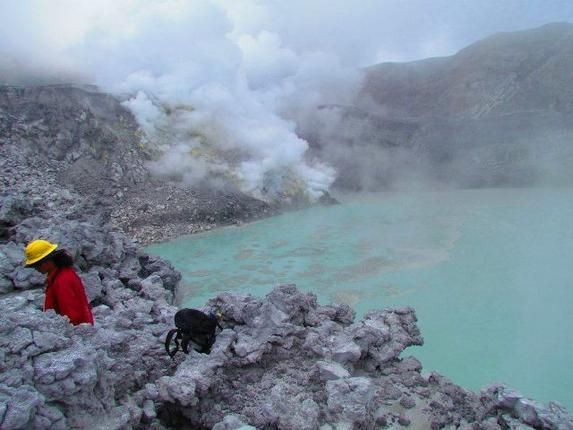
New Zealand volcanologists warned Friday that the central North Island mountain of Ruapehu was showing signs of an imminent eruption. The government's Institute of Geological and Nuclear Sciences ( GNS Science) said the temperature beneath Ruapehu's Crater Lake was about 800 degrees centigrade, but the lake itself was only 20 degrees centigrade, which suggested a vent was partly blocked.
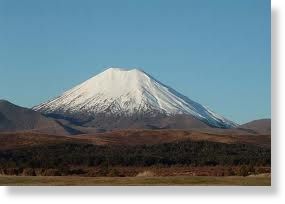
That could lead to a pressure build-up beneath the Crater Lake, indicating a heightened likelihood of eruptions over the coming weeks to months. "We think the pressure beneath Ruapehu Crater Lake has increased and this makes an eruption more likely over the next weeks to months," GNS Science duty volcanologist Steve Sherburn said in a statement.

A build-up of pressure beneath the Crater Lake was thought to have caused the last eruption in 2007 and a smaller eruption in 2006.

Bizarro Earth

Poás Volcano erupts in Costa Rica

Image
© RSNExperts from the National Seismological Network are keeping the volcano under surveillance.
The Poas Volcano early Sunday awoke residents of the province of Alajuela with a strong rumble.

At about 1 a.m., the volcano's crater ejected mud and ash more than 500 meters into the air. Ashes traveled hundreds of meters around the national park, rangers reported.

Although the volcano is frequently active, this kind of strong explosion has not been recorded since 2006. Experts said the activity was normal, but they will continue monitoring the volcano.

Poás Volcano National Park will remain open to tourists while experts determine if there is any risk to visitors.

Info

Mysterious pumice raft in Pacific explained

Havre Volcano
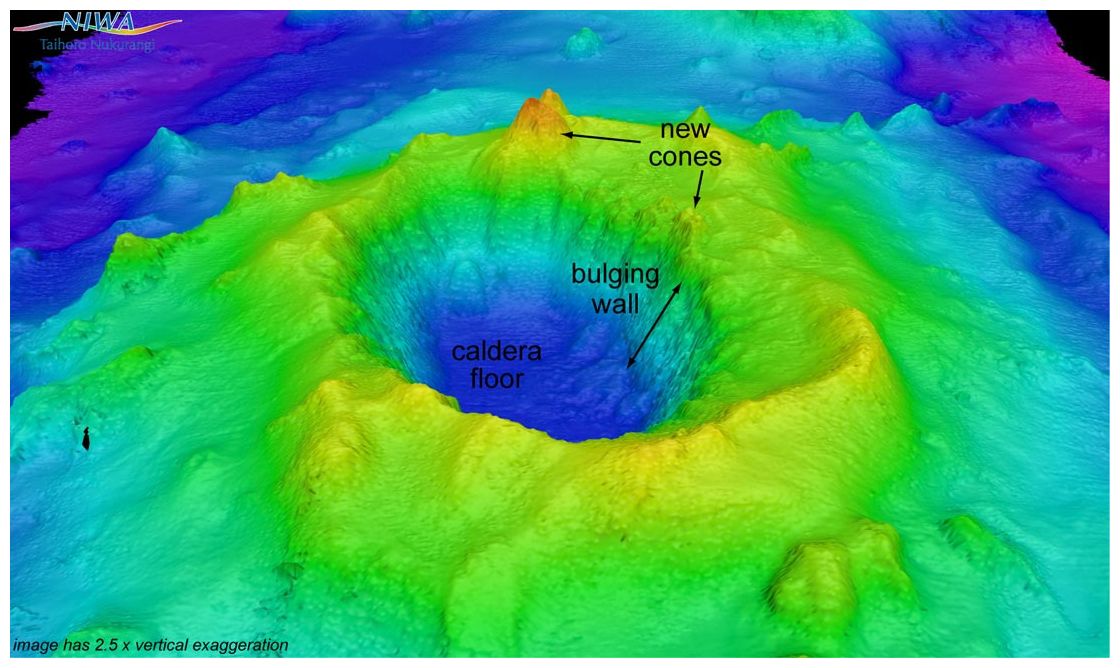
© NIWA/GNS ScienceA multibeam echosounder image showing the undersea volcano called Havre Seamount, including a new cone that formed during the July 2012 eruption.
Back in August, an enormous floating mass of pumice was spotted in the South Pacific Ocean off the coast of New Zealand. New evidence of changes on the seafloor confirms an erupting undersea volcano created the sprawling rock raft.

New Zealand scientists aboard the research vessel Tangaroa recently mapped the underwater volcano, Havre Seamount, which erupted on July 19 and was thought to have sent pumice rocks floating over a stretch of ocean 8,500 square miles (22,000 square kilometers). Now, the scientists say they detected a new volcanic cone - a feature built during an eruption - at Havre Seamount, reaching within 3,600 feet (1,100 meters) of the surface.

(Pumice forms when volcanic lava cools quickly. Gas gets trapped inside as the lava hardens, resulting in porous lightweight rocks that can float.)