
Comment: The following essay was recently published in Russia in Global Affairs, the Russian equivalent of Foreign Affairs in the US. We have translated it from the original at globalaffairs.ru, the cryptic title of which was: 'Одиночество полукровки (14+)' - The Solitude of a Half-Blood (14+).
Its author is Vladislav Surkov. If Russian philosopher Aleksandr Dugin is mischaracterized in the West as "Putin's brain," then Surkov is similarly mischaracterized "Putin's éminence grise." Surkov was Deputy Chief of the Russian Presidential Administration from 1999-2011, during which time he apparently played a role in the transition from Yeltsin to Putin and later developed the concept of sovereign democracy, which is arguably 21st century Russia's 'state ideology'.
Surkov also served as Deputy Prime Minister for Economic Modernisation from 2011-2013, and has since remained an aide to Putin, apparently with the specific brief of handling Russia's relationships with Abkhazia, South Ossetia and Ukraine. When Western elites went apoplectic because Crimea joined the Russian Federation in 2014, Surkov was one of the first names on Obama's sanctions list. Asked how he felt about no longer being able to travel to the US, Surkov responded:
"The only things that interest me in the US are Tupac Shakur, Allen Ginsberg, and Jackson Pollock. I don't need a visa to access their work."As Western actors hurl invective, sanctions, cyberattacks, political subterfuge and proxy wars at Russia - all apparently with a view to 'correcting' its policy decisions in the short-term, and thus its developmental trajectory in the long-term - Surkov sweeps through Russian history to explain why he believes that the 'civilizational crisis' his country finds itself in today marks the beginning of a new era and new identity for Russia...
[Hyperlinks to Wikipedia and other sources concerning historical events/actors referenced by the author are ours]
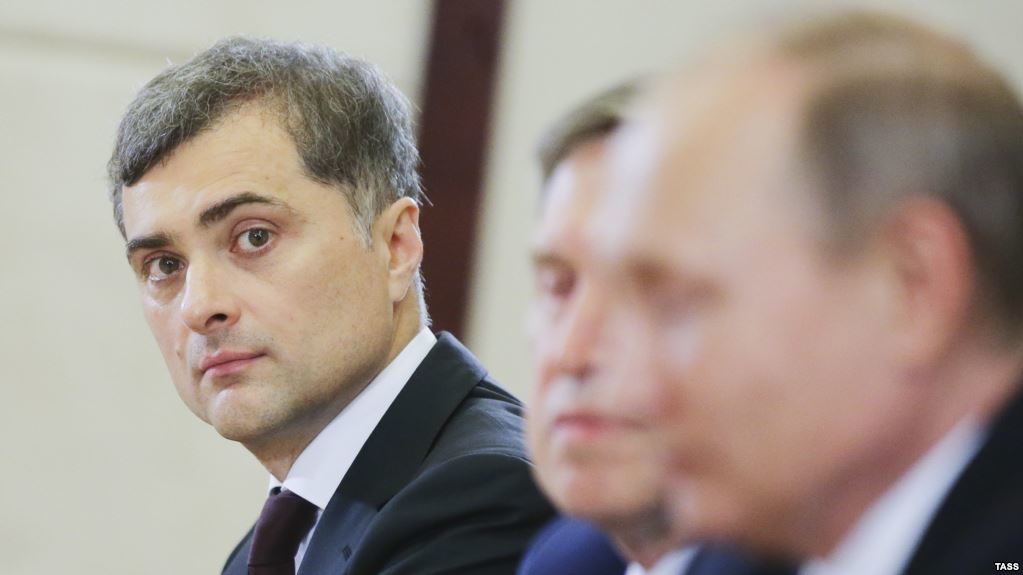
Vladislav Surkov
The excitement of those who inform passes to those who are being informed. The excited ones often mistake their own excitement for a thinking process, and this excitement replaces the latter, which leads to long-term 'convictions' and 'principles' being replaced with one-shot 'opinions'. It is also the source for incompetent assessments, which no one seems to mind. That's the price for news being fresh and hot.
Few can hear the mocking silence of fate through the background media noise. Few are interested to know that there is slow and massive news that doesn't come from shallow waters, but from the depth of life, where geopolitical structures and historical eras collide. It takes time before we can understand their full meaning, but it is never too late to do so.


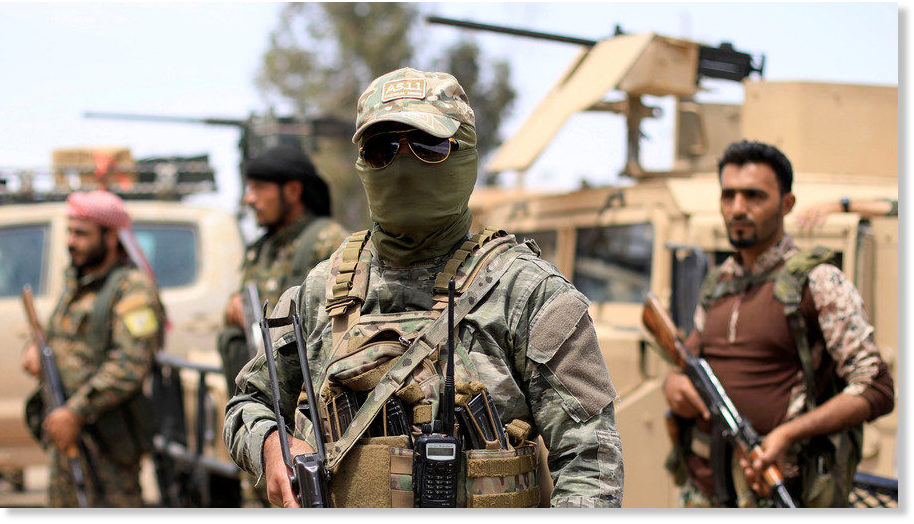










Comment: It speaks volumes that, as things currently stand, US forces are geographically situated BETWEEN Syrian and Russian forces and the remaining ISIS pockets on the Syrian-Iraqi border.
Are they there, in fact, to protect what's left of the 'Islamic State'?