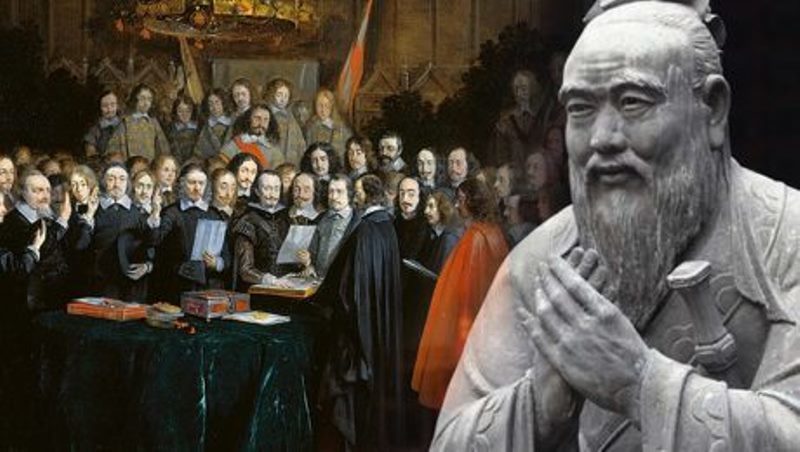
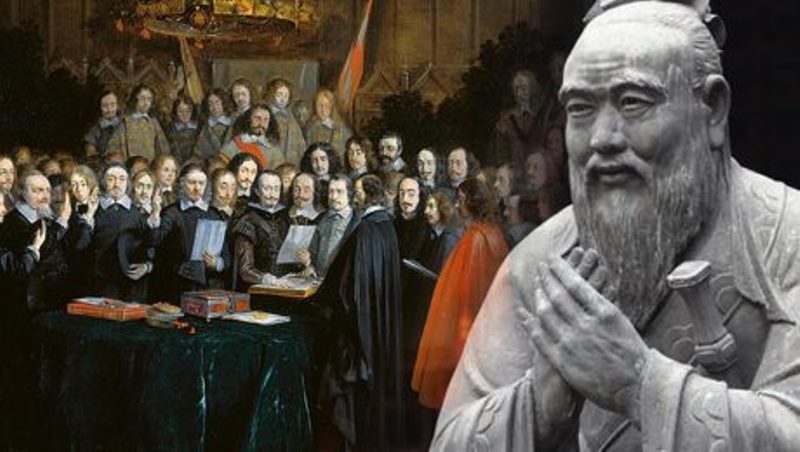
Left: 'The Ratification of the Treaty of Münster' (Westphalia), 15 May 1648, by Dutch painter Gerard ter Borch. Right: Confucius, China's 'Jesus'
On January 10, 2019, the talented journalist Pepe Escobar wrote a widely circulated report entitled
"All Under Heaven: China's Challenge to the Westphalian System", which explained how China's ascension to a position of global influence with the Belt and Road Initiative is ushering in a challenge to the Western system of values, which has been hegemonic since the 1648 Treaty of Westphalia.
Pepe's article was informed by the work of Professor Xiang Lanxin, director of the Centre of One Belt and One Road Studies at the China National Institute for SCO International Exchange and Judicial Cooperation, and Zhao Tinyang of the Chinese Academy of Social Science. Both scholars have advocated a post-Westphalian world order based upon a fallacy which posits that China's ancient philosophical traditions of
Tianxia (aka: "All under Heaven") is not only incompatible with the Western system of confrontation and dominance of the weak and different, but totally antagonistic.
While the principle of
Tianxia is a beautiful and important concept for Westerners to understand, and truly is the basis for international harmony which transcends the narrow limits of geopolitics plaguing the west, there is something dangerously false embedded in Tinyang's thesis which needs to be exposed. The fact is that
Tianxia is not only in complete harmony with the principle of Westphalia, but that the decay of Western values into the Hobbesian mess of total war and economic manipulation is not due to anything within the Treaty of Westphalia but rather in spite of it.















Comment: Can we say... ideologically-possessed?