Health & WellnessS


Syringe

Flashback Vaccines' dark inferno: What's not on the insert labels?

vaccine ingredients
© birthofanewearth.blogspot.com
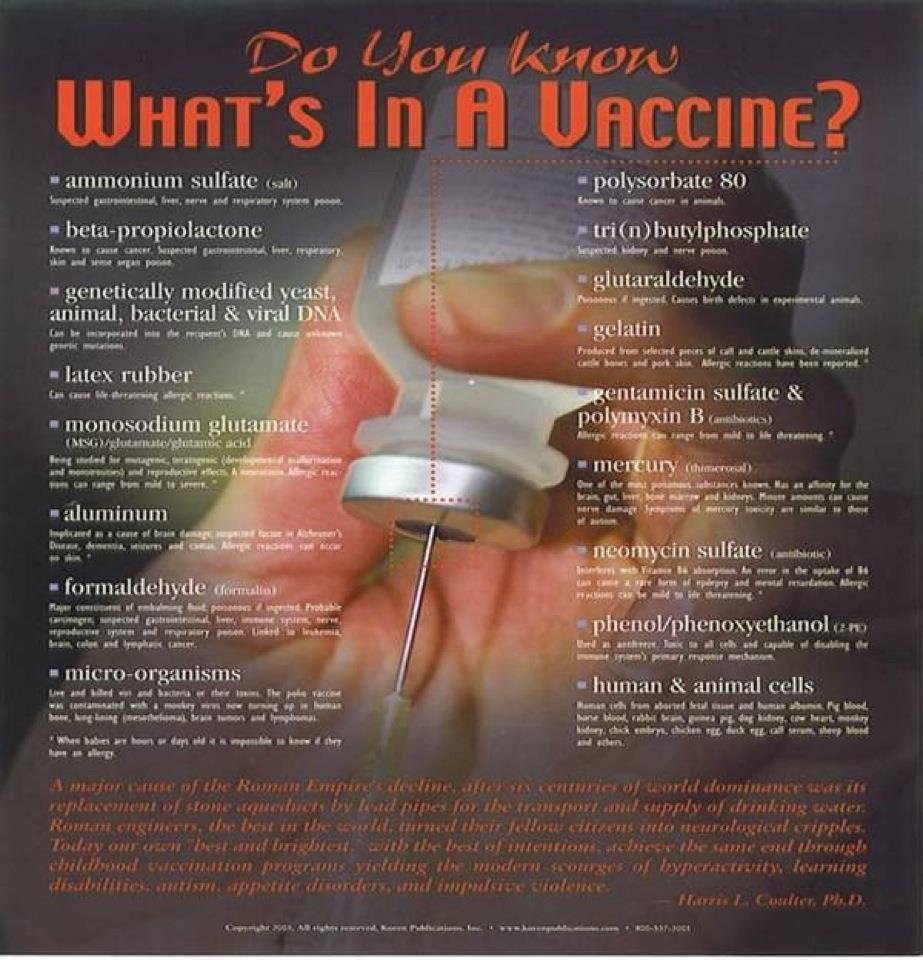
The vast majority of scientists, physicians, nurses, and public health educators trust that the ingredients in a vaccine have been individually and synergistically proven safe and ef­fective. The public believes that these vaccines, aside from their specified virus(es), are sterile solutions, free from undesirable contaminants not listed on the manufacturers' package inserts. When the pediatrician injects a vaccine into the muscle of a child, the parents' unquestioning faith is that this is the case. In other words, we want to believe that vaccines have been generated under perfect conditions for the safety of children and ourselves.

Our investigation shows that most people do not know what is actually in a vaccine: the active ingredients listed on product labels, the inert ingredients, and, most important, the hidden ingredients. Even more remote is taking the time to actually study the subject matter, review the scientific literature, and discover the truth for oneself. To our amazement, that truth was easy to find. But it is a truth that will scare the hell out of you.

Comment: 25 facts about vaccines and the pharmaceutical industry coverup


Attention

Surging hubris at the Environmental Protection Agency

EPA hubris
The EPA is tossing aside safety data; Companies "testing" their own products have led to the EPA sweeping major environmental and social problems under the rug.

In 1978, eight women from the small western Oregon town of Alsea sent a letter to the EPA documenting a frightening series of miscarriages—all of which had occurred shortly after the spring spraying season. The women wanted to know if there was a connection between their spontaneous abortions and the weed killers 2,4,5-trichlorophenoxyacetic acid (2,4,5-T) and 2,4-dichlorophenoxyacetic acid (2,4-D) that timber companies had been spraying in the forests surrounding their homes.

The EPA administrator, Douglas Costle, found the letter disquieting. He asked staff scientists to look into the possible connection between the spraying of these herbicides and the incidence of women giving birth to children without brains or with fatal brain defects.

Comment: EPA gives green light to 'Agent Orange' herbicide, failing humans and the planet
Ignoring the concerns of scientists, doctors, food safety advocates, environmentalists, and more than half a million U.S. citizens, the Environmental Protection Agency (EPA) on Wednesday issued their final approval for what has been dubbed Dow AgroSciences' 'Agent Orange' herbicide.

In a press statement, the agrochemical giant
said that their Enlist Duo herbicide is now registered for use on Dow Enlist-brand genetically engineered corn and soy crops, which the U.S. Department of Agriculture (USDA) approved less than a month ago.

The herbicide is made from a combination of glyphosate, the main ingredient in Monsanto's Roundup, and 2,4-D, a component of the toxic Agent Orange herbicide used during the Vietnam War, which has been linked to numerous health issues including increased risks of non-Hodgkin's lymphoma, Parkinson's and immune system problems.


Alarm Clock

Center for Disease Control: 'Alarming' new record of drug overdose deaths in the U.S.

prescription drugs
© post-gazette.com
Deaths from opioid drug overdoses have hit an all-time record in the U.S., rising 14 percent in just one year, the Centers for Disease Control and Prevention reported Friday.

More than 47,000 people died from these drug overdoses last year, the CDC reported.

"These findings indicate that the opioid overdose epidemic is worsening," the CDC's Rose Rudd and colleagues wrote in their report.

"The increasing number of deaths from opioid overdose is alarming," said CDC Director Dr. Tom Frieden.

Comment: How did middle America become addicted to heroin?


Info

New research shows inorganic mercury from dental fillings is very damaging to key cell processes

inorganic mercury
University of Georgia research has found that inorganic mercury, which was previously thought to be a less harmful form of the toxic metal, is very damaging to key cell processes.

This study is the first to compare the effects of inorganic and organic mercury compounds at the biochemical, physiological and proteomic levels in any model organism, according to the study's lead author Stephen LaVoie, a microbiology doctoral student. Published in December in the Journal of Biological Inorganic Chemistry, the research looked at how inorganic and organic mercury affected specific molecular processes.

Inorganic mercury from the ore cinnabar was used for centuries against infections; in modern times, humans synthesized organic mercurials as antimicrobials, such as merthiolate.

"Today, most human exposure to inorganic mercury is from dental fillings, and organic mercury exposure is from methylmercury in fish," said study co-author Anne Summers, a microbiology professor in the Franklin College of Arts and Sciences.

Comment: Alternative health practitioners have been saying this for years, yet medical officials have been loathe to admit the toxic effects of exposure to mercury amalgams, despite the fact that this information has been known for over a decade. The mercury contained in dental fillings damages the brain and kidneys, harms the thyroid and adrenal system and has been linked to autism.


Magnify

Study identifies liver-generated hormone that regulates "sweet tooth"

sugar cravings
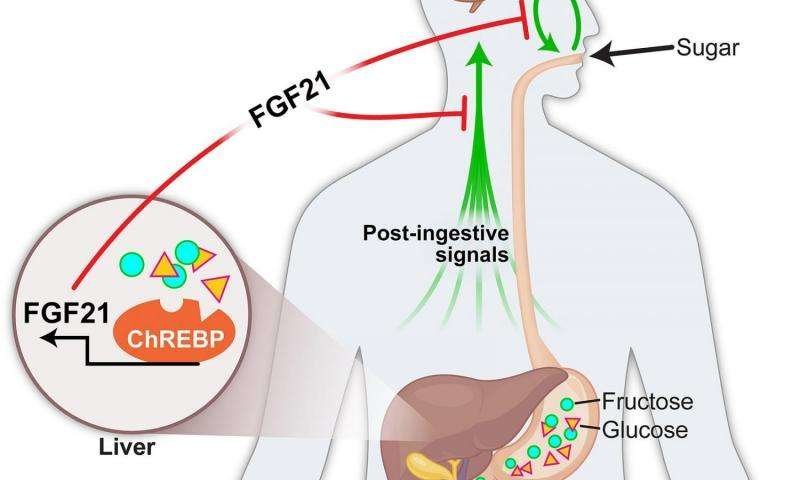
© University of IowaA University of Iowa-led study has identified a hormone that appears to be involved in sugar cravings and consumption. The research could improve diet and help patients who are diabetic or obese.
We all love our sugar, especially during the holidays. Cookies, cake, and candy are simply irresistible.

While sugar cravings are common, the physiological mechanisms that trigger our "sweet tooth" are not well defined.

A University of Iowa-led study in mice shows that a hormone produced by the liver, fibroblast growth factor 21 (FGF21), suppresses the consumption of simple sugars. The researchers report that FGF21 is produced in the liver in response to high carbohydrate levels. FGF21 then enters the bloodstream, where it sends a signal to the brain to suppress the preference for sweets.

"This is the first liver-derived hormone we know that regulates sugar intake specifically," says Matthew Potthoff, assistant professor of pharmacology in the UI Carver College of Medicine. Potthoff is co-senior author on the paper, published online in the journal Cell Metabolism, with Matthew Gillum, professor at the University of Copenhagen (Denmark).

Airplane

Study: Infectious disease spread is fueled by international travel, trade

Airplane flying
© ASU
International trade and travel has literally opened up new vistas for humans, ranging from travel to exotic places to enjoying the products and services of those distant lands. But along with international trade and travel comes the risk of spreading infectious diseases, a growing problem in today's global economy, says an Arizona State University researcher.

"The recent Ebola outbreak made us realize that we are all just a plane ride away from exposure to emerging infectious diseases," says Charles Perrings, an ASU professor of environmental economics. Perrings recently published the paper, "Options for Managing the Infectious Animal and Plant Disease Risks of International Trade," in the early online version of the journal Food Security.

The paper reported project results to an international conference "Global Plant Health Risks and Consequences: Linking Science, Economics and Policy," hosted by the British Food and Environment Research Agency, and supported by the Organisation for Economic Cooperation and Development's Cooperative Research Programme on Biological Resource Management for Sustainable Agricultural Systems. Perrings is the principle investigator of a project funded by the National Science Foundation-National Institutes of Health-U.S. Department of Agriculture Ecology and Evolution of Infectious Diseases program in collaboration with the UK's Biotechnology and Biological Sciences Research Council.

In the paper, Perrings describes the growth of international trade since the 1950s and the increasingly tight coupling of developed and developing economies. The paper considers how the global community currently deals with trade-related infectious disease risks of animals and plants, and asks how the system could be made more effective.

An example of the impact of an infectious disease came in 2001 in the UK when an outbreak of hoof and mouth disease cost some $10 billion and more than 2 million sheep and cattle had to be destroyed, Perrings said. More recently, African swine fever--a much more serious disease of pigs--has been spread in the Caucasus region through trade in pork, pork product or through waste in trade vehicles.

Heart

How Muscle Testing Works: Bioenergetic Fields

Chakra aura
© Shutterstock
At the request of many patients, friends and colleagues I am posting a short, detailed write-up of how muscle works. The explanation is spread out over two separate posts as it is based on two different principles. This is Part 1: The Physics of Bioelectric Fields.

As one of the world's leading proponents of muscle testing, I am often asked how it works. This used to take a long time to explain and when pressed for time, I would defer the question by stating: "Unless you're a Biophysicist, its probably not going to make sense to you". Then one day I said that to someone who turned out to be a Biophysicist but it didn't make sense to her either. That was an eye-opener for me.

Over the course of our conversation, I realized why muscle testing didn't make sense to her and also, why it hasn't made sense to anyone else since it was invented 50 years ago. By the end of our talk I had explained it to her satisfaction in the language of modern scientific theory and she understood it for the first time. More importantly, I had worked out once and for all how to explain muscle testing simply.

What follows is a condensed version of what we talked about.

Comment: This is definitely an interesting field and well worth further study for those suffering health complaints. For more info, see:


Attention

Bosnia: Sarajevo schools close down because of air pollution

Bosnian schoolchildren with face masks
© AP Photo/Amel EmricA group of school children walk on street with face mask in Sarajevo, Bosnia, on Wednesday, Dec. 23, 2015
Sarajevo authorities say they are closing down schools because of high pollution mixed with fog, and volunteers have begun distributing face masks to those who still decided to get out of the house despite warnings to reduce movement.

Schools are closing down after more than a month of dense fog, broken only by three or four clear days. Authorities said Wednesday it has been the longest siege of foul weather in decades.

Air pollution in Bosnia
© AP Photo/Amel EmricBosnian man walks on the street during fog in Sarajevo, Bosnia, on Tuesday, Dec. 22, 2015. Local authorities in Sarajevo advised the population to reduce movement in the mornings and evenings due to health risks caused by air pollution
Flights have been canceled for the past few days because of fog, a common occurrence at Sarajevo's airport in winter.

Meanwhile, people on social networks have been sharing photos of flocks of birds walking down streets, unable to fly because of reduced visibility.

Source: Associated Press

Comment: Research published earlier this year indicates that air pollution kills 3.2 million people around the world every year. See also:


Evil Rays

Dr. Nicholas Gonzalez warned about the health risks from EMF pollution

EMF pollution
© Zen Gardner
Weeks before his untimely death in July 2015, Dr. Nicholas Gonzalez, M.D., met with Camilla Rees, founder of ElectroMagneticHealth, to discuss his concerns about the proliferation of wireless technologies found in our everyday life and their link to serious health concerns, including cancer.

We, at NaturalHealth365, appreciate the opportunity to share some of Dr. Gonzalez's knowledge of this critical, often controversial, issue.

Comment: Read the following series of articles by Larry Bowers; providing some background, detailed descriptions of man-made sources of EMF, past study results, and what you can do to measure your EMF exposure, in addition to what steps you can take to minimize it.


Fire

Chronic inflammation can fan the flames of depression

stress in the body
© psychcentral.com
Chronic inflammation in the bloodstream can "fan the flames" of depression, much like throwing gasoline on a fire, according to a new paper from researchers at Rice University and Ohio State University.

"Inflammation: Depression Fans the Flames and Feasts on the Heat" appeared in a recent edition of the American Journal of Psychiatry. The study reviewed 200 existing papers on depression and inflammation.

"In the health area of psychology at Rice, we're very focused on the intersection of health behavior, psychology and medicine," said Christopher Fagundes, an assistant professor of psychology and co-author of the paper. "One thing that we're particularly interested in is how stress affects the immune system, which in turn affects diseases and mental health outcomes, the focus of this paper."

Comment: Psychoneuroimmunology: How inflammation affects your mental health