
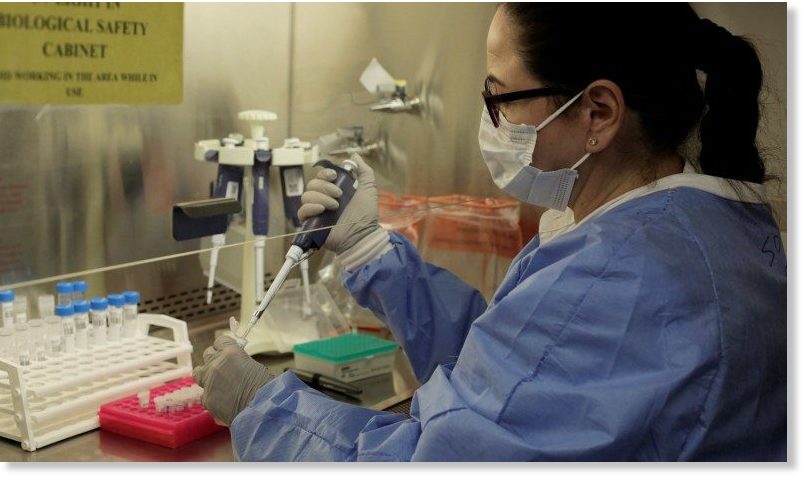
© David Ryder/ReutersMicrobiologist Milagros Sola processes coronavirus tests in a lab at Madigan Army Medical Center at Joint Base Lewis-McChord, Wash., April 14, 2020.
We should have good answers on this soon thanks to "serology" tests, which detect whether someone has antibodies for COVID (meaning they had the virus at some point in the past even if they are not currently infected). But here I'd like to offer a quick overview of what we already know. My own guess is that while we are substantially undercounting cases, it is unlikely that more than, say, 10 percent of the population already has it. Since about two-thirds of the population needs to get it to achieve "herd immunity," that would give us a long way to go if we just lift the lockdowns and hope for the best.
Comment: That's assuming lockdowns even work, and that the costs they incur (monetary AND human) don't overtake the costs of just "hoping for the best". It may be that in the long term, this is just another virus humanity has to pass through. As it is, the mortality rate either similar to, or perhaps 2x, that of the ordinary flu. It's no black death, and certainly won't end up decimating the population. The containment measures however, have a higher chance of doing just that.
To begin, some very simple numbers. At this writing, the U.S. has about 600,000 confirmed cases and a population of about 330 million people. If we are undercounting cases by a factor of ten, that still puts us around 2 percent. To get to 10 percent infected we'd need to be undercounting by a factor of about 50.














Comment: See also: