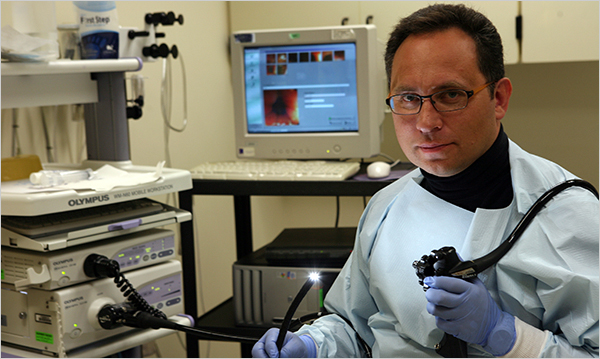
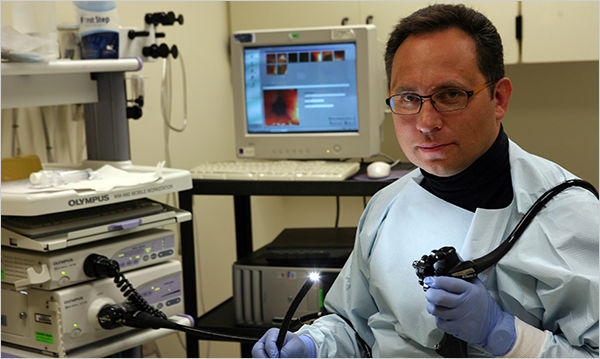
© New York TimesDr. Alexander Khoruts, a gastroenterologist at the University Minnesota, used bacteriotherapy to help cure a patient suffering from a gut infection.
In 2008, Dr. Khoruts, a gastroenterologist at the University of Minnesota, took on a patient suffering from a vicious gut infection of Clostridium difficile. She was crippled by constant diarrhea, which had left her in a wheelchair wearing diapers. Dr. Khoruts treated her with an assortment of antibiotics, but nothing could stop the bacteria. His patient was wasting away, losing 60 pounds over the course of eight months. "She was just dwindling down the drain, and she probably would have died," Dr. Khoruts said.
Dr. Khoruts decided his patient needed a transplant. But he didn't give her a piece of someone else's intestines, or a stomach, or any other organ. Instead, he gave her some of her husband's bacteria.
Dr. Khoruts mixed a small sample of her husband's stool with saline solution and delivered it into her colon. Writing in the
Journal of Clinical Gastroenterology last month, Dr. Khoruts and his colleagues reported that her diarrhea vanished in a day. Her Clostridium difficile infection disappeared as well and has not returned since.
The procedure - known as bacteriotherapy or fecal transplantation - had been carried out a few times over the past few decades. But Dr. Khoruts and his colleagues were able to do something previous doctors could not: they took a genetic survey of the bacteria in her intestines before and after the transplant.








Comment: For a more in depth look at the 'Hidden Fungus' that makes you ill read the following articles:
For a Celiac Sufferer, a New Mystery Illness
The Dark Side of Wheat - New Perspectives on Celiac Disease and Wheat Intolerance
Gluten: What You Don't Know Might Kill You
In addition read the following forum threads:
Candida - The Silent Epidemic
Anti-Candida, Inflammation, Heavy Metals Detox and Diet