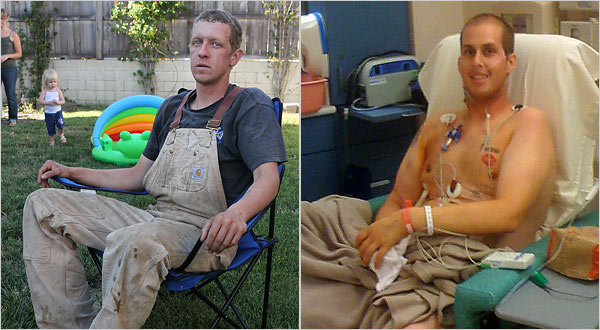
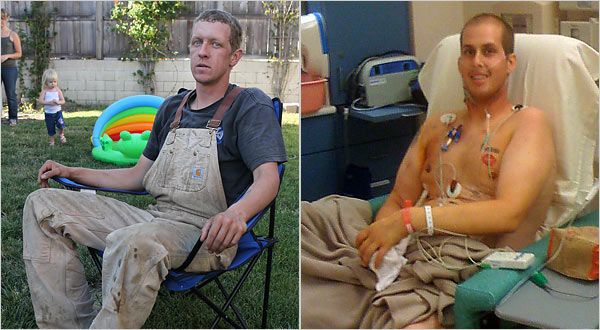
© New York TimesTwo Cousins, Two Paths Thomas McLaughlin, left, was given a promising experimental drug to treat his lethal skin cancer in a medical trial; Brandon Ryan had to go without it.
Growing up in California's rural Central Valley, the two cousins spent summers racing dirt bikes and Christmases at their grandmother's on the coast. Endowed with a similar brash charm, they bought each other matching hardhats and sought iron-working jobs together. They shared a love for the rush that comes with hanging steel at dizzying heights, and a knack for collecting speeding tickets.
And when, last year, each learned that a lethal skin cancer called melanoma was spreading rapidly through his body, the young men found themselves with the shared chance of benefiting from a recent medical breakthrough.
Only months before, a new drug had shown that it could safely slow the cancer's progress in certain patients. Both cousins had the type of tumor almost sure to respond to it. And major cancer centers, including the University of California, Los Angeles, were enrolling patients for the last, crucial test that regulators required to consider approving it for sale.
"Dude, you have to get on these superpills," Thomas McLaughlin, then 24, whose melanoma was diagnosed first, urged his cousin, Brandon Ryan. Mr. McLaughlin's tumors had stopped growing after two months of taking the pills.
But when Mr. Ryan, 22, was admitted to the trial in May, he was assigned by a computer lottery to what is known as the control arm. Instead of the pills, he was to get infusions of the chemotherapy drug that has been the notoriously ineffective recourse in treating melanoma for 30 years.
Even if it became clear that the chemotherapy could not hold back the tumors advancing into his lungs, liver and, most painfully, his spine, he would not be allowed to switch, lest it muddy the trial's results.









Comment: For more information on counteracting dementia, see these Sott links:
Read, Eat Well and Keep Spirits High to Avoid Dementia
Stress in Middle Age Could Contribute to Late-Life Dementia
Educated people cope better with dementia